

Quick Answer: What Are Ronghua?
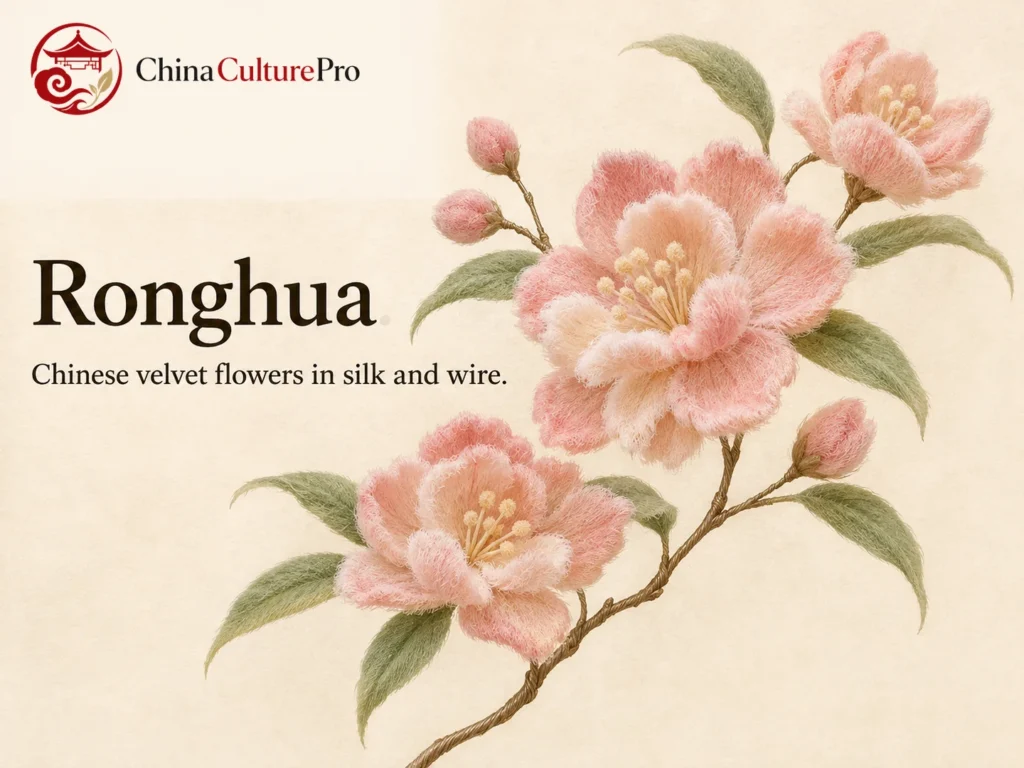
Ronghua(绒花,rónghuā), often called Chinese velvet flowers, are ornaments formed from fine silk fibers supported by thin metal wire. The soft surface comes from the prepared fibers, while the wire allows the maker to shape and assemble the design.[1]
- The material: Silk and a fine wire core work together.
- The form: Petals and leaves can become flowers, ornaments or more elaborate compositions.
- The setting: Nanjing is an important center, with other regional flower-making traditions also documented.
“Velvet” describes a characteristic appearance and texture here. It does not mean that every piece is cut from a sheet of woven velvet fabric.

A small silk blossom can look almost weightless, with a softly luminous surface and carefully curved petals. Look closer and its structure becomes clearer: fine fibers surround a slender support, and separate parts meet to form a three-dimensional ornament. Ronghua belongs within Chinese traditional crafts, where material preparation and hand shaping both matter.
Silk Fibers, Wire and the Velvet Effect
Silk supplies the visible surface; fine wire supports it. A craft-materials catalogue names brass wire for Nanjing flowers, while workshop accounts describe copper wire.[2] Both support shaped fiber-covered components.
The exposed fibers create the velvety effect. Their direction and density affect how a leaf or blossom catches light. That is why a finished piece can appear plush while retaining crisp contours.
This use of silk differs from weaving a cloth or stitching an embroidered picture. The guides to Chinese silk weaving and Chinese embroidery introduce those related but distinct ways of working with the same broad material.
From Soft Strips to Petals and Leaves
Prepared, colored silk is secured into slender strips before those strips are shaped. In a university team’s account of observing Nanjing makers, the demonstration included working silk onto fine wire, tightening it into strips and trimming the resulting material into petal or leaf forms.[3]
Trimming and assembly do different jobs. Trimming changes the outline and taper of an individual component. Bending gives it a curve; joining brings the components into a larger flower or composition. The final silhouette depends on the maker’s choices at each of these stages.
A published interview with artisan Zhao Shuxian describes softened and dyed silk being worked onto a wire frame, then trimmed and shaped.[4] The sequence varies with the workshop and the design.
Flowers, Auspicious Names and Other Shapes
The word for prosperity(荣华,rónghuá), also written ronghua in unmarked romanization, sounds close to the craft name. A Nanjing University workshop report records a teacher explaining that wordplay and its association with good wishes.[1] Notice the different final tone: the craft name and the auspicious expression are close in sound, rather than identical written words.
Such symbolism gives an ornament a social meaning beyond its material. A flower can be chosen as a festive decoration or a gift expressing a wish. That meaning remains a cultural association, not a promise that wearing it changes someone’s fortune.
The forms extend beyond naturalistic blossoms. Beijing’s account of its museum displays describes velvet birds, animals, auspicious characters and phoenix-crown compositions.[5] “Velvet flowers” is therefore a convenient craft name, not a complete inventory of possible subjects.
Nanjing and Other Flower-Making Traditions
Nanjing is closely associated with ronghua, but it is not the only city with a velvet-flower tradition. Jiangsu’s first provincial heritage list names both Nanjing and Yangzhou under velvet-flower-making techniques.[6] Beijing also documents velvet flowers within its broader artificial-flower culture.[5]
The craft catalogue distinguishes fiber-strip velvet flowers from silk flowers shaped using woven fabrics.[2] Compare the construction as well as the regional name.
A regional label identifies a tradition or training context. To date an individual ornament, look for its own documentation; contemporary historical-style clothing and an antique object are separate questions.
Heritage Records and Living Transmission
The official Jiangsu list includes velvet-flower-making techniques as a provincial project. Nanjing’s official inventory records the project at provincial level, gives March 2007 as its publication date and names the Nanjing Folk Museum as the safeguarding organization.[6][7] These are records of a craft tradition, rather than certification of every object sold under its name.
Transmission continues through instruction as well as finished pieces. Nanjing University reports a workshop taught by a student of Zhao Shuxian, while a Nanjing community account describes a course progressing from materials to core shaping techniques.[1][8]
Those examples show how learners encounter the craft today. The wider explanation of Chinese intangible cultural heritage helps distinguish a listed practice, its safeguarding work and an individual maker’s output.
Looking at a Finished Ronghua Piece
Observe the fiber direction, tapered edges and joins between components. These details reveal the reshaping and assembly described in the craft catalogue.[2]
Then consider the format. Zhao Shuxian’s interview describes customers wearing flowers in their hair and on hats, bags or clothing, for both ordinary use and special occasions.[4] A small brooch and a large head ornament can draw on the same craft while solving different design problems.
Ask how the maker describes the fibers, support and intended use. A photograph can show color and silhouette; a clear maker’s account adds information about construction. Contemporary styling can be appreciated on its own terms, alongside the craft’s regional and historical contexts.
FAQs About Ronghua
Are ronghua made from velvet fabric?
Traditional examples discussed here use prepared silk fibers and fine wire. Woven-fabric flowers are a related but different construction.
Are ronghua only hair ornaments?
No. They can also be worn on clothing or accessories, or assembled into larger decorative pieces.
Are ronghua made only in Nanjing?
No. Nanjing is important, while official and museum sources also document Yangzhou and Beijing traditions.
Does heritage recognition certify every flower?
No. The cited provincial listing concerns a craft practice. It does not automatically authenticate an individual object or seller.
Sources
[1] Nanjing University. Ronghua Workshop: Silk, Wire and Auspicious Wordplay
[2] Rong Design Library. Chinese Traditional Crafts: Velvet Flowers and Silk-Flower Construction
[3] Nanjing University of Finance and Economics. Fieldwork and Demonstrations at the Nanjing Folk Museum
[4] Lin Qi, China Daily, republished by Chinaculture. Eternal Blossoms Made with Silk and Wire
[5] Beijing Magazine. Works of Art with Flower Decorations
[6] Jiangsu Provincial Government. First Provincial Intangible Cultural Heritage List: Velvet-Flower-Making Techniques
[7] Nanjing Culture and Tourism Bureau. Official Intangible Cultural Heritage Inventory
[8] Nanjing Municipal Social Work Department. Community Ronghua Classes and Craft Transmission