

Quick Answer: What Is Quiet Night Thought About?
Quiet Night Thought (靜夜思, Jìngyè Sī), by Li Bai (李白, Lǐ Bái), connects moonlight with longing for home. Pale light resembles frost; the speaker looks up toward the moon, then lowers his head in remembrance. It is a five-character quatrain (五言絕句, wǔyán juéjù): four lines and 20 characters.[1][2]
- The first impression: Moonlight on the ground creates a moment of uncertainty.
- The movement: Raising and lowering the head turns a visual experience into inward thought.
- The feeling: Home is named only at the end, giving the preceding scene its emotional focus.
The poem does not itself supply an exact date, festival, lodging place or reason for being away.
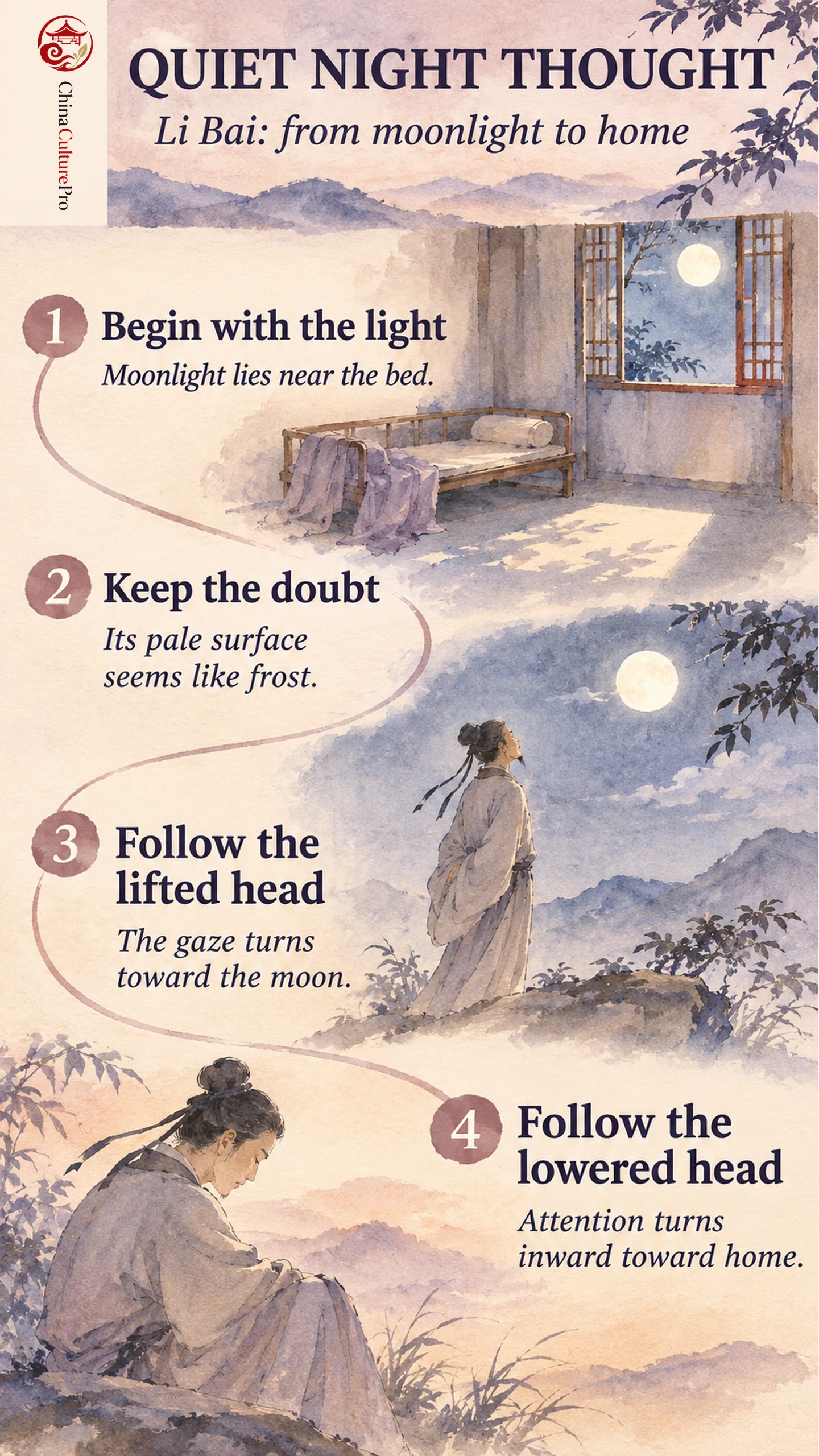
A patch of pale light begins the poem; a thought of home ends it. Between them, the speaker makes two small movements, lifting his head and lowering it. The language gives little explanation, yet that shift from looking outward to remembering carries the whole emotional scene.
The Complete Poem and an English Sense Translation
This original English rendering uses the familiar text associated with Three Hundred Tang Poems (唐詩三百首, Tángshī Sānbǎi Shǒu), including 明 in the first and third lines. Other received versions differ; two changes are compared below.[1]
| Chinese line | English sense translation |
|---|---|
| 床前明月光, | A bright wash of moonlight lies before my bed; |
| 疑是地上霜。 | I wonder whether it is frost spread on the ground. |
| 舉頭望明月, | I lift my head to gaze at the shining moon; |
| 低頭思故鄉。 | I lower my head and think of my home. |
“Bed” follows the common interpretation of the first word. It is a translation choice, not a reconstruction of the room’s furniture or architecture.
Moonlight That Resembles Frost
The first line names light; the second registers an impression of something solid. Frost gives pale moonlight an imagined surface and a suggestion of cold. The word of uncertainty prevents the comparison from becoming a simple report of actual frost.[1]
It is possible to imagine a sleepy or momentarily confused observer, but the poem does not describe waking from a dream. Nor does it state that snow has fallen. Those additions can make an illustration or retelling vivid while changing how much the text actually tells us.
The interest lies in the hesitation itself. Something seen at close range becomes strange enough to prompt a second look, setting up the upward movement in the next line.
A Raised Head, a Lowered Head and Thoughts of Home
The last two lines balance opposite bodily actions. The head rises toward the moon, then lowers as attention turns toward homeland (故鄉, gùxiāng). The repeated word “head” makes the change easy to picture without narrating a long chain of thoughts.[1]
The moon is visible here, while home is absent from the immediate scene. That relationship gives the familiar theme of Chinese moon poetry a particularly compact form: an object in view draws the mind toward somewhere far away.
The last line does not list family members, describe a childhood house or promise a return. Its openness allows the thought of home to remain larger than a single remembered detail.
Why Different Editions Have Different Words
Readers may encounter the same title with different first and third lines. The received text printed with Li’s collected works has 看, “look at,” and 山, “mountain”; the familiar anthology text uses 明, “bright,” in both positions.[1][3]
| Position | Familiar anthology reading | Reading in the collected-work text |
|---|---|---|
| First line | 床前明月光: bright moonlight before the bed | 牀前看月光: looking at moonlight before the bed |
| Third line | 舉頭望明月: raising the head toward the bright moon | 舉頭望山月: raising the head toward the mountain moon |
Both versions preserve the frost comparison, the paired head movements and the final thought of home. These are textual variants of the same poem, rather than two unrelated works. A reading guide should identify which wording it translates; encountering another version does not by itself mean that someone has misremembered the poem.
Here the familiar 20-character anthology text remains intact. The comparison does not claim to establish the author’s original manuscript or a complete history of every edition.
How to Read the Poem’s Four Movements
- Locate the light: Begin with the pale brightness before interpreting what it means.
- Keep the uncertainty: Read the frost as a questioned impression, rather than confirmed weather.
- Follow the lifted head: Let the gaze move from the nearby ground toward the moon.
- Follow the lowered head: Notice how the final thought of home changes the meaning of the earlier light.
FAQs About Quiet Night Thought
Does the first word definitely describe a modern bed?
Chuang (床, chuáng) is commonly understood as a sleeping bed here. Commentators have also proposed seating or structures associated with a well. These competing interpretations do not justify presenting one precise modern bedroom—or one well—as a proven reconstruction.[3]
Does the poem name a season or festival?
It names neither. The frost-like impression can suggest cold, but the text alone does not establish a particular season or a moon-viewing festival.
Does it identify an exact date and lodging place?
No. Dates and places assigned by later accounts belong to biographical interpretation; none is stated in these four lines.
Sources
[1] Li Bai. Quiet Night Thought, received anthology and collected-work texts
[2] Ministry of Education, Taiwan. Revised Mandarin Chinese Dictionary: Quiet Night Thought
[3] Shan Zhouyao and Xie Xiangrong, Education Bureau seminar materials. Appreciation of Recommended Passages VI, Quiet Night Thought section