
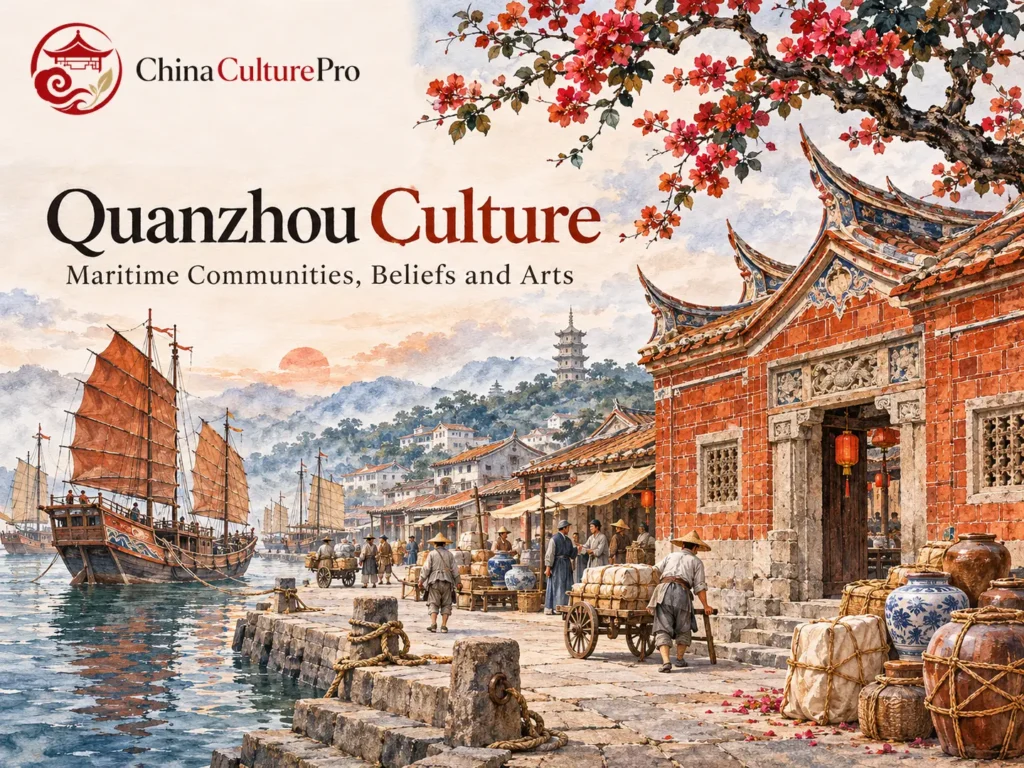

Quick Answer: What Is Quanzhou Known For Culturally?
Quanzhou (泉州, Quánzhōu) in southern Fujian was a major port during the Song and Yuan periods. Its history survives in a network of sites, from kilns and bridges to docks and places of worship. The city is also part of a living Minnan (闽南, Mǐnnán) tradition of music and performance.[1][2][3]
- Trade: The UNESCO World Heritage property contains 22 components, including places that made, transported and sold goods.[1][2]
- Religious life: Qingjing Mosque (清净寺, Qīngjìng Sì) and Tianhou Temple (天后宫, Tiānhòu Gōng) preserve different sides of a city where commerce brought people and beliefs together.[1][4]
- Performance: Nanyin (南音, nányīn) combines instrumental music and singing, with a repertoire shared in southern Fujian and overseas communities.[3]
The old port makes more sense when you follow goods beyond the waterfront and listen to the traditions that remained after the trading routes changed.
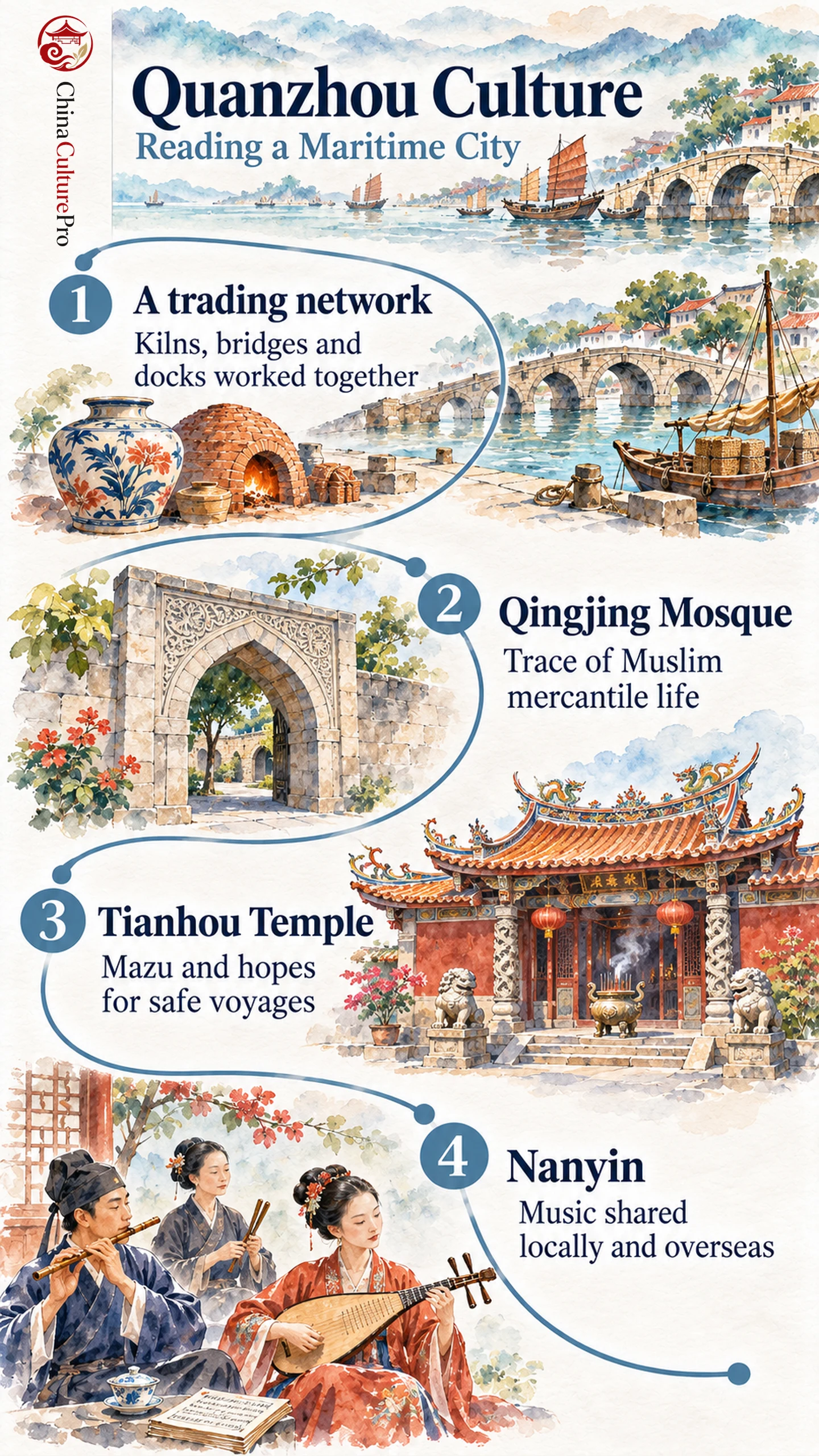
The places that explain Quanzhou are spread out. A kiln shows where goods came from, a stone dock shows how they traveled, and a place of worship helps identify who lived and traded there.
Four Ways to Read Quanzhou Culture
| Starting point | What to notice | What it explains |
|---|---|---|
| Dehua kilns and Shihu Dock | Production inland and a landing site by the water | How multiple settlements supported trade.[1][2] |
| Qingjing Mosque | The stone entrance and other surviving fabric | Muslim community life in the Song–Yuan port.[1] |
| Tianhou Temple | A temple honoring Mazu (妈祖, Māzǔ) | Maritime beliefs and traditions of praying for safe voyages.[2][4][5] |
| Nanyin | A horizontally held lute, flute and sung pieces | Music shared by Minnan communities at home and overseas.[3] |
How the Port Worked Beyond the Waterfront
The World Heritage property documents Quanzhou’s place in Asian maritime trade from the tenth to the fourteenth centuries. The property includes a maritime trade office site, several historic bridges, kiln sites at Dehua and a dock at Shihu. Taken together, those places show what the port needed in order to work. Making ceramics, getting the goods to a landing and overseeing trade required different people and infrastructure.[1][2]
Records also use the name Zayton for Quanzhou. The city’s role in maritime Silk Road history belongs to a longer record of trading cities on the Chinese coast. The Qing-era trade history of Guangzhou provides a view of a different port and period.[1][6]
What the Places of Worship Tell Us
Qingjing Mosque dates back to the eleventh century. Along with Islamic tombs, it records the presence of Muslim communities in the city. Kaiyuan Temple is a Buddhist site in the same multi-part World Heritage property. These sites can be read together while retaining the histories of the distinct communities and uses associated with each one.[1][2]
Tianhou Temple honors Mazu, a deity central to many coastal beliefs and customs. In Quanzhou, merchants and other seafarers prayed for safe sailing. The municipal account dates the temple’s founding to 1196 and distinguishes that date from the much later form of its existing main hall.[4][5]
Nanyin and Puppetry in Living Communities
Nanyin is a musical tradition of Minnan, or southern Fujian. Some pieces are instrumental. Others use voice, including ballads sung in the local Quanzhou variety. The ensemble can include a bamboo flute and a pipa (琵琶, pípá) held horizontally. Those details give a listener or viewer something to recognize beyond the name.[3]
Music has traveled with people in Minnan culture, and performing arts also depend on local training. Quanzhou marionettes are part of Fujian’s wider range of puppetry. UNESCO selected a provincial program for training future practitioners for its Register of Good Safeguarding Practices. That recognition concerns a training program, while the World Heritage property protects places.[3][7]
FAQs About Quanzhou Culture
What Does Quanzhou’s World Heritage Listing Include?
The listing covers 22 components linked to Song–Yuan Quanzhou. They include transport, production, administration and religious sites, rather than a single historic building.[1][2]
Why Is Mazu Associated With Quanzhou?
Tianhou Temple in Quanzhou honors Mazu. Sailors and merchants took part in traditions of praying for safe voyages, as at other coastal places associated with her worship.[4][5]
Is Nanyin Only Performed in Quanzhou?
Quanzhou is closely associated with nanyin and its sung repertoire. The music also belongs to other communities in southern Fujian and among Minnan people overseas.[3]
Sources
[1] UNESCO World Heritage Centre. Quanzhou: Emporium of the World in Song–Yuan China
[2] ICOMOS and UNESCO. Evaluation of the Quanzhou World Heritage Property
[3] UNESCO Intangible Cultural Heritage. Nanyin
[4] Quanzhou Municipal Government. Tianhou Temple
[5] UNESCO Intangible Cultural Heritage. Mazu Belief and Customs
[6] Fitzwilliam Museum. Chinese Export Art: The Thirteen Hongs Collection
[7] UNESCO Intangible Cultural Heritage. Training Future Fujian Puppetry Practitioners