


Quick Answer: What Is Pu, the Uncarved Block?
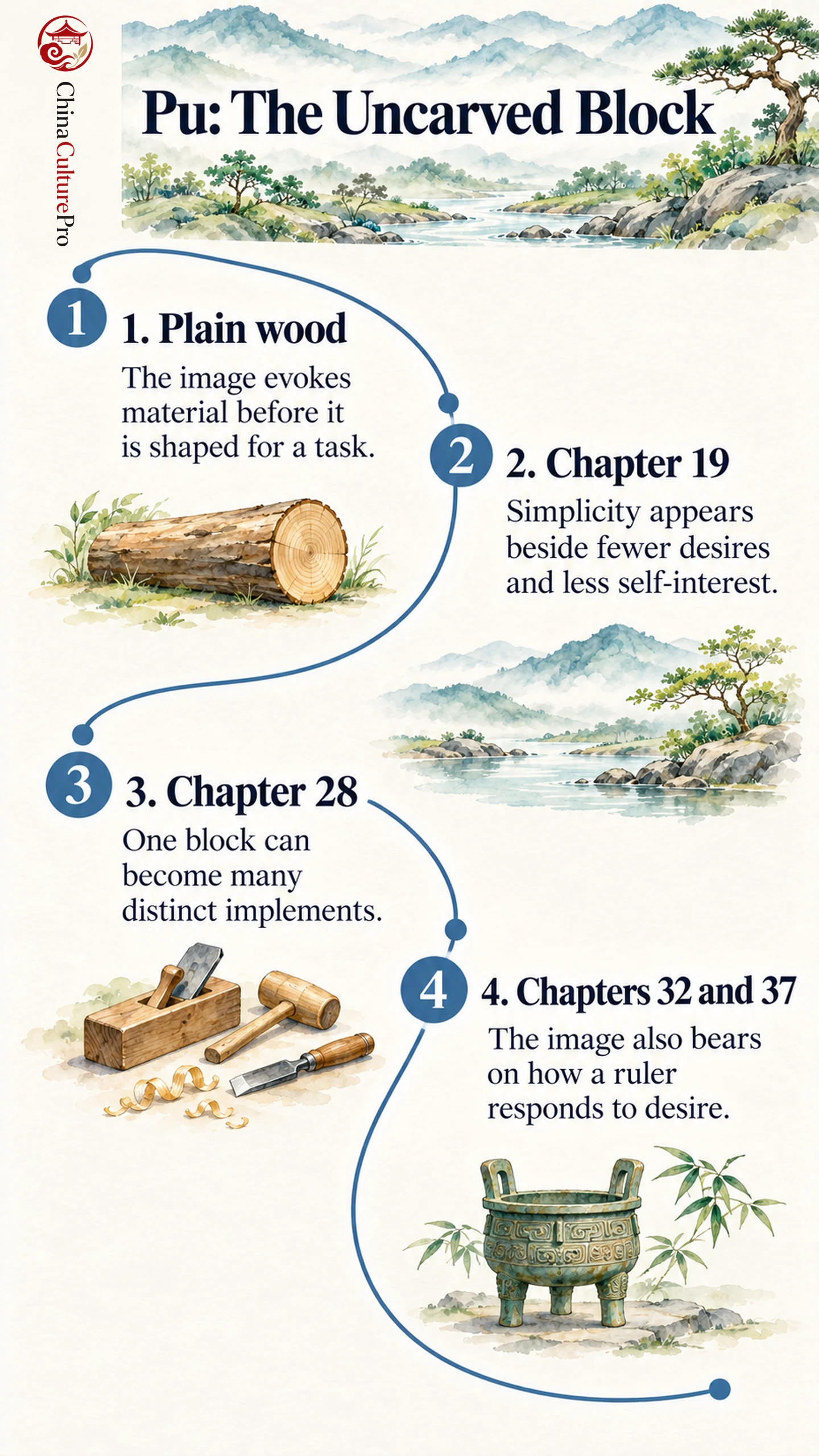
Pu (朴, pǔ), written 樸 in traditional Chinese, evokes plain wood before it has been shaped into an implement. The Daodejing (道德经, Dàodéjīng) uses the image to think about plainness, the growth of desires and the relation between an undivided whole and its distinct uses.[1][2][4]
- Personal conduct: The text associates plainness with less self-interest and fewer desires.
- Differentiation: The block can be divided into implements, each with a more definite use.
- Government: The nameless block gives the text a way to imagine restraint as things transform.[1][2][3]
The image changes its emphasis from chapter to chapter. Plainness, what can emerge from it and the way it may be preserved all receive attention.
A wooden bowl is useful partly because its form is settled. A block can still become many things. The image draws attention to what shaping makes possible and to what a fixed form leaves behind.
Chapter 19: Plainness and the Growth of Desire
In the received Chapter 19, holding to uncarved wood appears beside an image of plain, undyed material. The passage brings these images together with reduced self-interest and fewer desires. It places that advice amid criticisms of what people learn to pursue and value. Plainness has a moral and political bearing because expectations can encourage people to compete for outward signs of success.[1][2][4]
The pairing matters in translation. “Simplicity” can make the ethical point accessible, while “uncarved block” keeps the picture of material before it is given a definite shape. Retaining the picture helps prepare a reader for the chapter in which the block becomes implements.[1][2]
Chapter 28: From One Block to Many Implements
The received Chapter 28 speaks of returning to the uncarved block and then of the block dispersing into implements. The movement can be read in two directions. A single material gives rise to things with specific functions, and the image of returning invites attention to what their distinctions may conceal. A finished object has advantages that are visible precisely because it has acquired a form.[1][2][4]
The chapter moves from the implements to the sage and the leadership of officials, then ends with a paradox about the finest shaping or ordering avoiding cuts. Readers differ on the force of the final wording. The movement from the block to particular uses allows the reader to ask what an ordered whole can preserve when it contains different functions.[1][2]
Chapters 32 and 37: Plainness in Government
Chapter 32 associates the nameless Way with an uncarved block that appears small but cannot simply be made subordinate. The chapter asks what might follow if rulers could hold to that quality. Chapter 37 brings in the nameless block when desires threaten to arise amid transformation. A related passage appears among the excavated texts from Guodian, where the nameless uncarved quality likewise figures in the response to desire.[1][2][3]
The setting gives plainness a public meaning. These passages ask how rulers might respond without encouraging the very desires they seek to manage. The relation to wu wei comes into view when the text imagines things changing of themselves and gives the ruler a role that does not depend on directing every change.[1][2][3]
FAQs About the Uncarved Block
Is the uncarved block the same as the Dao?
In Chapters 32 and 37, the image is closely associated with the nameless Way. Other chapters apply it to conduct or to what happens when a whole is divided. It is an image that helps convey different aspects of Daoist thought.[1][2]
Does pu require giving up all skill?
Chapter 28 recognizes the production and use of implements. Its closing paradox asks readers to think about how the sage orders or shapes without cutting things apart. The chapter gives no simple rule for rejecting tools or expertise.[1][2]
How does pu relate to wu wei?
The block evokes plainness, especially before a thing has been assigned a narrow function. Wu wei concerns how a person or ruler acts. Chapter 37 connects them by imagining transformation in its own course and a restrained response when desires arise.[1][2][3]
Sources
[1] The Chinese Literature Translation Trust. Daode Jing: Chinese Text and English Translation
[2] Stanford Encyclopedia of Philosophy. Laozi
[3] Chinese Text Project. Guodian: Laozi A
[4] Stanford Encyclopedia of Philosophy. Daoism, including Pu Simplicity