
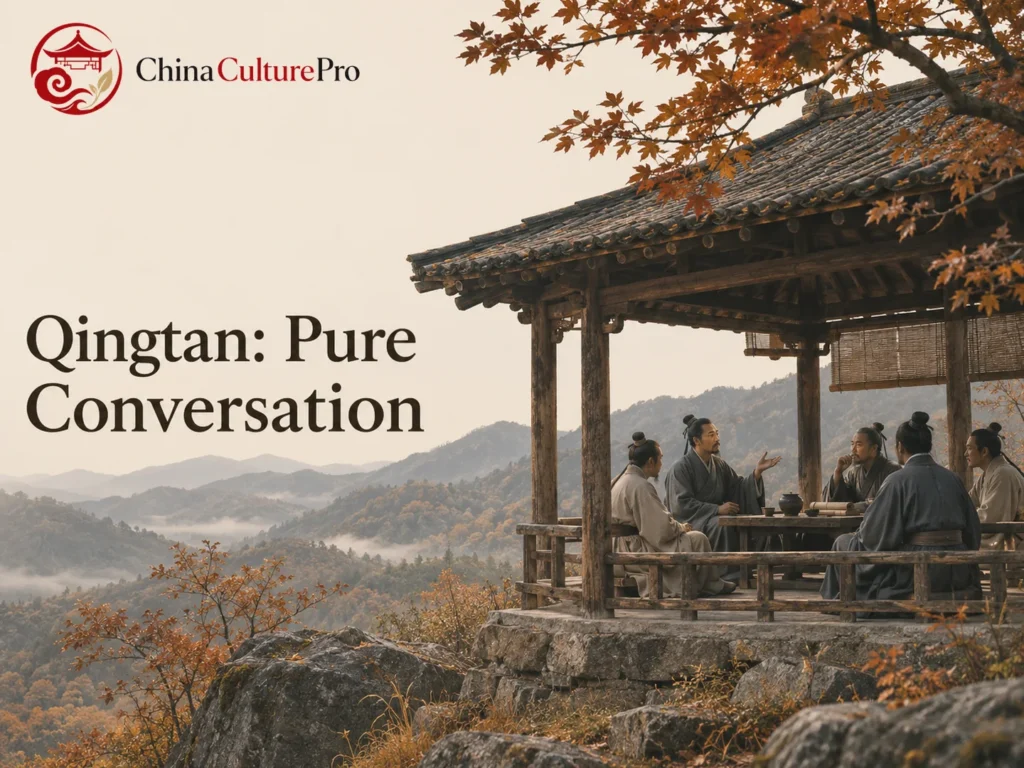

Quick Answer: What Was Qingtan?
Qingtan (清谈, qīngtán), usually translated as pure conversation or pure talk, is a historical term for forms of cultivated conversation associated with early medieval Chinese elites. Exchanges could display verbal skill, reputation and philosophical judgment. Later accounts also turned them into stories about how educated people used their talents.[1][2][3]
- Setting: A group could hear an exchange, recognize a skillful answer and circulate the story.
- Content: Topics included language, the cultivation of life and the nature of music.
- Evidence: Surviving anecdotes preserve how conversations were remembered and judged.[1][2][3]
Usage changed over time. The term can describe a social setting for ideas without implying that all participants followed one doctrine.

A short answer can have two effects in a story about pure conversation. It can make a philosophical distinction, and it can change what an audience thinks of the person who made it. Accounts of the practice often preserve both at once.
How Pure Conversation Worked as a Social Practice
Pure conversation is associated especially with the Wei and Jin periods. Descriptions include exchanges among educated people whose audience could follow literary allusions and appreciate a careful or unexpected reply. The audience mattered because an exchange could be repeated elsewhere. A reputation formed through talk could extend beyond the people who originally heard it.[1][2][3]
Some accounts trace aspects of the practice to political criticism and the assessment of character toward the end of the Han. The relationship helps explain why a conversation remembered as refined could still matter to a person’s public standing. Later gatherings had different occasions and interests. It is more precise to ask what a specific description shows about its setting than to treat every exchange as an example of a fixed salon ritual.[1][2][3]
What Intellectual Questions the Conversations Took Up
Some topics belonged to debates now associated with Xuanxue (玄学, xuánxué), often called Dark Learning or Learning of the Mysterious. One report gives an example. The Shishuo Xinyu (世说新语, Shìshuō Xīnyǔ), also known as A New Account of Tales of the World, says in 4.21 that the senior official Wang Dao (王导, Wáng Dǎo) spoke about nourishing life, words and meaning, and Ji Kang’s views on music after moving south.[2]
The three subjects show a range within cultivated talk. A discussion about words and meaning concerns what speech can communicate. An argument about music can ask what is in the sound and what the listener brings to it. Read together, the topics give a sense of how an exchange could move among practical, interpretive and philosophical concerns. The anecdote shows what the collection thought worth remembering about Wang Dao. Its selective list leaves other conversations outside the frame.[1][2]
How Later Stories Shaped Its Reputation
The fifth-century Shishuo Xinyu arranges anecdotes about people who lived earlier. Its concise scenes are evidence of how qualities such as wit, distinction or character were remembered. A polished reply has a literary role in the story, and the resulting scene offers limited evidence for reconstructing the exact words spoken on an earlier occasion.[2][3]
Later retellings could also make cultivated speech an emblem of political neglect. One account of the fall of Western Jin uses the reputation of Wang Yan, an accomplished speaker, to pose a question about what influential people owed the state. The story turns verbal brilliance into a question about responsibility. A reader can see how the later account judges conduct during the crisis, while the causes of the collapse require a different set of evidence.[2][4]
FAQs About Qingtan
Is pure conversation another name for Xuanxue?
The labels can overlap. Pure conversation describes forms of exchange, whereas Xuanxue identifies intellectual inquiries and texts. Historians note that the meanings and uses of both names changed.[1][2]
Where can readers find accounts of the exchanges?
The Shishuo Xinyu is an important collection of anecdotes. Its organization and brief scenes give a reader access to how speakers were remembered and how particular exchanges were made meaningful.[2][3]
Did pure conversation cause the fall of Western Jin?
Later writers sometimes made pure conversation a symbol of official neglect. Their criticism records a view of the period and is evidence for its reputation. A claim about why the dynasty fell would require evidence about the political crisis itself.[2][4]
Sources
[1] The Cambridge History of China. Qingtan and Xuanxue
[2] Stanford Encyclopedia of Philosophy. Neo-Daoism
[3] University of California Press. Contemplating the Ancients: Aesthetic and Social Issues in Early Chinese Portraiture
[4] Rafe de Crespigny, East Asian History. The Three Kingdoms and Western Jin: A History of China in the Third Century AD