
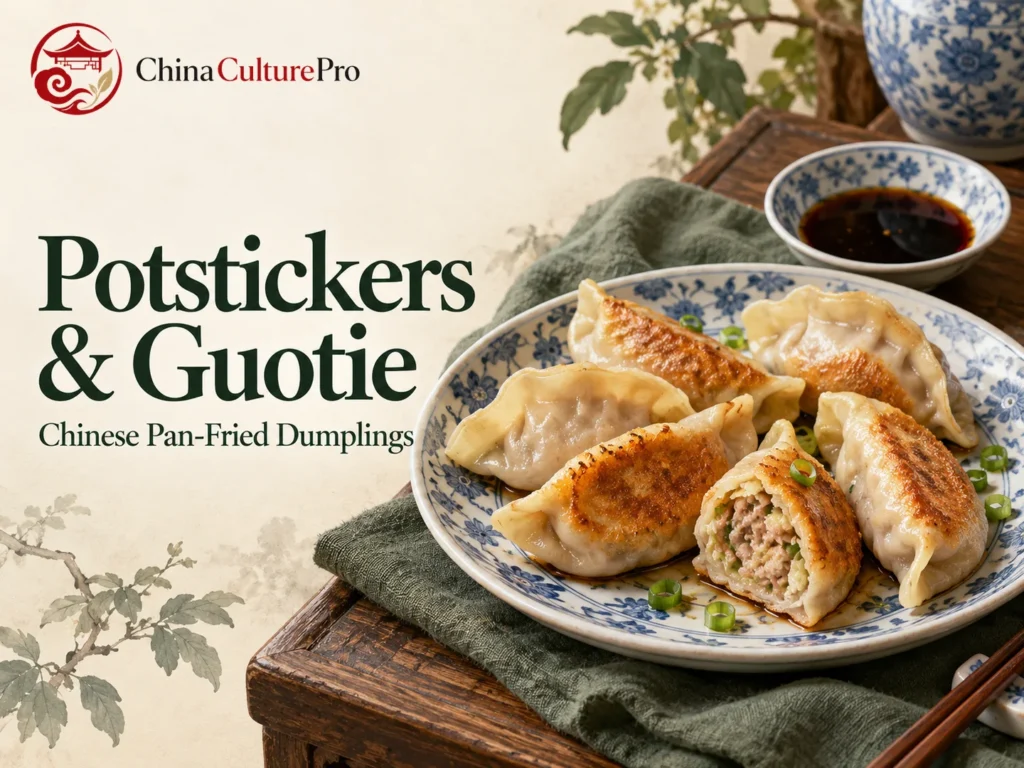

Quick Answer: What Are Potstickers?
Potstickers are Chinese filled dumplings commonly known as guotie (锅贴, guōtiē), literally “pot” or “pan” plus “stick.” A little oil and water in a flat pan combine frying with moist heat.[1]
- Wrapper: Usually a thin, flexible wheat-flour skin surrounding the filling.
- Filling: Savory ingredients, often meat with vegetables, although pork is not compulsory.
- Texture: A browned, crisp base contrasts with a softer upper wrapper and moist filling.
English menus use the name broadly. Open ends and a lacy crust are possible features rather than requirements; Chinese usage varies by place.
A crisp underside and a soft upper wrapper make potstickers easy to recognize. Their names are less straightforward: an English menu may use “potstickers” for different forms of jianjiao (煎饺, jiānjiǎo). Understanding the wrapper, filling and cooking method helps explain the differences.
Guotie, Jianjiao and Other Dumplings: What’s the Difference?
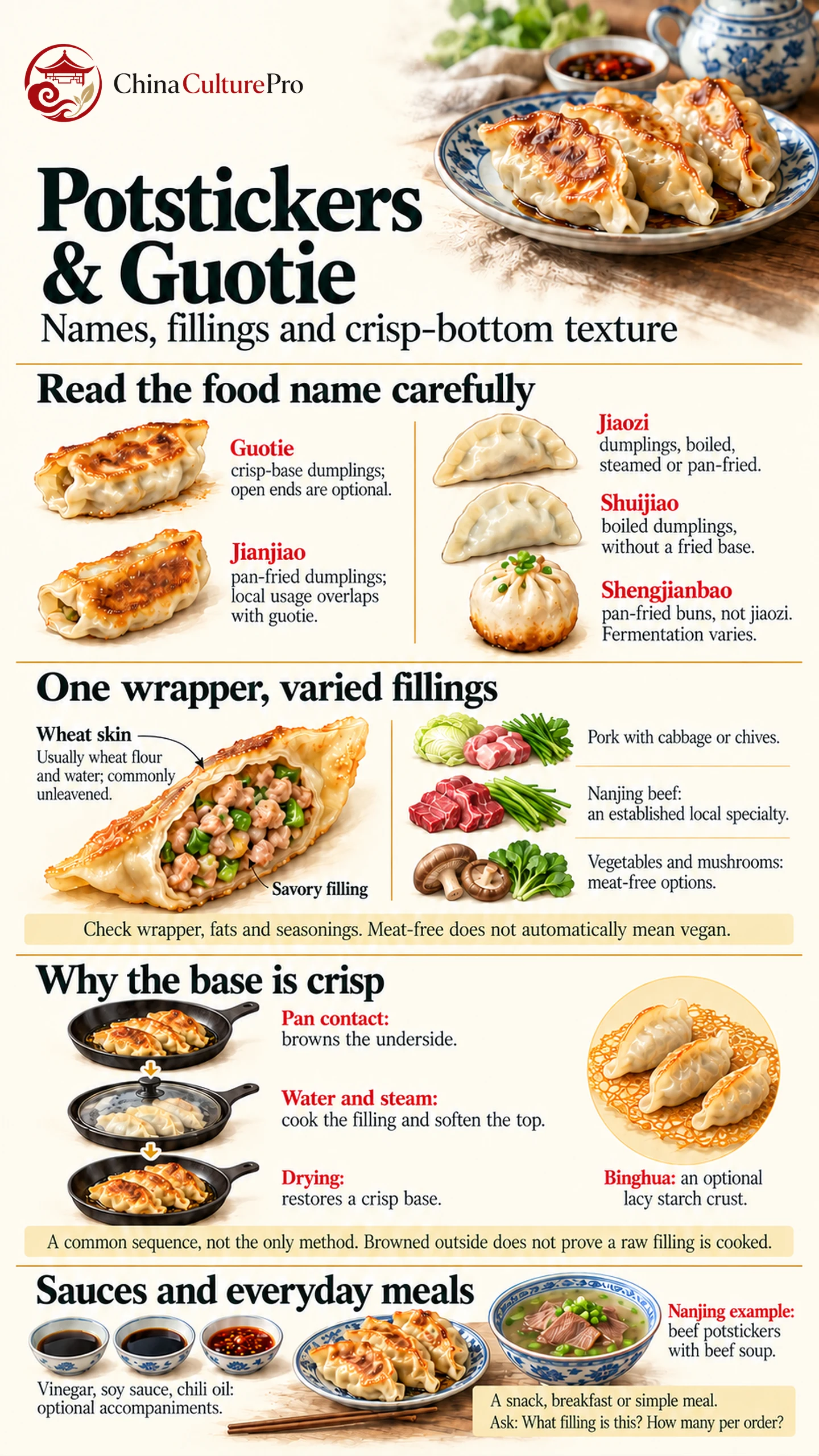
Jiaozi (饺子, jiǎozi) are a family of filled dumplings that can be boiled, steamed or pan-fried. The English word “dumpling” is broader still: it can appear in translations for foods that Chinese speakers distinguish as dumplings and buns. Sharing an English label does not make their Chinese categories identical.[2]
For menu reading, separate the food’s identity from its preparation. These four names offer a useful comparison:
| Name | Main identifying features | What the name does not establish |
|---|---|---|
| Guotie | Filled dumplings with a pan-browned base, commonly cooked using a little oil and water. | They need not have open ends, a pork filling or a connecting lace crust. |
| Jianjiao | Pan-fried dumplings; the word emphasizes the frying method. Local versions may start with raw or already cooked dumplings. | It does not universally mean reheated leftovers. In some places, the name overlaps with guotie. |
| Shuijiao (水饺, shuǐjiǎo) | Dumplings cooked by boiling, normally with a soft wrapper all around. | They do not acquire a fried base through boiling alone, though cooked dumplings can subsequently be pan-fried. |
| Shengjianbao (生煎包, shēngjiānbāo) | Pan-fried buns, usually plump and round, with a crisp base and a moist filling. | They are buns rather than a branch of jiaozi. Fermentation and the amount of broth vary between styles. |
Some cooks distinguish elongated, partly open guotie from sealed, crescent-shaped jianjiao. That distinction is useful when describing a particular style, but it is not a nationwide naming rule. Everyday usage can cross those boundaries.[3]
Likewise, dough fermentation alone cannot identify a food. Shanghai shengjianbao include fermented, semi-fermented and unfermented styles. A pleated round bun and an elongated dumpling may therefore share both a crisp bottom and an unleavened wrapper while remaining different foods.[4]
Wrappers, Fillings and Regional Variations
A familiar potsticker wrapper uses wheat flour and water to form a thin, resilient skin. It is commonly unleavened, with enough flexibility to hold filling and withstand moist cooking. Thickness and dough preparation vary, so a thick seam or thin skin alone does not identify a particular regional style. Compared with the browned base, the upper skin should remain supple rather than becoming an all-over fried shell.
The filling is a separate choice. “Potsticker” tells you more about the food’s familiar cooking style than about which meat or vegetable is inside. Three useful examples show the range:
- Pork with cabbage or chives: Pork-and-vegetable combinations are familiar Chinese dumpling fillings. Cabbage and chives give different textures and flavors; chives contribute a pronounced allium note. Ginger and soy sauce may appear in the seasoning, but they do not form a compulsory national formula. A cabbage label also does not necessarily mean a meat-free filling.[2]
- Nanjing beef guotie: Beef-filled potstickers are an established local specialty and an example of guotie beyond northern China. The local style has a crisp base, flexible skin and savory meat juices. It occurs in Nanjing’s breakfast and quick-meal traditions. This local association does not mean beef versions cannot be found elsewhere, or that every beef dumpling is halal.[5]
- Vegetable and mushroom versions: Cabbage, carrots, shiitake mushrooms and bamboo shoots can form a meat-free filling. Other recipes use tofu or different vegetables. These are ingredient options rather than one fixed regional recipe. A vegetable version can still have a crisp base; removing meat does not remove the defining contrast between the base and upper wrapper.[6]
For dietary needs, inspect the actual filling, wrapper, fats and seasonings. A plain-looking wheat skin may contain egg, while a vegetable filling may include an animal-based seasoning. “Vegetarian” and “vegan” therefore need separate confirmation; neither can be established by the dumpling’s shape.[7]
How Potstickers Get Their Crisp Bottoms
The contrast comes from different parts of the dumpling meeting different cooking conditions. The base touches the hot, lightly oiled pan; water and steam help cook the rest. A common sequence has three stages:
- Initial pan contact: The filled dumplings sit on their flat bases in a lightly oiled pan. Direct contact begins browning that surface while the upper wrapper remains away from the pan.
- Moist cooking: Water is introduced and the pan is covered. Steam and the hot cooking environment help cook the wrapper and filling, keeping the upper skin soft. During this stage, a previously crisp base can temporarily soften.
- Drying and crisping: Once the water has evaporated, continued pan contact lets the underside dry and become crisp again. This final contrast is what distinguishes the familiar pan-fried result from an entirely soft boiled dumpling.[6]
That sequence explains the effect, rather than supplying a universal recipe. Nanjing records also describe a water-and-oil stage followed by further frying. Starting with previously boiled or steamed dumplings is another possible route to a browned base; the menu name alone does not identify the sequence.[5]
An optional binghua (冰花, bīnghuā), or “ice-flower” skirt, comes from a starch-containing liquid that dries into a thin, lacy crust around the dumplings. It adds crunch but is not necessary for guotie.[2] Deep-frying is a different technique, even when the frozen product being fried is marketed as a potsticker. Browning by itself also does not establish that a raw filling is cooked through.
Serving Potstickers: Sauces and Everyday Meals
Vinegar, including rice vinegar, soy sauce and chili oil are familiar accompaniments. They offer different effects: vinegar adds acidity, soy sauce adds savory saltiness, and chili oil adds heat and aroma. They may be combined or used separately; there is no national requirement to use all three or follow one ratio.[2][6]
Potstickers can be a snack, part of breakfast or the substantial component of a simple meal. Nanjing’s beef potstickers with beef soup illustrate one local pairing, rather than an obligatory combination. A bowl of soup alongside crisp dumplings also creates a different eating experience from putting the dumplings directly into broth.[5]
When ordering, two questions resolve more uncertainty than an English translation alone:
- Filling: “这是什么馅?” means “What filling is this?”
- Portion: “一份有几个?” means “How many come in one order?”
Do not assume one order has the same number of pieces in every shop. Confirming the filling and count is particularly useful when several people are sharing. Sauce can remain optional: tasting a piece first helps you judge whether it needs extra seasoning, and dipping only part of it preserves the contrast between the soft wrapper and crisp base.
FAQs About Potstickers
Are potstickers the same as gyoza?
They are related, but the labels belong to different culinary contexts. Gyoza is the Japanese term; pan-fried versions can have a similar crisp base. Gyoza can also be boiled or steamed, so the word does not always indicate potsticker-style cooking.[8]
Do you have to boil potstickers before frying?
No. A common method cooks uncooked dumplings directly in the pan with oil, water and steam. Precooking followed by frying is another approach, not a requirement that applies to every guotie or jianjiao.
Can frozen dumplings be cooked as potstickers?
Many can, when the product permits pan-frying. Check whether they are raw, pre-steamed or fully cooked, then follow their own instructions. Some go straight into the pan frozen; other instructions include a boiling stage. There is no universal thawing or cooking time.[7][9]
Can potstickers be vegetarian?
Yes. Vegetable or mushroom fillings can replace meat. Check the wrapper and seasonings too: egg, animal fats or meat-based stock may be present in some versions. A meat-free filling alone does not establish that the complete dish is vegan.
Sources
[1] Taiwan Ministry of Education. 鍋貼: Concise Mandarin Dictionary
[2] Institute of Culinary Education. Types of Chinese Dumplings
[3] People’s Daily. “煎饺”与“锅贴”
[4] Shanghai Government. Luo Chun Ge and Shengjianbao Styles
[5] Nanjing Local Chronicles Office. 南京记忆:金陵小吃之饺子
[6] Hon’s. Vegetable Potstickers: Ingredients and Preparation
[7] Wei-Chuan. Pork and Vegetable Potstickers: Label and Instructions
[8] Embassy of Japan in the UK. Japanese Kitchen: Gyoza
[9] Wei-Chuan. Fully Cooked Chicken Potstickers: Instructions