
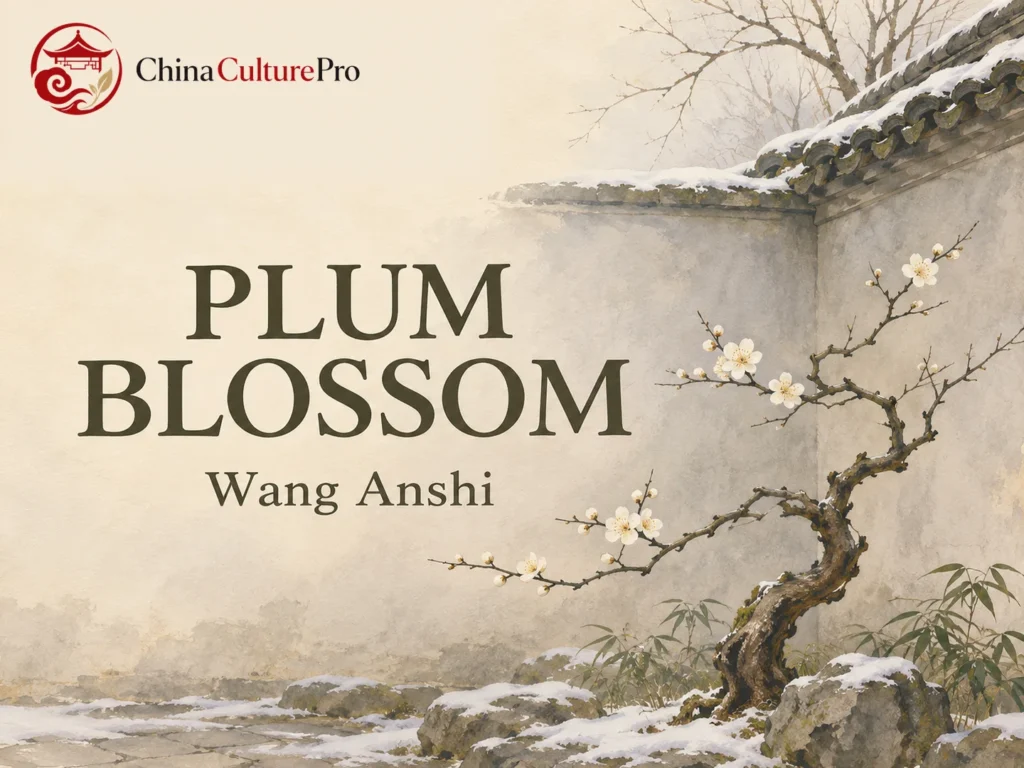

Quick Answer: What Is Wang Anshi’s Plum Blossom About?
Plum Blossom (梅花, Méihuā), by Wang Anshi (王安石, Wáng Ānshí), describes a few plum branches flowering alone in the cold. Its speaker knows the pale shapes are not snow because their fragrance reaches him. This five-character quatrain (五言絕句, wǔyán juéjù) contains four lines and 20 characters.[1]
- The setting: A wall corner places the flowers away from a grand central display.
- The discovery: Scent supplies the reason for distinguishing blossom from snow.
- The traditional reading: Flowering in difficult conditions can suggest integrity and independence.[2]
That moral interpretation does not establish an exact episode or date in the poet’s political career.

A pale cluster by a wall could resemble snow from a distance. What identifies the living flowers is something the eye cannot see: their scent. This small act of recognition gives the poem its turn, while the blossoms’ cold surroundings invite a reading about character.
The Complete Poem and an English Sense Translation
The Chinese text below is complete. This original English rendering preserves the connection between knowing in the third line and the reason supplied in the fourth.[1]
| Chinese line | English sense translation |
|---|---|
| 牆角數枝梅, | At a corner of the wall, a few plum branches |
| 凌寒獨自開。 | bloom alone, defying the cold. |
| 遙知不是雪, | From a distance I know they are not snow: |
| 為有暗香來。 | their delicate scent has reached me. |
“A few branches” gives the scene a modest scale. It does not mean exactly one blossom or a counted number of trees.
A Few Branches in an Unshowy Corner
The opening begins with position and quantity rather than a declaration of the flower’s symbolic meaning. A corner can be overlooked; a few branches do not fill the whole garden. The second line makes their presence more striking by placing their flowering against cold surroundings.[1]
The phrase braving the cold (凌寒, líng hán) carries a sense of resistance. “Alone” intensifies that impression. The flowers are not presented as part of a crowded celebration of spring.[2]
Keeping this scale matters. A translation that turns the scene into an entire mountain covered in plum blossom would lose the quiet concentration of the opening.
How Fragrance Answers the Snow Comparison
The third line gives a judgment before explaining it. The speaker knows from afar that the pale forms are not snow. The fourth line answers the reader’s natural question: how can he tell? Their scent reaches him.[1]
Subtle fragrance (暗香, àn xiāng) means a faint or unobtrusive fragrance here. “Dark” is a possible literal association of the first character, but the phrase does not require a nighttime scene.[2]
Snow provides a visual comparison; fragrance supplies a difference. The poem does not actually narrate an initial mistake followed by a correction. The scent crosses the distance that the third line retains.
The Plum as a Figure of Integrity
In traditional readings of plum blossom symbolism, cold-resistant flowering can stand for steadfast character. The unobtrusive corner and continuing fragrance make that interpretation especially fitting here. The flowers possess a quality that is perceptible even without a prominent position.[2]
Wang was a reforming statesman of the Northern Song (北宋, Běi Sòng). His political identity helps explain why readers connect the solitary plum with personal conviction. Hong Kong Education Bureau’s reading notes also present this self-portrait reading as an interpretation, rather than the poem’s explicit declaration.[2]
It is more precise to describe that possibility than to assign every wall, branch and patch of cold to a named opponent or policy. The visible scene remains the basis of the reading.
How to Read the Poem through Two Senses
- Keep the scale small: Picture a few flowering branches at a wall corner.
- Register the cold: Notice how flowering gains force from its difficult surroundings.
- Pause after the judgment: Ask what lets the speaker know the pale forms are not snow.
- Let scent answer: Read the final line as evidence, then consider how that quiet distinction supports a moral interpretation.
FAQs About Plum Blossom by Wang Anshi
Does dark fragrance mean the scene is at night?
No. The phrase describes an unobtrusive fragrance in this context. The poem gives no definite time of day.
Does the poem say snow is actually falling?
No snowfall is narrated. Snow is introduced as something the distant pale blossoms resemble, then distinguished from them through scent.
Is the plum definitely Wang Anshi himself?
Reading the flower as a figure for the poet’s integrity is a traditional interpretation. The poem itself does not name a political event or explicitly equate the blossom with its author.
Sources
[1] Wang Anshi. Plum Blossom, complete Chinese text
[2] Education Bureau, Hong Kong. Plum Blossom: author introduction, vocabulary and reading notes