


Quick Answer: What Does Pingyao’s Ancient City Preserve?
Pingyao Ancient City (平遥古城, Píngyáo Gǔchéng) in Shanxi preserves the layout of a historic county town, including walls, streets, shops, courtyards and official buildings. Its merchant houses and remittance firms also record the town’s role in Qing commerce.[1][2]
- A walled town. The Ming enlargement of 1370 helped establish the outline visible in the historic plan.[2]
- Financial history. Rishengchang (日升昌, Rìshēngchāng) operated as a remittance firm, with a street-facing business and private working space behind it.[2][3]
- A wider heritage property. Shuanglin Temple (双林寺, Shuānglín Sì) and Zhenguo Temple (镇国寺, Zhènguó Sì) are also inscribed, outside the walls.[1]
The date of the Ming plan gives the city a historical framework. Its buildings show later activity, alterations and repair.[1][2]
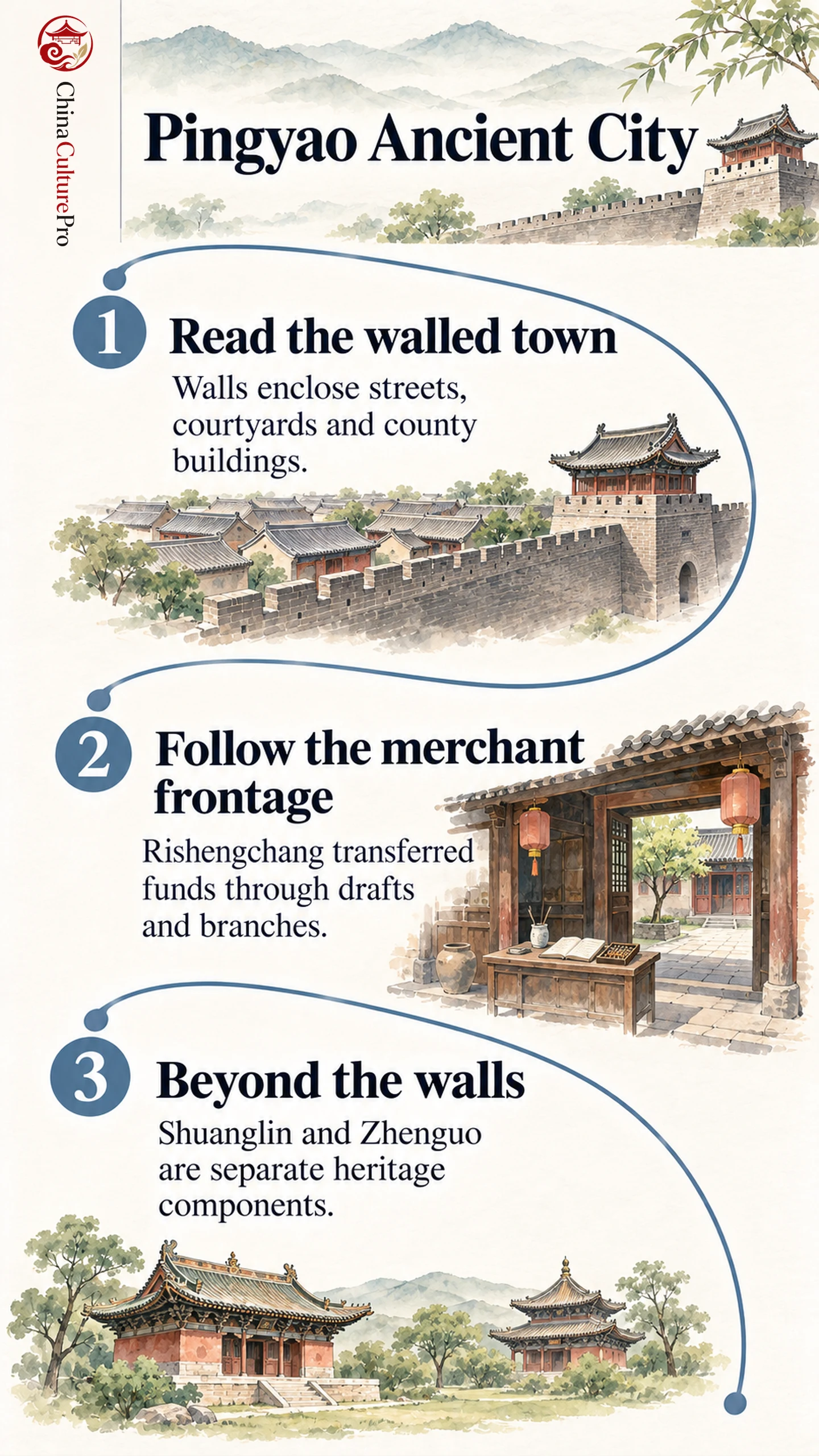
In Pingyao, walls enclose a functioning network of streets and lanes. Read the spaces within that network and the city becomes a record of county administration, merchant work and household life, that can be read from the walls inward.
How the Walls, Streets and Courtyards Fit Together
| What to look at | What it reveals |
|---|---|
| Walls and gates | The extent and controlled entrances of the county town |
| Main streets | Movement between commercial, civic and religious spaces |
| Smaller lanes and courts | Access to households and work areas behind the street fronts |
| County offices | A distinct seat of local administration inside the walls |
During the 1370 Ming expansion, the defenses and internal layout were substantially reworked. The broad outline and street pattern remained recognizable as later generations occupied, maintained or rebuilt individual buildings. The wall is therefore evidence of urban organization. It cannot date every house within it.[1][2]
What Rishengchang Tells You About Shanxi Merchants
Rishengchang, founded in 1823, was a piaohao (票号, piàohào), a firm that transferred funds through drafts and connected offices. A merchant could arrange a payment through the firm’s network rather than carry an equivalent amount of silver for the whole journey. The Shanxi piaohao guide explains how drafts and branches worked.[2][3]
Read the old premises in relation to the street. A customer could reach the business from the commercial frontage, while activities inside continued around a courtyard. The adapted courtyard shows how a financial firm could use the same basic building arrangement as nearby shops and houses. It also links the surviving plan to the wider merchant culture of Shanxi.[1][2][3]
Two Temples Outside the Walls
Shuanglin Temple and Zhenguo Temple are separate parts of the World Heritage property. Shuanglin is known for painted Buddhist sculpture. Zhenguo preserves an early timber hall, the Hall of Ten Thousand Buddhas, dated to the Five Dynasties period. Each adds a different kind of religious and architectural evidence to the shops and courtyard houses inside Pingyao’s walls.[1][2]
FAQs About Pingyao Ancient City
Was all of Pingyao built in 1370?
That year marks a major Ming enlargement and fortification. The city retained that framework as later households, institutions and businesses altered their buildings.[1][2]
What service made Rishengchang significant?
The firm transferred funds through drafts and a network of branches. Its old premises help show how a remittance business occupied a commercial courtyard property.[2][3]
Do the two named temples stand inside the walls?
Shuanglin and Zhenguo lie outside the walled city. They belong to the same World Heritage property as separate components.[1]
Sources
[1] UNESCO World Heritage Centre. Ancient City of Ping Yao
[2] ICOMOS. Ancient City of Ping Yao evaluation and its urban fabric
[3] Shanghai Municipal Government. Rishengchang and Pingyao’s commercial history