
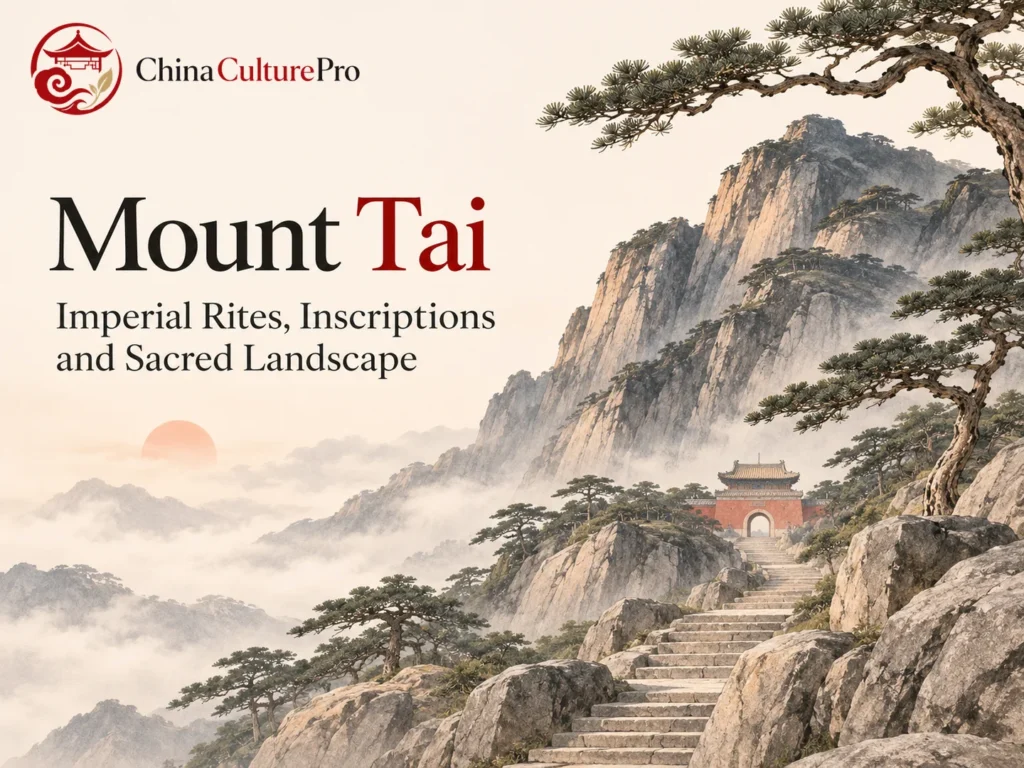

Quick Answer: Why Was Mount Tai Sacred to Chinese Emperors?
Mount Tai (泰山, Tài Shān), in Shandong, was a setting for imperial ceremonies, mountain worship and religious pilgrimage. In the rites known as fengshan (封禅, fēngshàn), rulers paid homage to Heaven and Earth. Temples, paths and inscriptions record several kinds of activity on the mountain.[1][2]
- At the foot. Dai Temple (岱庙, Dài Miào) preserves an architectural setting for worship of the mountain deity.[1][3]
- On the ascent. Shrines and inscriptions mark distinct places and traditions along the mountain route.[1]
- Near the summit. A cliff inscription dated 726 records a Tang emperor’s rites.[2][4]
A date in a text can refer to the performance of a rite, the carving of a record or the making of a later paper rubbing.[2][4]
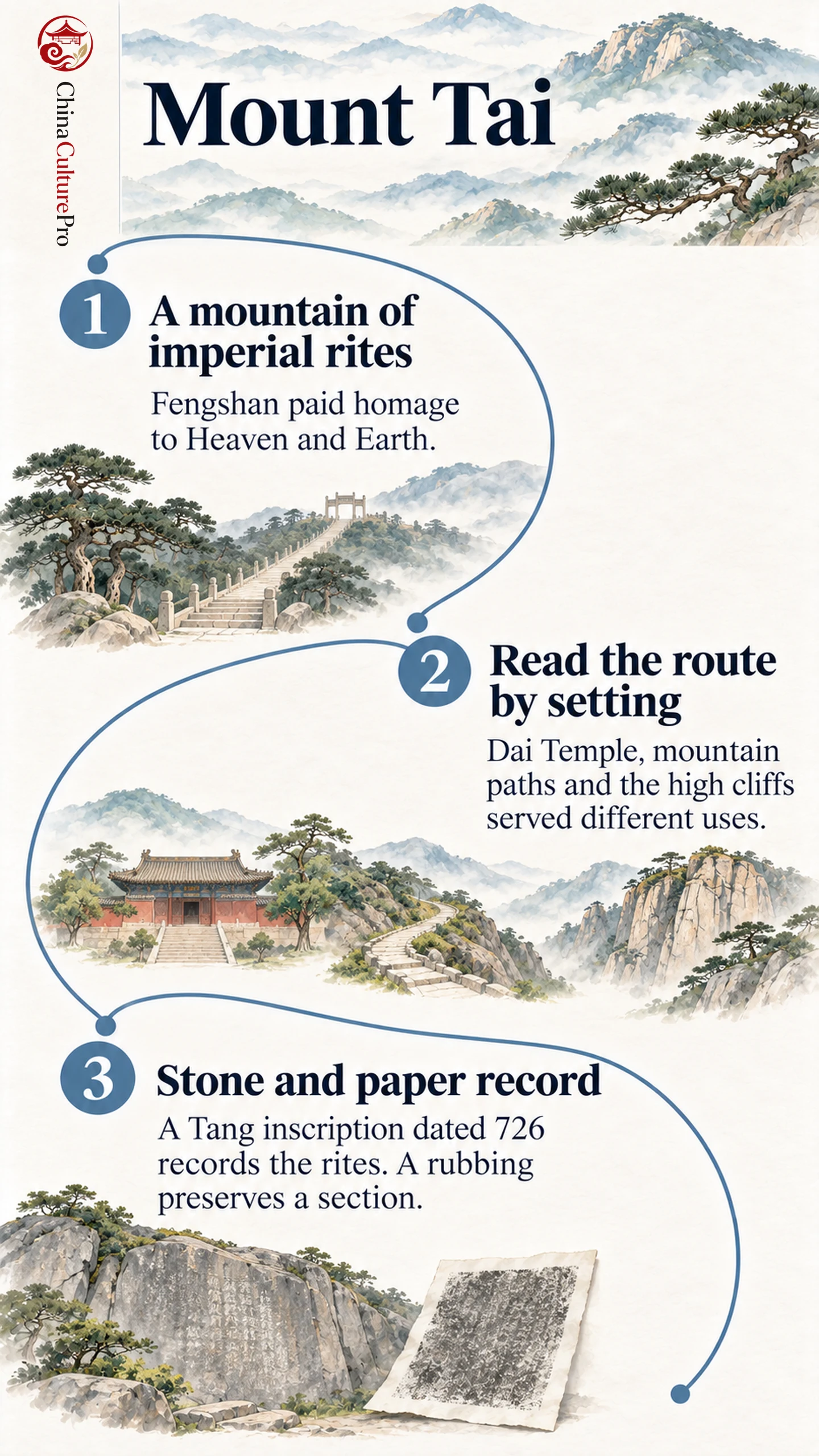
At Mount Tai, the setting and surface of an inscription are part of the evidence. A royal inscription carved high on a cliff addresses worshippers and later viewers in a different way from a stone tablet set into a temple court. The approach to the summit links such texts to the places where ceremonies and worship occurred.
What Fengshan Expressed
Mount Tai was revered before the first Qin emperor performed sacrifices there in 219 BCE. Later emperors used fengshan to give thanks and present their rule in relation to cosmic order. The two parts of the rite involved offerings to Heaven and Earth at different settings. They depended on a sacred mountain landscape as well as on the authority of the ruler.[1][2]
The form and sequence changed across periods. A mountain ritual could also be marked in writing long after the court moved on. Compare the Temple of Heaven, where Ming and Qing rituals were organized around purpose-built altars in Beijing.[1][5]
Read the Route from Dai Temple to the High Cliffs
| Setting | What you can read there |
|---|---|
| Dai Temple | The gates, courtyards and palace-style halls of a large shrine to the mountain deity |
| Ascending paths and valleys | Shrines, inscriptions and texts that mark several different devotional traditions |
| High cliffs | Rock-cut records whose scale and placement draw on the landscape itself |
Dai Temple occupies the lower setting in Tai’an. Its courtyards contain stelae assembled from many periods. Farther up the mountain, the Valley of Inscribed Buddhist Scriptures preserves a Northern Qi inscription carved into the rock. The two locations show that imperial ritual was only one of the cultural uses of the mountain.[1][3] At Laojun Mountain, a different tradition used the ridge as a setting for Daoist shrines.
A Tang Carving and Its Paper Rubbing
A cliff-face text known as Ji Taishan Ming (纪泰山铭, Jì Tàishān Míng) records the successful completion of the Tang emperor Xuanzong’s sacrifices. The carving at Daguan Peak is dated 726. The date belongs to the making of the stone record, while the text looks back to the ceremonial event.[2][4]
A paper impression in the University of California, Berkeley collection reproduces part of the fifth section of the inscription. The catalog’s description allows you to place the individual sheet within the much larger text. A guide to Chinese stone rubbings explains how to distinguish a carved record from the impression taken from its surface.[4]
FAQs About Mount Tai’s Cultural History
Which Mount Tai structure was built for worship of the mountain deity?
Dai Temple served as a major shrine to the God of Mount Tai. Its enclosure, gates and halls occupy a site near the foot of the mountain.[1][3]
Does every inscription on Mount Tai record an emperor’s sacrifice?
The mountain also has Buddhist scriptures and inscriptions from other religious, literary and historical settings. Read the subject and location of each inscription.[1][4]
What does the date 726 refer to?
It is the date cataloged for Xuanzong’s inscription. The text commemorates a sacrifice, and a surviving impression can be a later object again.[2][4]
Sources
[1] UNESCO World Heritage Centre. Mount Taishan
[2] Mount Tai Scenic Area Management Committee. Stone gateways, stelae and cliff inscriptions
[3] Mount Tai Scenic Area Management Committee. Dai Temple, introduction
[4] University of California, Berkeley Library. Ji Taishan ming, catalog record for an impression
[5] UNESCO World Heritage Centre. Temple of Heaven, an Imperial Sacrificial Altar in Beijing