

Quick Answer: Why Does Lingyin Temple Matter?
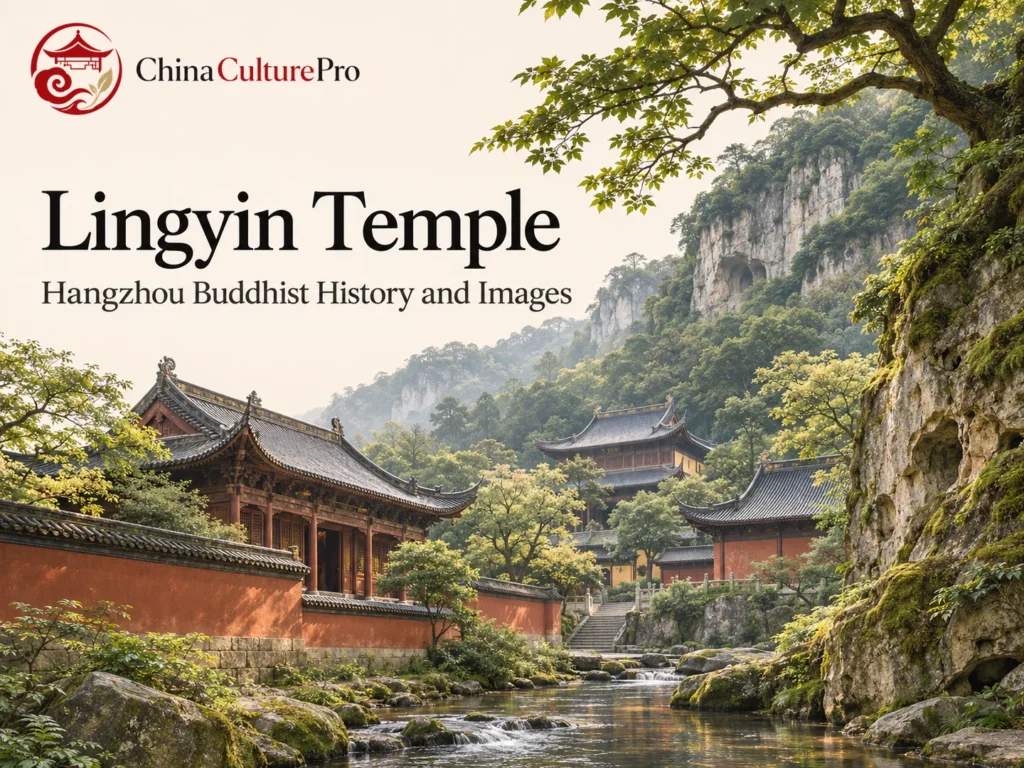
Lingyin Temple (灵隐寺, Língyǐn Sì) is a Buddhist monastery in the wooded hills west of Hangzhou’s West Lake. Its founding tradition dates to 326 CE and the monk Huili. Across the stream, the limestone faces of Feilai Feng (飞来峰, Fēilái Fēng) preserve a distinct group of Buddhist carvings.[1][2][3]
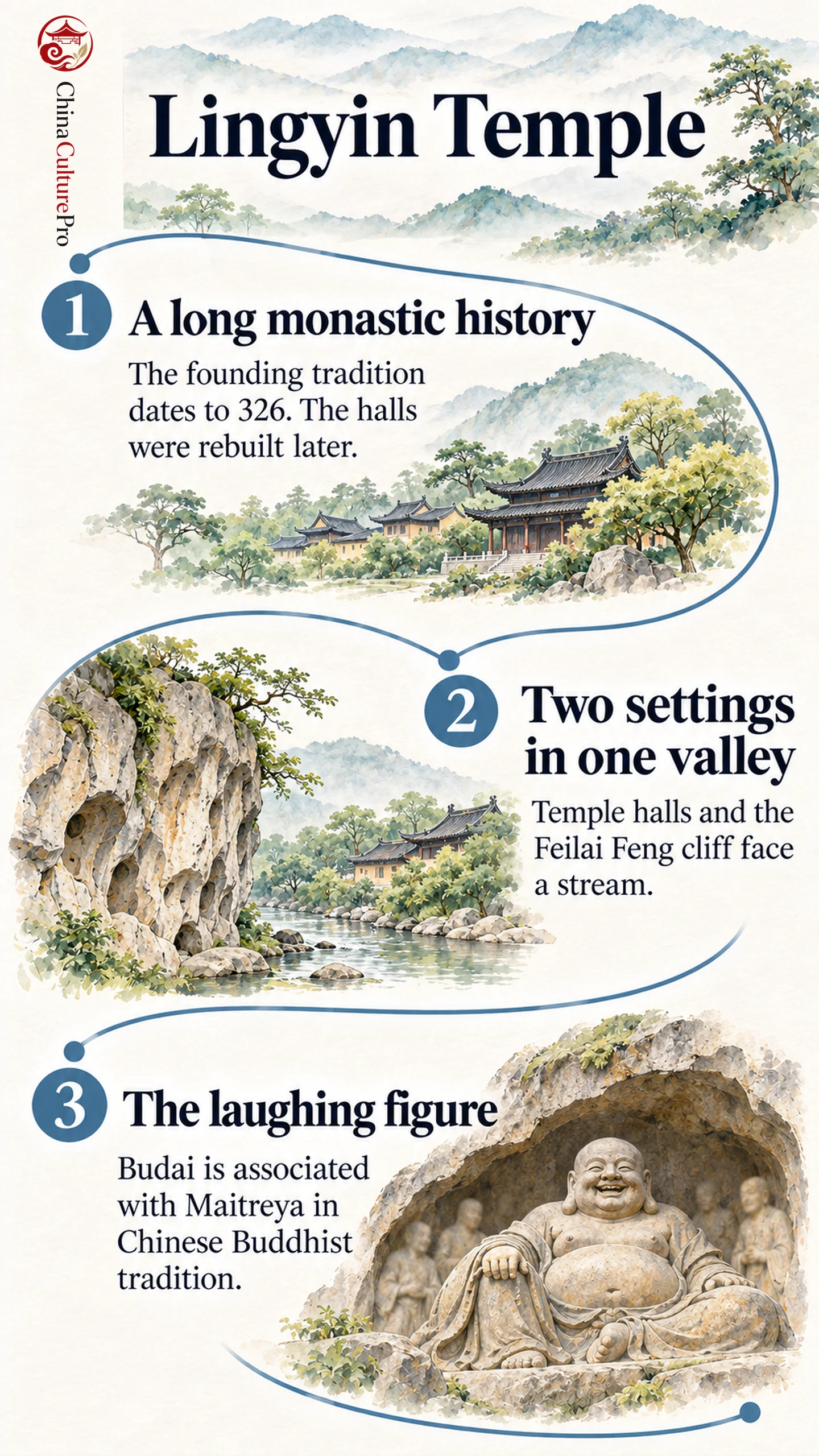
- Monastic history. The founding date marks the institution’s origins. Later patrons repaired or rebuilt its halls.[1][2]
- Cliff sculpture. A Southern Song niche shows the laughing Budai (布袋, Bùdài) with a surrounding group of disciples.[3]
- Landscape setting. The stream places the monastery and the carved cliff within sight of one another.[1]
Lingyin’s halls and the sculptures across the stream have separate building and carving histories.[1][2][3]
At Lingyin, the transition from rock face to monastery changes what you are looking at. The carved images belong to a limestone landscape. The sequence of temple halls serves prayer, ritual and monastic use. Either can help explain the role of Buddhism in the hills around the lake.
How the Monastery Took Shape Over Time
The monastery traces its foundation to Huili in the Eastern Jin period. Its own account links the traveler to an observation that the opposite peak resembled a sacred mountain in India. That is a founding story about how the site acquired meaning. The subsequent repair history gives firmer dates for particular changes to the monastery.[1][2]
A Qing episode illustrates the difference between a name and a structure. After the Kangxi emperor’s 1689 visit, a plaque associated the monastery with the name Yunlin, or Cloud Forest. Later renovations rebuilt or altered parts of the complex. For the longer setting, the West Lake cultural landscape shows how religious sites, hills and water became part of Hangzhou’s cultural geography.[2][4]
Read the Halls and Rock Carvings Separately
| Setting | What to look for | What it helps explain |
|---|---|---|
| Monastery axis | Heavenly Kings Hall, the main hall and further halls | How the monastery gives different forms of worship a place along the route |
| Cliff and caves | Niches carved into limestone | How artists set a figure or group into the rock |
| Stream and wooded valley | The space between the temple and the carvings | Why the two locations are easy to visit together yet have different histories |
The Heavenly Kings Hall and main hall stand along the monastery’s axis. On the other bank, the shape and viewing angle of each recess matter. A cliff niche may frame several related figures, while a major hall centers attention on the image used there for worship.[1][2][3]
What the Laughing Figure at Feilai Feng Represents
The broad smile and exposed belly in a well-known Southern Song niche identify Budai, the Cloth Bag Monk. Chinese Buddhist traditions associate Budai with Maitreya (弥勒, Mílè), the future Buddha. He appears with eighteen luohans (罗汉, luóhàn), or arhats. The grouping gives Maitreya a recognizable Chinese form and places him among figures whose names and number developed in East Asian tradition.[3]
This figure belongs to the cliff carving history. The central image in the monastery’s main hall represents Shakyamuni, the historical Buddha. Compare the image’s setting and companions before treating “Buddha” as the name of the same figure in both places. In Chinese Buddhism, different images can serve distinct devotional purposes.[2][3] At Mount Emei, the elephant mount is a different visual cue, identifying the bodhisattva Samantabhadra.
FAQs About Lingyin Temple
Does the monastery still have buildings from 326?
The date belongs to its traditional foundation. The temple’s history records construction and renovations in later periods.[1][2]
Are the Feilai Feng sculptures inside the monastery halls?
They occupy limestone cliffs and caves across the stream from the monastery. The halls and cliff carvings are different settings within the same valley.[1][3]
Who is the laughing figure at Feilai Feng?
The notable Southern Song group depicts Budai, a monk associated with Maitreya in Chinese Buddhist tradition, with eighteen arhats.[3]
Sources
[1] Hangzhou municipal English portal. Lingyin Temple and its setting
[2] Lingyin Temple. Brief introduction, history and the monastery axis
[3] Southeast Review of Asian Studies. Indigenizing Deities, the Budai Maitreya at Feilaifeng
[4] UNESCO World Heritage Centre. West Lake Cultural Landscape of Hangzhou