


Quick Answer: What Is a Northeast Chinese Kang House?
A kang (炕, kàng) is a heated masonry platform built into a room. In many traditional houses in northeast China, the platform connects to a stove and chimney. Hot gases from the stove pass below the platform before leaving through the chimney, warming the surface used for sitting or sleeping.[1][5]
- Stove: A cooking fire can supply heat for the platform as well as the kitchen.[5]
- Platform: Its masonry absorbs heat and releases it into the room.[3]
- Room use: In Huanren (桓仁, Huánrén), the platform served for meals, rest and visits.[2]
The northeastern examples below show several ways of arranging and supporting the platform.
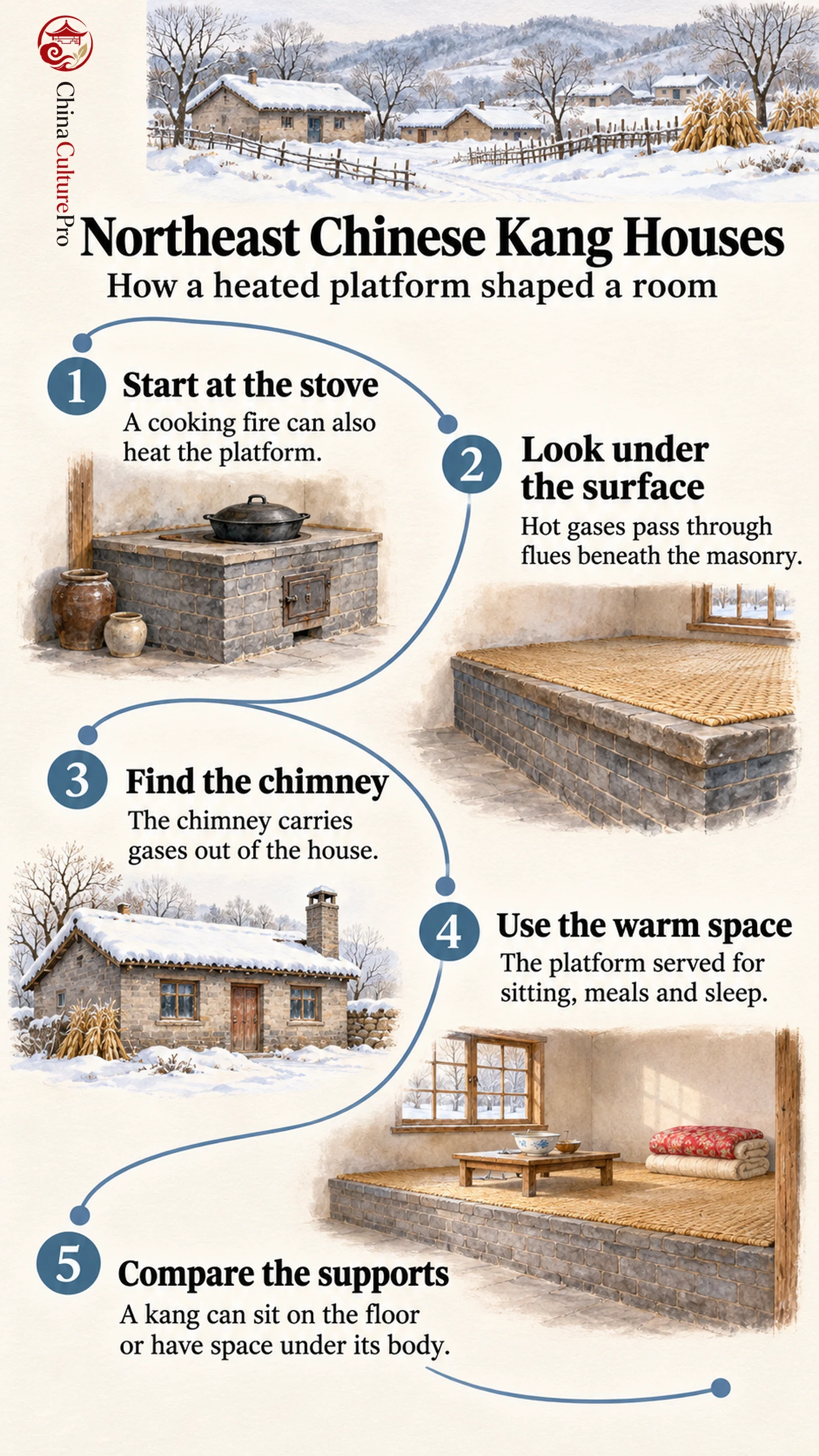
The raised sitting surface is easy to see in a furnished room. What matters for heating is what lies beneath it. In a kang house, the seat belongs to a system that extends from the cooking area to the chimney.[1][2]
From the Stove to the Platform and Chimney
As hot gases pass through flues beneath the platform, the masonry takes up heat. The gases continue toward the chimney. The masonry holds heat and continues to release it after the fire dies down.[3][5]
Huanren’s craft inventory describes a local platform built with stone slabs and clay. A broader architectural history also documents platforms of brick, earth or stone.[1][2]
How the Platform Shaped Daily Life
A wide heated platform provided room for more than one activity. A household could sit or eat there during the day and use it for sleeping at night.[2]
In some Manchu courtyard houses, heated masonry ran along several walls, so the platform shaped how people used much of the room. A house with a platform along one wall gave a different relation between the heated surface and the floor.[2]
Grounded and Elevated Kangs
In a grounded design, the platform body meets the floor. Its sitting surface can still be raised above the room. In the elevated design described in engineering studies, a space opens beneath the body, exposing another surface to the room air.[4]
A study in Dalian (大连, Dàlián) documented a partly elevated type in three houses, with part of the underside raised and part still touching the floor. The study describes the same three components in these houses, with changes to how the platform was supported.[3]
The heated floors of Korean houses in Yanbian offer a nearby comparison in how heating can shape the use of a room.[6]
FAQs About Northeast Chinese Kang Houses
Is the Kang Just a Bed?
It can serve as a sleeping place, a heated seat and a platform for activities such as meals and conversation.[2]
Does a Kang Use the Same Space as an Ondol?
A kang usually forms a defined raised platform. In traditional Korean ondol arrangements, heat can warm a broad room floor from below.[4][6]
What Did China Recognize in Huanren?
In 2021, China listed the local craft of building kangs in Huanren as national intangible cultural heritage.[2]
Sources
[1] Architectural History. The Chinese Domestic Architectural Heating System
[2] China Intangible Cultural Heritage Network. Huanren Kang-Building Techniques
[3] Solar Energy. Field Survey of Northeast China Homes with Kangs and Passive Solar Walls
[4] Energy and Buildings. Research on Elevated Kangs in Rural Northeast China
[5] U.S. Environmental Protection Agency Research Database. Chinese Kang as a Domestic Heating System in Rural Northern China
[6] Landscape Research Japan. Wood Use in Korean-Chinese Houses