
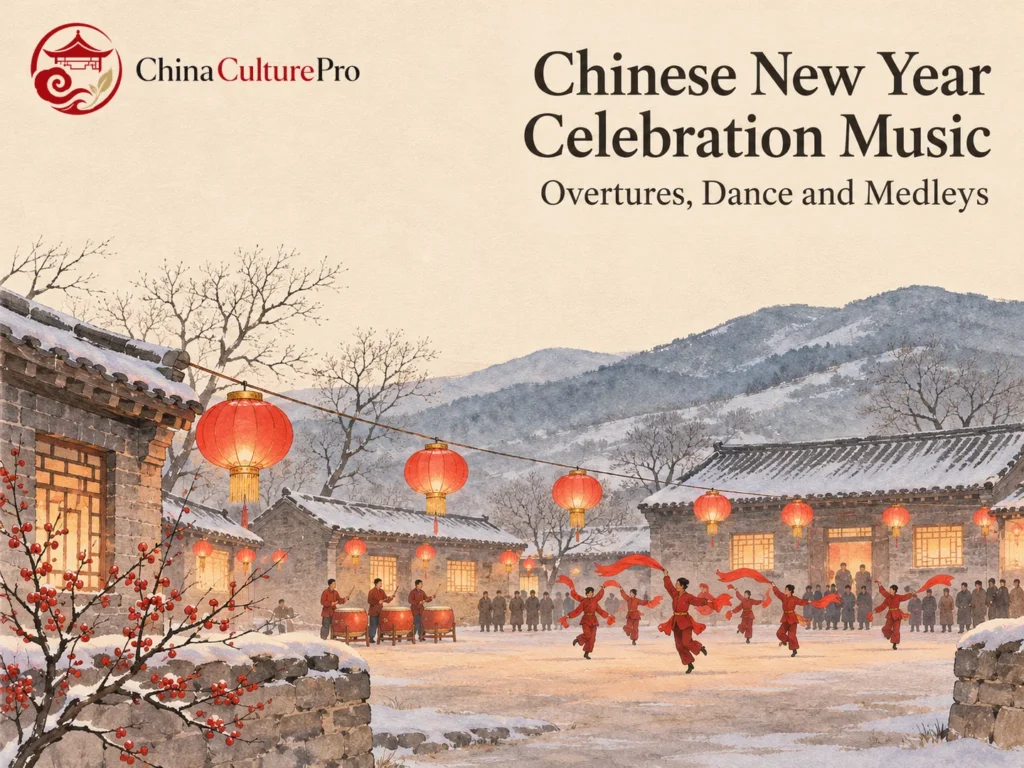

Quick Answer: What Is Chinese New Year Celebration Music?
Chinese New Year celebration music ranges from local dance tunes to concert overtures and medleys. A widely programmed example is Spring Festival Overture (春节序曲, Chūnjié Xùqǔ) by Li Huanzhi (李焕之, Lǐ Huànzhī), written in 1955–1956.[1][6]
- Folk roots: The overture draws on northern Shaanxi folk music and yangge (秧歌, yānggē) dance rhythms.[2][3]
- Suite: The overture is the first movement of Li’s four-movement Spring Festival Suite.[2]
- Medley: Celebrating the New Year (贺新年, Hè Xīnnián) also appears as the title of a separate song medley.[5][6]
Use the composer or arranger credit when a festive title is hard to distinguish by its English wording.

In one piece, a quick drum pattern can set the pace for the whole orchestra. In a medley, the energy comes partly from recognizing a new tune as it enters. Listen to the pulse first, then see how the program describes the piece.
Hear the Yangge Roots
Accounts of Li’s time in Yan’an describe his experience of New Year festivities and participation in a yangge group. The Guangzhou Symphony Orchestra identifies folk suona melodies and dance percussion rhythms as elements of the overture. Listen for the emphases in the drum part that give the opening its dance character.[2][3]
The surroundings matter as well. Chinese New Year traditions vary from household gatherings to community performances. The overture evokes a particular northern festival sound within that wider set of celebrations.
Find the Overture Within the Suite
The Spring Festival Suite has four movements. The first, also known as Overture: Great Yangge, is the one frequently played on its own. Listen for the driving opening and the more lyrical middle section before the pulse regains its force.[2][3]
The Los Angeles Philharmonic lists winds, brass, percussion and strings in its setting. The Hong Kong Chinese Orchestra credits Peng Xiuwen for the instrumentation and Yan Huichang for its revision. Singapore Chinese Orchestra programs a separate adaptation by Sim Boon Yew.[1][4][6]
Distinguish an Overture From a Medley
Singapore’s Rhapsodies of Spring program lists Li’s overture and Law Wai Lun’s Celebrating the New Year as separate works. Law’s medley links three popular songs and introduces dance rhythms such as rumba, cha-cha and tango. Listen for the moment the arranger moves from one recognizable tune to the next.[5][6]
Compare the Opening, Middle and Return
Play two versions of the overture and listen for which instruments introduce the opening rhythm. Notice which section of the orchestra takes the melody in the middle and what happens when the festive pace returns. Then hear how a different concert piece uses bright articulation in Dance of the Golden Snake.
A 2022 New Year program paired the overture with Horse Racing for Erhu. For another instrumental selection, Step by Step Higher offers a Cantonese tune associated with good wishes.[7]
FAQs About Chinese New Year Celebration Music
Who composed Spring Festival Overture?
Li Huanzhi composed it as the first movement of his Spring Festival Suite.[1][2]
Is Celebrating the New Year the same as Spring Festival Overture?
In the Singapore Chinese Orchestra program, Celebrating the New Year is Law Wai Lun’s separate medley of popular songs.[5][6]
How long is the overture?
The Los Angeles Philharmonic lists about five minutes. Timing depends on the rendition.[1]
Sources
[1] Los Angeles Philharmonic. Spring Festival Overture
[2] Guangzhou Symphony Orchestra. 2020 Guangzhou New Year Concert
[3] Xinhua. The Spring Festival Overture and Its Roots
[4] Hong Kong Chinese Orchestra. Voices of Spring
[5] Singapore Chinese Orchestra. Rhapsodies of Spring 2024: Programme
[6] Singapore Chinese Orchestra. Rhapsodies of Spring 2024: Programme List
[7] Embassy of China in Canada. Happy Chinese New Year 2022 Concert Program