


Quick Answer
The Baisha murals (白沙壁画, Báishā bìhuà) are historic wall paintings in and around Lijiang, Yunnan. Some of the best-known examples are in Dabaoji Palace (大宝积宫, Dàbǎojī Gōng), where scenes from Han and Tibetan Buddhist traditions appear alongside Daoist subjects. The paintings are part of a wider collection spanning several buildings.[1][2][3]
- Where: Dabaoji Palace, Liuli Hall (琉璃殿, Liúlí Diàn) and Dading Pavilion (大定阁, Dàdìng Gé) are in Baisha. A related surviving group is at Dajue Palace in Shuhe.[3]
- What to look for: In Dabaoji Palace, the Guanyin (观音, Guānyīn) scene and the peacock deity’s assembly face one another across the hall.[2]
- What survives: Original murals, painted copies and digital records offer different views of the work.[3][4]
A label naming the hall and wall gives you a better starting point than the broad name “Baisha murals” alone.
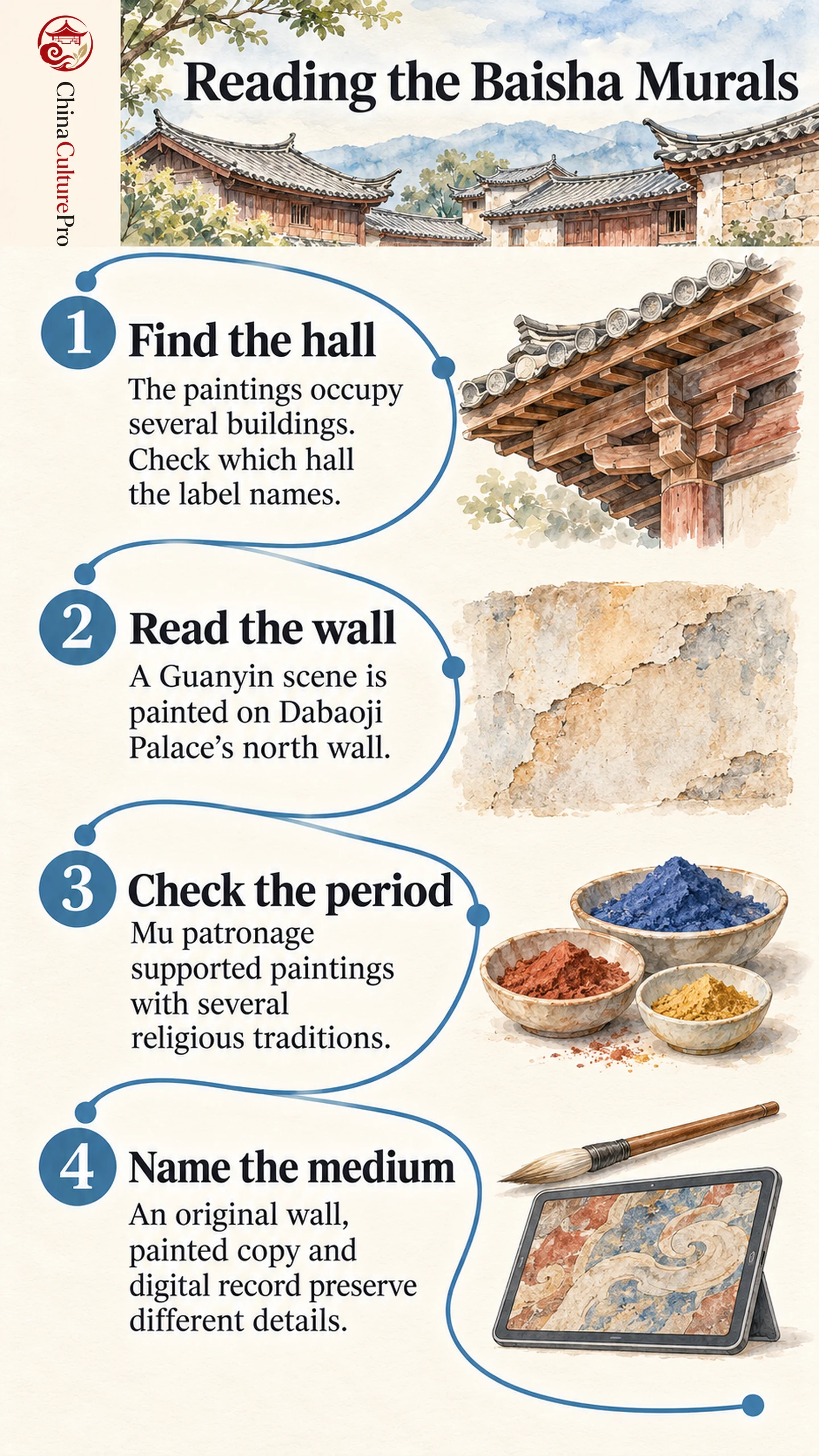
On a wall in Dabaoji Palace, Guanyin rescues people from danger. Across the room, another mural assembles figures around the peacock deity Mahamayuri. Standing between those two paintings would give you a different sense of the work from seeing either reproduced on its own. That relationship between picture and place is central to understanding the Baisha murals.[2]
Where the Baisha Murals Are
Baisha is one of the three settlements in the UNESCO World Heritage property of the Old Town of Lijiang, alongside Dayan and Shuhe. UNESCO describes Lijiang as a point of exchange among Naxi, Han, Tibetan and Bai communities. The murals sit within that larger history of Yunnan culture.[1]
The Yunnan provincial record identifies groups at Dabaoji Palace, Liuli Hall and Dading Pavilion in Baisha. It also includes Dajue Palace in Shuhe in its description of surviving Lijiang murals. A museum or book may therefore discuss the paintings in Baisha itself or use a wider Lijiang grouping. The building name gives a more reliable point of comparison when two accounts describe different works.[3]
What the Paintings Show Inside Dabaoji Palace
The hall’s north wall includes an illustration of a Lotus Sutra episode featuring Guanyin, the bodhisattva of compassion. The scene shows Guanyin coming to the aid of people in distress. Across the hall, on the south wall, an assembly centres on Mahamayuri, associated with the peacock. A painting of the assembly of Shakyamuni Buddha occupies the screen wall. Together these works make up a central group within the hall.[2]
Other paintings change the setting as you move through the space. Near the entrance, the Three Officials of Heaven, Earth and Water are a Daoist subject. Farther inside, some paintings incorporate Tibetan Buddhist imagery and lineage figures. Their placement helps a reader see which figures greet a visitor and which scenes belong to the same area of worship.[2]
How Mu Patronage Shaped the Paintings
The Mu family governed Lijiang under the Ming as hereditary local chieftains. Their patronage reached religious institutions connected with both Han and Tibetan traditions. A study of Dabaoji Palace interprets the placement of the paintings as a deliberate use of imagery drawn from the different religious communities with which the Mu dealt. The image programme gives one way of reading that history, alongside the names and dates preserved in inscriptions.[2]
The same study describes an earlier visual programme at Liuli Hall with much closer ties to Han Chinese painting conventions. The difference is worth keeping in mind when an account characterises all the Baisha murals as a single style. The buildings belong to the same area. Their paintings reflect choices made in different periods.[2]
The murals can also be read alongside other parts of Naxi cultural history. The Sanduo Festival centres on a Naxi protective deity, while Naxi ancient music brings together several named repertoires in the way it is discussed today. The festival, music and murals each took shape in a different setting within Lijiang.
What Copying and Digitization Preserve
A Yulong County exhibition project approved in 2019 brought together 55 painted copies. Those pieces reproduced examples of the Lijiang murals for display beyond the original sites. The figure counts exhibition copies. A survey of surviving originals has to specify which buildings and wall units it includes.[3]
A later local report described work underway in 2025 to capture and reconstruct mural details digitally. The project complemented conservation work on wall paintings and repairs to historic buildings. A copy can help a viewer see a figure at eye level, and a digital record can document detail and position. In the original hall, the images still have their physical relationship to doors, corners and one another.[4]
FAQs About the Naxi Baisha Murals
Are All the Murals in Baisha?
The murals that give the group its name are in Baisha. The wider provincial account of surviving Lijiang murals also names Dajue Palace in nearby Shuhe. UNESCO lists Baisha and Shuhe as two components of the larger Old Town of Lijiang property.[1][3]
When Were the Dabaoji Paintings Made?
One scholarly dating places the Dabaoji paintings in 1643–1646 by comparing Tibetan inscriptions on different walls. This is a date for the programme at Dabaoji Palace. The nearby murals at Liuli Hall belong to an earlier period.[2]
Sources
[1] UNESCO World Heritage Centre. Old Town of Lijiang
[2] Religions. A spatial analysis of the murals in the Dabaoji Palace
[3] Yunnan Commission on Ethnic and Religious Affairs. Baisha murals and the painted-copy exhibition
[4] Lijiang Daily. Baisha mural digitization and conservation work