


Quick Answer
Bökh (搏克, bókè) is Mongolian wrestling, practiced in several forms in China. The Ujumchin record from Inner Mongolia describes a bout that ends when a body part above the knee touches the ground. The Wusu record from Xinjiang gives a different finish, when both shoulders touch the ground at the same time.[1][2]
- Rules: The two documented traditions have different winning conditions.[1][2]
- Clothing: Ujumchin wrestlers can wear a leather jacket, wide white trousers and tall boots.[1]
- Setting: Wrestling is among the traditional sporting events at Mongolian festivals in China.[3]
A local ruleset and the event announcement are the best guides to what will count during a particular bout.
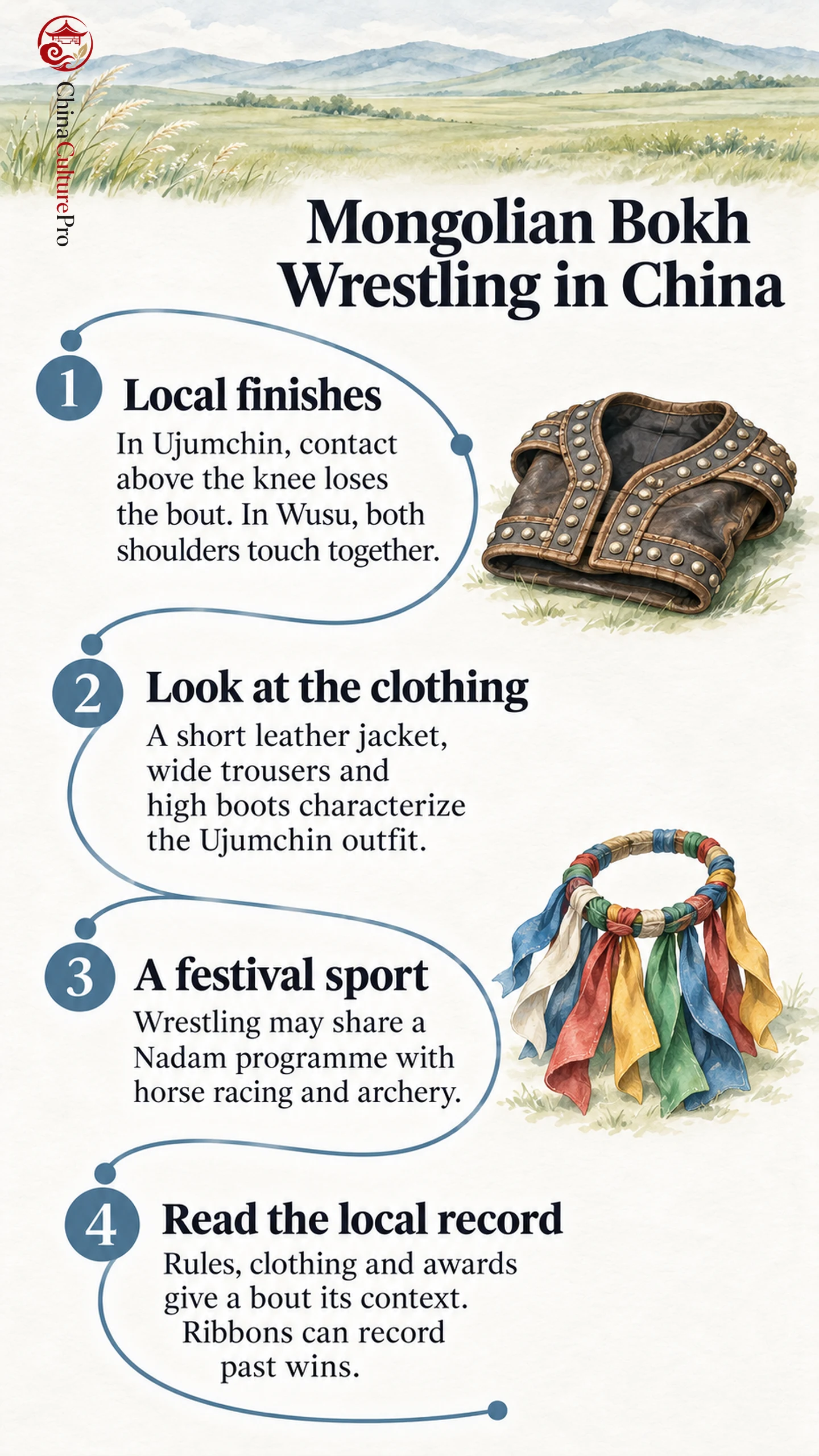
The crowd may recognize the decisive moment before a first-time viewer does. Knowing which kind of contact ends the bout helps explain the reaction. Clothing gives another clue, especially where colorful ribbons identify a wrestler’s achievements. The different local records also show why the wider category of Mongolian communities in China leaves room for distinct sporting traditions.
How Two Local Rules Decide a Bout
In East and West Ujumchin banners and nearby areas of Xilingol, the Chinese national inventory describes a single fall deciding the contest. In that account, the wrestler loses when a body part above the knee touches the ground. It describes traditional bouts without a time limit or weight classes. The decisive event is the fall itself.[1]
The Wusu record describes a different finish. Both of the opponent’s shoulders must touch the ground at the same time. Its account also describes an elimination format and no weight classes. The finish is the clearest way to distinguish what counts in the two named examples. An account of Wusu should specify the shoulders, while an account of Ujumchin can describe an above-the-knee fall.[2]
What Wrestlers Wear in Ujumchin
The Ujumchin inventory describes a short leather wrestling jacket with metal fittings, loose white trousers and high Mongolian boots. Several separate cloth and leather elements complete the clothing. The combination of trousers, boots and ribbon regalia gives a viewer more clues than the short jacket on its own.[1]
The colored neck ribbons known as jangga (将嘎, jiānggā) belong to a wrestler’s record of achievement. The local inventory links their use to results at tournaments of different sizes. When two competitors enter with different regalia, the ribbons carry information about earlier contests. The rule for this bout still decides the result in front of the spectators.[1]
In Wusu, the heritage record describes older dress that included leather shorts and bare feet. It also documents a later practice using a simpler belt. Those details help place a description or image in context when the clothing differs from the Ujumchin example.[2]
How Bökh Fits into Nadam
Nadam (那达慕, Nàdámù) is a Mongolian gathering at which wrestling can appear alongside horse racing and archery. At a festival, a bout is both a contest and part of a public occasion. A day of events may give spectators several sports to watch, while a heritage account can focus on the rules of one form of wrestling.[3]
Mongolia’s national Naadam is also organized around the three sports. The UNESCO description relates its annual July celebration to Mongolia. The comparison shows the reach of shared sporting traditions across borders. A programme for an event in China supplies the local date and competition details.[3][4]
What the Heritage Records Preserve
The two Chinese records preserve much more than a shared name. They connect rules to local organization, clothing and ways of awarding recognition. An announcement naming the venue and the wrestling style helps a viewer use the appropriate record. If the event description leaves out its rules, the observed finish can help the viewer ask a more precise question.[1][2]
Clothing, previous wins and the result of a bout are separate pieces of evidence. On its own, a photograph of the leather jacket tells little about the number of rounds or how a contest ended. A caption that names the style, place and occasion gives a better account of what the viewer can see.[1][2]
The regional guide to Mongolian ovoo worship describes communal observance at cairns. A sporting programme and a record of worship each describe a particular gathering, and their place names help distinguish them.
FAQs About Mongolian Bökh in China
Are There Weight Classes?
The Ujumchin and Wusu heritage descriptions both document traditional competition without weight classes. Check the published rules if you are following a particular organized event.[1][2]
Does UNESCO’s Naadam Listing Set the Rules in China?
The UNESCO Naadam entry documents Mongolia’s national festival. For the rules of a Chinese contest, use the relevant local description or event regulations, such as the documented Ujumchin and Wusu rules.[1][2][4]
Sources
[1] China Intangible Cultural Heritage Network. Mongolian wrestling in Ujumchin
[2] China Intangible Cultural Heritage Network. Mongolian wrestling in Wusu
[3] Visit Beijing. Bokh and its place in Mongolian events in China
[4] UNESCO Multimedia Archives. Naadam, Mongolian traditional festival