

Quick Answer: Is There One Chinese Mahjong Score?
Mahjong (麻将, májiàng) has several scoring systems. A number called “three fan (番, fān)” cannot be understood without naming the rules: it might describe a qualifying hand, a step on a conversion table, or part of an exponential calculation.
- Check eligibility: does the hand meet that ruleset’s winning conditions and minimum?
- Calculate hand value: which patterns and bonuses count, and which combinations are excluded?
- Calculate settlement: how does that value convert, who pays, and which adjustments apply?
Choose one complete rulesheet before playing. The examples below compare named frameworks and published implementations; they are not interchangeable regional instructions.
A familiar set of tiles does not guarantee a familiar score. Two groups can recognize the same triplets and sequences yet disagree about whether a hand may win or what each opponent owes. Learn the basic turn sequence through our mahjong rules guide, then keep the scoring sheet beside the table.
Compare Four Scoring Frameworks
| Framework | Main scoring mechanism | Question to settle before play |
|---|---|---|
| Hong Kong faan (番, fān in Mandarin) | Count qualifying features, then use the agreed faan-to-payment table | What is the minimum, what counts toward it, and where does the table cap? |
| MCR (国标麻将, guóbiāo májiàng) | Add permitted pattern points; require eight excluding flowers; apply a separate settlement formula | Which combinations are excluded, and is the minimum met before flowers? |
| Sichuan fan (番, fān) | Published implementations can use powers of two, different caps and different self-draw adjustments | Is self-draw an extra point or an extra fan? |
| Taiwanese tai (台, tái) | A published classic implementation uses a base plus a fixed amount per tai | What are the base, per-tai rate and dealer adjustments? |
The Mandarin reading accompanies the Chinese character in the first row; “faan” is the Cantonese label commonly used in English descriptions of Hong Kong play. Identical characters do not make the four calculations equivalent. The framework-specific details follow below.[1][2][4][5][6]
Hong Kong Faan: Qualifying First, Then Converting
In the Hong Kong scoring description used here, an All Pungs hand receives three faan. Three is also a common winning minimum, although the published explanation acknowledges other minimums. A table that agrees on three can therefore treat that pattern as reaching its threshold, subject to the rest of its winning rules.[1]
The next task is conversion. Three faan is not automatically three settlement points. Read the agreed payment table and its limit before calculating the payment. Do not assume every Hong Kong group doubles the same starting value indefinitely, or that every bonus helps satisfy the minimum.
Write down the minimum and conversion separately. For example, “minimum three faan” answers whether a low-value hand can win; it does not answer what a four-faan hand pays. Our Hong Kong mahjong guide keeps that regional framework distinct from other Chinese games.
MCR: Add Patterns, Check Eight, Then Settle
Mahjong Competition Rules, abbreviated MCR, provides 81 scoring patterns. Count allowed combinations rather than adding every description that seems to fit: its rules restrict repeated or overlapping scoring. A legal win needs at least eight pattern points, excluding flower points from that minimum.[2][3]
Consider two arithmetic checks, assuming the hand otherwise satisfies the winning rules:
- Seven non-flower points plus two flower points total nine, but fail the eight-point qualifying threshold.
- Eight non-flower points plus two flower points qualify and produce a ten-point hand value.
Flowers can increase a qualifying score without rescuing an under-minimum hand. Identifying a flower correctly is therefore different from knowing what it can accomplish; see our mahjong tile guide.
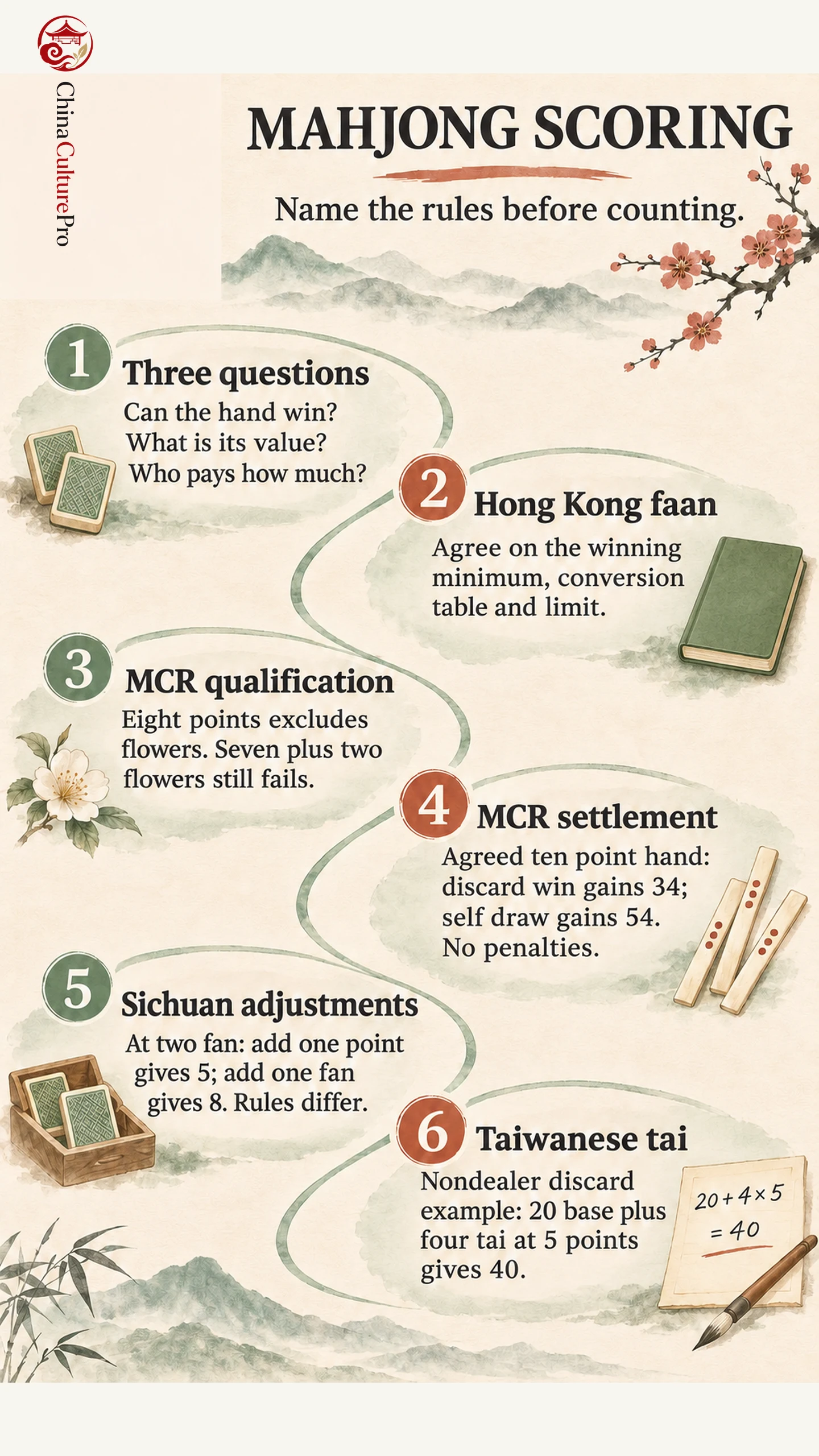
Settlement is a separate calculation. With no penalties, each non-winner pays the winner an eight-point base. On a discard win, the discarder also pays the hand value. On self-draw, each of the three opponents pays the base plus hand value.[2]
For an agreed final hand value of ten points, including any eligible flower points, the original arithmetic is:
- Discard win: the discarder pays 18; the other two pay eight each. The winner gains 34.
- Self-draw: each opponent pays 18. The winner gains 54.
These are settlement examples, not claims that an unspecified tile arrangement scores ten. The hand’s patterns must first be identified and accepted.
Sichuan: A Point and a Fan Are Different
Blood Battle (血战到底, xuèzhàndàodǐ) illustrates why “Sichuan scoring” needs a specific rulesheet. Two published online implementations use different self-draw adjustments and limits.
One implementation assigns one base point at zero fan, doubles by fan level, caps the base at three fan, and adds one point per liable opponent for self-draw. Another caps at four fan and counts self-draw as one additional fan. These settings belong to the two implementations; other Sichuan tables may use different settings.[4][5]
Start with an otherwise agreed two-fan hand, below either cap:
- Extra point: 2² + 1 = 5 points per liable opponent.
- Extra fan: 2³ = 8 points per liable opponent.
The difference is the location of the adjustment. Adding one after conversion does not equal increasing the exponent by one. At a limit, the cap also matters, so do not extend the example mechanically to every higher hand.
Blood Battle can continue after a player wins. Count the opponents still liable for the event rather than automatically multiplying every result by three. Separate payments for declared quads and end-of-hand adjustments can also affect the final balance; the examples above isolate the winning payment.[4][5] Our Sichuan mahjong article explains the playing structure behind those differences.
Taiwanese Tai: A Base Plus a Rate
The published Taiwanese Classic implementation used here starts with sixteen ordinary hand tiles and normally completes five groups plus a pair, seventeen tiles before accounting for extra tiles in quads. It calculates payment as a base plus an agreed amount for each tai. The discarder pays for a discard win; self-draw involves all three opponents, with dealer-related adjustments to consider.[6]
Take an illustrative non-dealer winning from another non-dealer. Agree on a base of 20 points and five points per tai. If the accepted hand has four tai, the payment is:
20 + (4 × 5) = 40 points.
That is forty settlement points, not forty tai. The four-tai value and five-point rate serve different jobs. The numbers are chosen to make the arithmetic visible, not to prescribe a standard rate for Taiwanese play.
Dealer status, repeat-dealer rules and local pattern values require the selected sheet. A calculator is useful only when its rule settings match the game being played; selecting “Taiwanese” alone may not establish every condition.
Read a Scoring Sheet in Four Steps
- Identify the framework and setup. Record the ruleset, hand structure, tile inventory, minimum and any local changes before the first deal.
- Check whether the win is legal. Verify its structure, how the winning tile was obtained and the qualifying minimum before adding bonuses that cannot help eligibility.
- Count the permitted value. List the actual patterns and eligible bonuses, then remove overlaps or excluded combinations under that sheet.
- Apply settlement and record it. Use the agreed conversion, cap, payer responsibilities and adjustments; check that the winner’s gain matches the opponents’ combined losses.
Keep the pattern calculation and payment calculation on separate lines. If two players disagree, locate the rule that changes the result before recalculating. Moving to a different family, such as American mahjong, requires learning its own winning and scoring framework too.
FAQs About Mahjong Scoring Systems
Do eight points always make a legal MCR win?
No. The hand must also have a permitted structure and winning method. Flower points cannot supply any missing portion of the eight-point minimum.[2]
Is one fan worth the same everywhere?
No. A fan or faan label needs its ruleset’s conversion method, limits and payment conditions. Taiwanese tai likewise should not be substituted directly into a Hong Kong or Sichuan formula.[1][4][6]
Do all the listed patterns stack?
No. MCR has explicit rules restricting overlapping and repeated combinations. Other frameworks have their own exclusions, so recognizing several pattern names does not prove that all their values can be added.[2]
Does the hand value equal the winner’s total gain?
Not necessarily. A hand value can feed a further formula involving base payments and several opponents. Calculate the hand first, then apply the named framework’s settlement rules.[2][6]
Sources
[1] Mahjong Time. Hong Kong Mahjong Scoring
[2] World Mahjong Organization. Mahjong Competition Rules, bilingual rulebook
[3] Mahjong International League. A Guide to Mahjong: Chinese / Official International Rules
[4] Mahjongo. Sichuan Mahjong: rules and scoring
[5] JoyPip. Sichuan Mahjong: rules and scoring
[6] Hé Fēn Mahjong. Taiwanese Classic Rules