
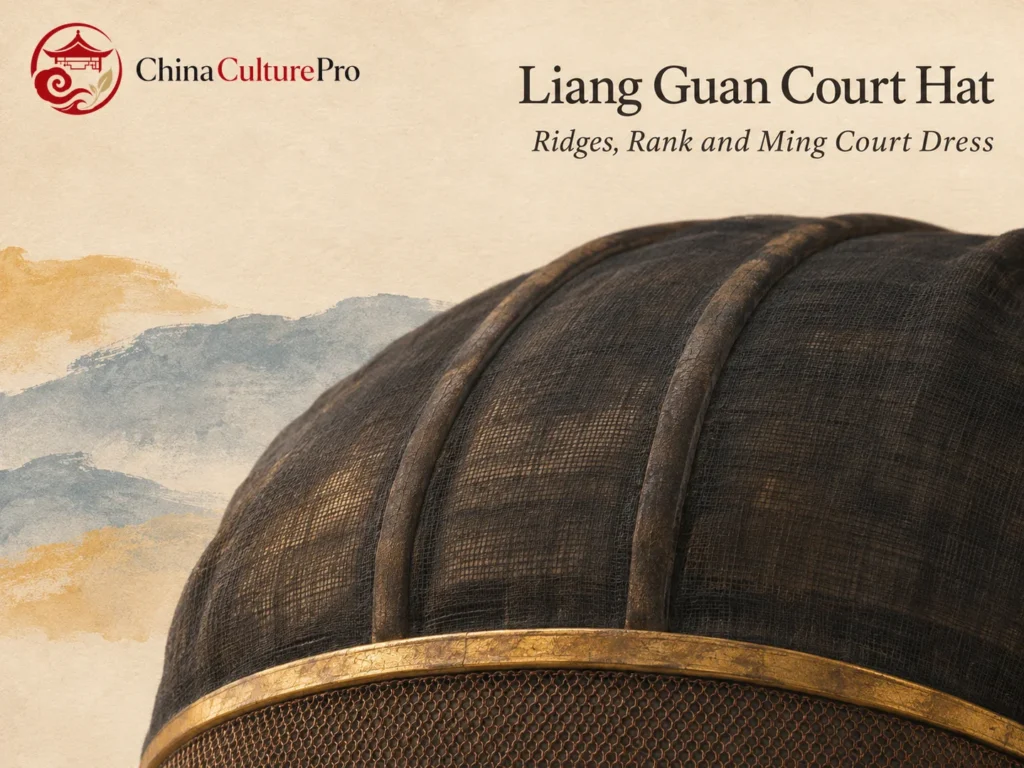

Quick Answer: What Is a Liang Guan?
The liang guan (梁冠, liángguān) is a court hat with raised ribs called liang (梁, liáng). Ming dress regulations prescribed it for civil and military officials wearing formal court attire, or chaofu (朝服, cháofú). The number of ribs marked rank under a dated set of rules.[1]
- Look on top: A Shandong Museum crown has five surviving leather ribs attached to its arched black gauze top.[2]
- Use the Ming rule: Ordinary official grades run from seven ribs for first rank to one for eighth and ninth ranks.[1]
- Check the occasion: The hat appears in prescriptions for major ceremonies, together with red silk garments, belts and hanging ornaments.[1]
Use the wearer’s office, the kind of event and the condition of the object to interpret any count.

At first glance, gold ornaments may stand out more than the ribs that give the liang guan its name. Look across the crown itself before interpreting its outline or decoration. A rulebook, a portrait and a preserved hat each answer a different question about what an official wore.
What the Ridges Look Like on a Surviving Hat
An example preserved by the Confucius family and now held by Shandong Museum illustrates how the parts fit together. Its front band sits over the forehead, the rear projections rise like ears, and the lacquered gauze top forms an arch between them. Gilt framing and copper mesh appear in the front and rear sections. The leather ribs sit on the gauze itself, separate from the gilt frame around the crown.[2]
Five leather ribs survive. Stitching traces near one edge have been interpreted as evidence of a sixth. That reading would fit the second-rank status associated with the Duke Yansheng (衍圣公, Yǎnshèng Gōng), the hereditary title held by descendants of Confucius. The sixth rib is a proposed reconstruction based on a trace, while the five remaining ribs can be counted on the object.[3]
When a photo shows the hat front-on, an ornament can hide the base of a rib. Use a view from above or an oblique angle to tell the raised ribs apart from the bands that frame the crown.
How Many Ridges Did Ming Officials Wear?
The History of the Ming records a rule from the twenty-sixth year of the Hongwu reign, 1393. For the nine grades of civil and military officials, the prescribed counts descend as shown below.[1]
| Official grade | Prescribed ribs |
|---|---|
| First | 7 |
| Second | 6 |
| Third | 5 |
| Fourth | 4 |
| Fifth | 3 |
| Sixth and seventh | 2 |
| Eighth and ninth | 1 |
Titled nobles followed additional rules. Dukes were assigned eight ribs with special ornaments. Marquises and earls wore seven with decorations that differed from those of first-rank officials. The regulations also mention the xiezhi (獬豸, xièzhì), a mythical creature used on censorial headwear. A count of seven can therefore point to more than one position until the rest of the hat and the wearer’s identity are known.[1]
How the Hat Fit Into Ming Court Dress
The Ming dynasty dress record calls for formal court attire on occasions including the New Year audience, the winter solstice, major sacrifices and the ceremonial reading of imperial orders. The hat was worn with a red upper garment and skirt, a white inner layer, a front panel covering the knees, and belts and hanging ornaments. Some of those accessories also varied with grade.[1]
The wushamao (乌纱帽, wūshāmào) belongs to a different outfit. The dress record specifies it alongside a round-neck robe, belt and boots for ordinary official wear. If the hat is hard to see, the round collar and the rest of the outfit can help identify which kind of official dress a portrait shows.[1]
Earlier forms also help put the Ming crown in context. The jinxianguan (进贤冠, jìnxiánguān) had rank-marking ribs in earlier periods. The Song record describes a five-rib form for some high-ranking officials, with distinctions involving office and ornament. For example, five ribs indicate third rank in the Ming table, while a Song description assigns five ribs to the first and second grades at specified occasions.[4][5]
How to Read a Portrait or Modern Reconstruction
Start with the date of the costume reference and the event it represents. Identify the shape of the crown and the view you are seeing. Check whether the full costume is visible, including the red and white layers where applicable. Then compare the stated grade or title with a contemporary dress rule.
For a reproduction, ask what evidence was used for the crown, including material, ornament and the number of ribs. A maker who cites the Shandong Museum example may choose to show the surviving five or reconstruct the proposed sixth.[3] An explanation of that choice is more informative than a label such as “Ming official hat.”
A crown with a flat board and hanging bead strands belongs to a different kind of ceremonial ensemble. Read about mianfu (冕服, miǎnfú) and compare the complete ensembles within traditional Chinese clothing.
FAQs About the Liang Guan
Did each rank have its own ridge count?
The 1393 Ming rule pairs grades six and seven at two ribs and grades eight and nine at one. It also gives titled nobles separate ornament prescriptions.[1]
Is the liang guan the same as the wushamao?
The liang guan was part of formal court dress in the Ming regulations. The wushamao was the black gauze hat used in the ordinary official outfit.[1]
Why might a surviving hat have fewer ridges than expected?
A rib can be missing from the surviving object. On the Shandong Museum example, five remain and stitching traces have been interpreted as evidence for a possible sixth.[2][3]
Sources
[1] History of the Ming. Volume 67, Dress of Civil and Military Officials
[2] China Cultural Relics News. Ming Clothing Preserved in the Confucius Family Mansion
[3] Dazhong News. A Guide to Ming Official Dress and the Shandong Museum Liang Guan
[4] Forbidden City. A Proposed Reconstruction of the Ming Liang Guan
[5] History of the Song. Court Dress and Three Types of Official Crown