


Quick Answer: What Is Mianfu?
Mianfu (冕服, miǎnfú) is ceremonial attire worn with a mianguan (冕冠, miǎnguān), a crown with a board over the head. In many forms, strings of beads called liu (旒, liú) hang from the board. The combination of crown, garments and accessories followed rules for particular wearers and rites.[1][3]
- Crown: A Dingling crown excavated from the Wanli emperor’s coffin had twelve strands at the front and twelve at the rear.[2]
- Clothing: An early Ming imperial rule distributed twelve emblems (十二章, shí’èr zhāng) between a dark upper garment and a separate skirt.[1]
- Rank and ritual: The rules distinguished wearers and changed with the occasion and period.[3][4]
Check the dated clothing rule or object record before treating a strand count or color as a general rule.
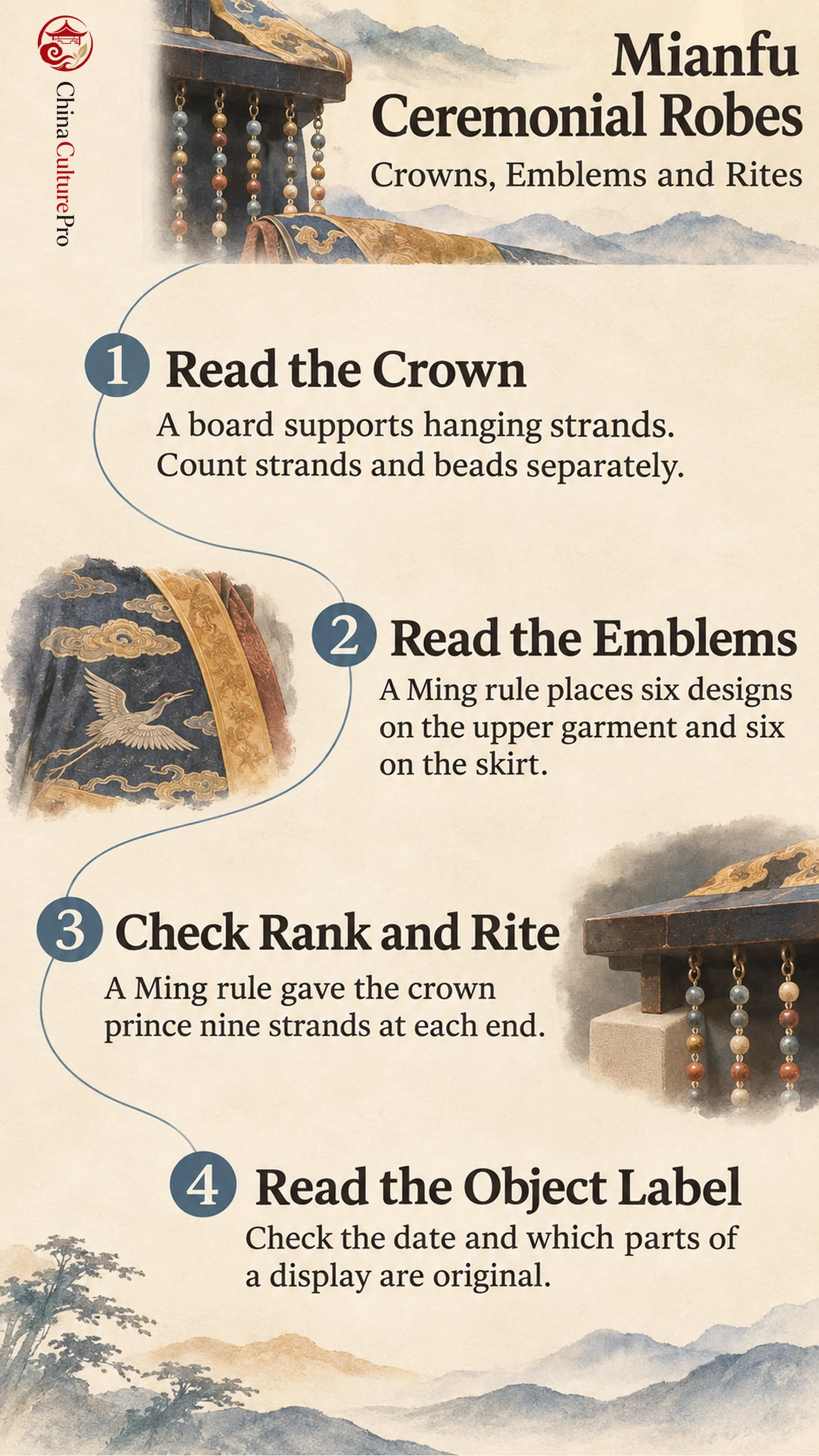
The bead strands are easy to notice in a portrait. The layers below them are just as important. A mian crown can belong with an upper garment, skirt and hanging ornaments, and different rules determine how those pieces form an outfit.
What the Crown and Clothing Include
In the Ming dynasty record, one form called gunmian (衮冕, gǔnmiǎn) paired the mian crown with patterned ceremonial garments. The imperial board had a rounded front and squared rear. The full outfit included an inner garment, a front panel over the knees, belts, pendants and hanging ribbons. The two cloth layers and the attached ornaments are part of the ensemble shown below the crown.[1]
The number of strands is separate from the number of beads threaded onto each strand. In the Hongwu emperor’s sixteenth-year rule, twelve strands hung at each end. The text also specifies twelve jade beads per strand. Keep that count separate from the emblems on the upper garment and skirt.[1]
Archaeologists found two mian crowns at Dingling, one of the Ming imperial tombs. The better-preserved one from the emperor’s coffin retained twelve strands on each edge and had a wooden board faced with black satin above and red satin below. The report counts nine jade beads on each strand along with pearls. The excavated crown matches the earlier strand count. The mix of jade and pearls on its strands is recorded separately.[2]
How to Read the Twelve Emblems
The twelve emblems are categories of designs on the clothing. One early Ming prescription places the sun, moon, stars, mountain, dragon and a patterned bird on the upper garment. The lower garment carries ritual vessels, aquatic plants, fire, grains, an axe emblem and a paired pattern. The rule names twelve different designs. A repeated dragon or bird does not add another category.[1]
A Qing festival robe at the Metropolitan Museum also bears twelve imperial symbols. That helps show how a motif system can recur on a garment with a different cut and purpose. The guide to Qing court robes and informal robes gives more context for separating the garment’s classification from the patterns it carries.[5]
How Rules Changed With Rank and Rite
The classical Rites of Zhou (周礼, Zhōulǐ) describes several crown-and-garment combinations tied to the wearer and the rite. It gives different dress for offerings to ancestral kings and rituals for mountains and rivers. Later courts interpreted and applied the classical system in different ways. A prescription from one period cannot settle how a different dynasty dressed for its own ceremonies.[3][4]
The Ming rules also differentiated members of the ruling family. A regulation from the Yongle reign specified nine strands at both ends and nine garment emblems for the crown prince. The emperor’s outfit had its own specifications. For formal headwear of civil and military officials, compare the separate liang guan (梁冠, liángguān), which marked rank with raised ribs.[1][6]
How to Interpret an Object or Reconstruction
Start with the date and wearer on the label. Check the shape of the board, the front and rear strands, and the number and material of the beads on any complete strand. Ask which parts of the display are original. The published Dingling illustration identifies a reconstructed crown body with original strands.[2]
If you are wearing an interpretation, check how the board stays level, whether the strands clear your face when you turn and which garments support the hanging pieces. Compare the outfit’s silhouette with the stated period model, using traditional Chinese clothing for context. Name the period reference and the parts that were adapted for modern wear.
FAQs About Mianfu Ceremonial Robes
Does mianfu refer to a single robe?
Mianfu refers to a ceremonial ensemble. Its components depend on the dated prescription, but can include a crown, upper and lower garments and several ornaments.[1][3]
Did every mian crown have twelve strands?
A Ming imperial prescription gives twelve at each end. A separate Yongle rule for the crown prince specifies nine at each end.[1][6]
Do twelve emblems identify a mianfu ensemble?
The emblems also appear on other ceremonial garments. A Qing festival robe with those symbols can be identified through its cut and collection record.[5]
Sources
[1] History of the Ming. Volume 66, Ceremonial Dress
[2] Institute of Archaeology, Chinese Academy of Social Sciences. Crowns Excavated at the Ming Dingling Tomb
[3] Zhang Ruyu, Classified Examination of Books. Ceremonial Dress in Classical Records
[4] Collected Journal of Historical Studies. Changes in the Six Mian Regulations of the Rites of Zhou
[5] Metropolitan Museum of Art. Emperor’s Twelve-Symbol Festival Robe
[6] Palace Museum Research Journal. Ceremonial Dress in the Early Ming