
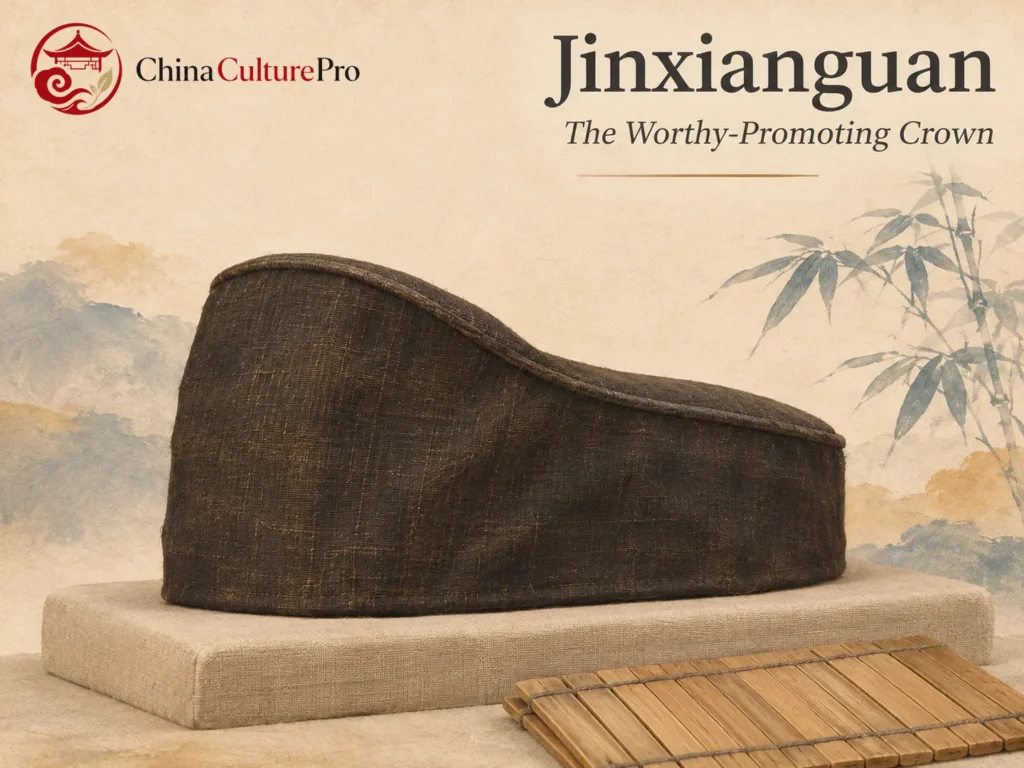

Quick Answer: What Was the Jinxianguan?
The jinxianguan (进贤冠, jìnxiánguān), often called the Worthy-Promoting Crown, was a form of Chinese official headwear. The Han dress treatise links it to learned men and distinguishes wearers by the number of raised elements called liang (梁, liáng). The crown’s appearance and rules varied over time.[1]
- Han description: The front is higher than the back in the recorded proportions.[1]
- Rank: The Han text names one-, two- and three-ridge versions for different groups.[1]
- Later use: A Jin burial model and Song ancestral portraits give examples outside the Han rules.[2][5]
Start with the object’s date and setting before using the profile or ridge count to identify it.

At the scale of a tomb figurine, a cap’s ridges can be harder to see than its overall silhouette. A dress treatise provides more exact distinctions, but describes a court system at a particular time. Read the physical image and the regulations side by side. Use the object to read the shape and the text to read the rule. If they come from different periods, keep the comparison provisional.
How the Han Record Describes the Crown
The dress treatise in the Book of the Later Han (后汉书, Hòu Hàn Shū) relates the jinxianguan to an older dark-cloth cap. It describes a front seven cun high, a back three cun high and a length of eight cun. Taken together, the figures show the relationship between the high front and the lower back in that description. They belong to the historical measurement system used by the text.[1]
Liang are the raised ridges the dress text counts. Look for repeated raised elements across the top and keep them distinct from the rim or features behind the crown. In a profile view a ridge can hide behind another one. A clear outline helps compare forms of traditional Chinese clothing, while an oblique view can be more informative for counting the ridges.
What the Ridge Count Meant in Han Dress
In the Han dynasty description, dukes and marquises have three ridges. A group that includes certain high-salaried officials down through court scholars has two. The text also describes a one-ridge form for people of lower position, including minor clerks and private students.[1]
The same account gives a two-ridge provision for members of the Liu ruling clan. Its commentary records a debate about the crown of an official responsible for imperial meals. His duties were used to argue for two ridges. Both details matter to someone reading an unlabeled image. One count could be shared by people with different duties and standing, even within the same dynasty.[1]
How Objects and Later Court Rules Change the Reading
A Western Jin tomb model from Jinpenling, Changsha, depicts two seated figures with writing equipment between them. The museum identifies the caps as single-ridge forms and interprets the figures as likely clerks comparing texts. The table and tools support that identification alongside the caps. A ridge count alone supplies less information than the whole scene.[2]
A painted figurine cataloged as a civil official of the Tang dynasty wears headwear identified as a jinxianguan. The Tang dress system distinguished between offices, even among people working at court. Officials of the Chancellery and the Secretariat used headwear associated with martial dress, while the Department of State Affairs used the jinxianguan.[3][4]
The Song dynasty ancestral portraits of the Shi family show several men with caps identified as jinxianguan. The archive describes their raised backs and their use of lacquered cloth and metallic ornament. A Ming historical comparison describes five-, three- and two-ridge court crowns in the early Song and records additional grades later. The broader liang guan (梁冠, liáng guān) category gives useful context for these later court caps.[5][6]
How to Identify It in an Image or Reconstruction
Look for the object label, date and a view of the crown from more than one angle. A dress rule identifies an expected form. A tomb figure shows a sculptor’s rendering, and a portrait with a name connects the costume with a particular sitter. None of those views gives a complete pattern by itself. If the source only shows a dark side silhouette, leave the ridge count open.
Also look at what the headwear accompanies. A hanging-bead crown is part of the formal dress discussed under mianfu (冕服, miǎnfú), while a wushamao black gauze hat belongs to a different official headwear tradition. If you are choosing a reconstruction, match the headwear, garment and occasion to the same source context. A dated model or painting is a better starting point than a costume listing that names a dynasty without giving its reference.
FAQs About Jinxianguan
Was the jinxianguan worn only by high-ranking officials?
The Han dress text includes lower positions as well as senior officials. It assigns a one-ridge form to groups including minor clerks and private students.[1]
Is every ridged court hat a jinxianguan?
Several court crowns used ridges. Check the dynasty, accessories, occasion and identification before giving the cap a specific name.[5][6]
Why do sources show different profiles?
The early description and later portraits belong to different dress systems and kinds of evidence. Some later caps have a higher back, while the Han text describes a high front.[1][5]
Sources
[1] Book of the Later Han. Carriages and Dress, Second Part
[2] Changsha Bamboo Slips Museum. Western Jin Figurines and the Work of Collating Texts
[3] Ye Wei, Tang Studies. Changes in Medieval Court Attendants Through Their Headwear
[4] National Museum of History, Taiwan Cultural Memory Bank. Painted Civil Official Figurine, 77-00625
[5] Ningbo Archives. Ancestral Portraits of the Shi Family
[6] Qiu Jun. Supplement to the Exposition of the Great Learning, Volume 98