
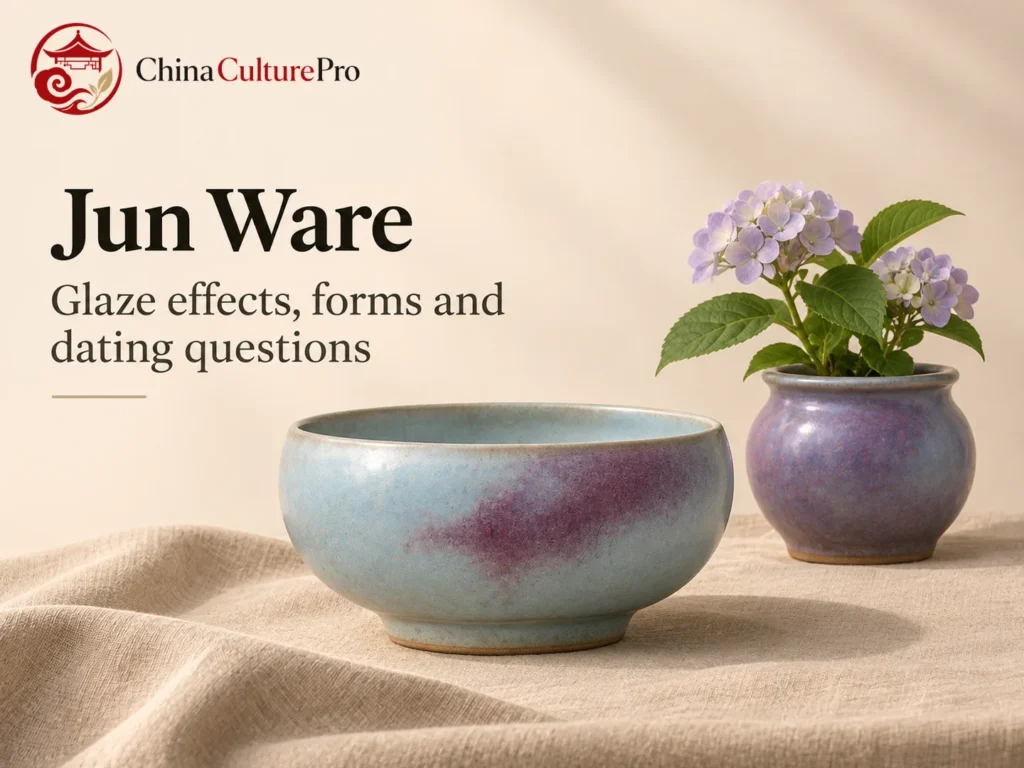

Quick Answer: What Is Jun Ware?
Jun ware(钧窑,jūnyáo)is a northern Chinese ceramic tradition associated especially with Henan. Its best-known surfaces have cloudy blue glazes, sometimes enlivened by purple or red areas. [1][3]
- Material: Museum catalogues commonly classify the vessels as glazed stoneware. [2]
- Appearance: Colour depends on glaze chemistry and the way its internal structure interacts with light. [4]
- Forms: Bowls belong to the tradition alongside distinctive numbered flowerpots and related vessels. [2][5]
- Dates: Early bowls and numbered palace vessels do not necessarily share the same chronology. [2][5]
Jun identifies a ceramic tradition, not one universal production date. A glaze colour, a base numeral and a later inscription answer different questions.
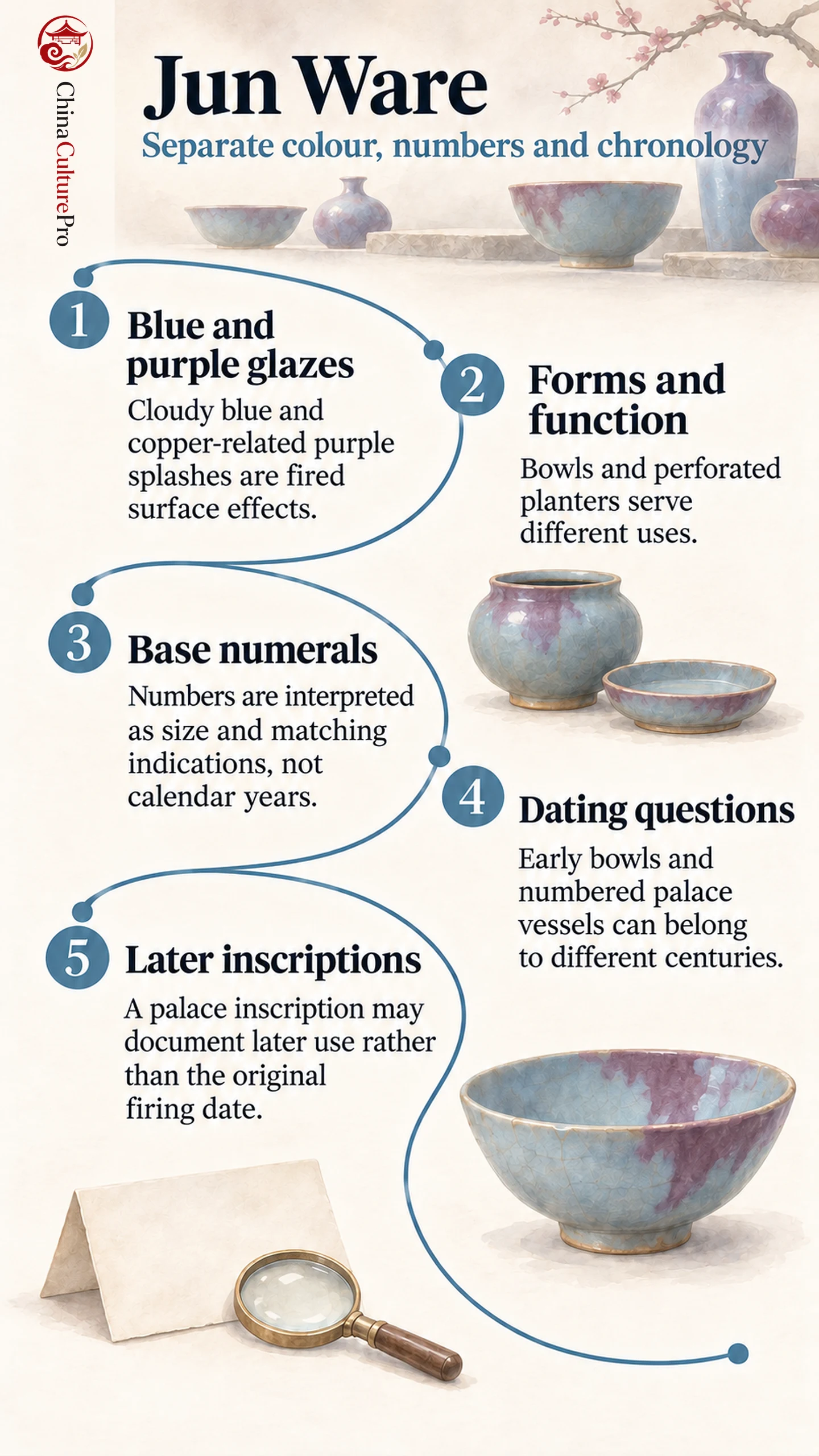
A blue bowl and a purple planter can both carry the name Jun while belonging to different periods and uses. Understanding them involves looking beyond colour to form, marks and the reasoning behind the label. This guide introduces those distinctions within the broader history of Chinese porcelain and ceramics.
Northern Kilns and a Long Production History
Yuzhou in Henan is a major location in Jun history. Excavations at Liujiamen and Hebeidi in Shenhou town during September–December 2001 uncovered kiln structures, settling tanks and large quantities of ceramic material. They provide an archaeological setting for production rather than relying only on objects preserved in collections. [1]
Jun’s history includes early blue-glazed bowls as well as later, more elaborate vessels. A small blue bowl, collection number 20.45, is dated to the first half of the twelfth century and classified as Northern Song. Its catalogue also connects northern Jun production with court supply. [2]
That evidence establishes an early part of the story. It does not require every purple-glazed planter with a numeral to belong to the same reign or century. [5]
Why Jun Glazes Look Blue, Purple and Cloudy
Yaobian(窑变,yáobiàn)describes transformations produced through firing. In Jun ware, the visible result involves both the glaze’s composition and its fine internal structure. It is more complex than a blue pigment simply painted over a pot.
A 2022 analytical study describes a glass structure containing tiny lime-rich droplets within a silica-rich matrix. Its explanation combines light absorption in darker, iron-rich regions with light scattering in paler regions. Together these effects contribute to the glaze’s sky-like, cloudy appearance. Small metallic copper particles were identified in the red areas examined. These findings concern the studied samples, rather than an identical structure in every Jun glaze. [4]
A blue-glazed bowl with a purple splash, collection 50.145.309, provides a clear visual example of copper-red glaze contributing to a varied surface. It is catalogued as Jin, twelfth–thirteenth century. [3]
The potter supplies the body and glaze materials; firing produces their final interaction. The varied surface records both deliberate preparation and transformations within the kiln. For the wider role of iron, see Chinese iron glazes.
Bowls, Planters and the Evidence of Form
A vessel’s profile and openings help explain its use. These three collection examples show different ways to read that evidence.
| Form | Features to notice | Documented example |
|---|---|---|
| Blue-glazed bowl | An open eating or serving form whose main visual effect is the pale glaze. | Bowl 20.45, Metropolitan Museum of Art. [2] |
| Globular planter | A high neck, flaring mouth and five openings through the base; the holes identify a planting function. | Planter F1907.38a-b, National Museum of Asian Art. [6] |
| Hexagonal flowerpot | Flat-sided geometry and a flaring profile, distinct from a rounded bowl. | Flowerpot 1942.661.1, Cleveland Museum of Art. [7] |
A shallow accompanying saucer belongs to a different part of the planting arrangement from the perforated container above it. In the documented globular planter’s interpretation, the original ensemble included a matching shallow saucer. [6]
The examples make shape relevant without turning every blue vessel into tableware. Our guide to reading Chinese ceramic shapes develops that approach.
What the Numbers on Jun Vessels Mean
Numbered Jun takes its name from Chinese numerals on the bases. They are generally interpreted as size or matching indications. The planter F1907.38a-b bears one, identified in its catalogue as the largest of ten sizes; matching a container with its saucer is a probable purpose. [6]
A different flowerpot, 50.145.306, bears six. Its catalogue treats a size interpretation as a possibility rather than a recorded production year. [5]
A numeral should therefore be transcribed and considered alongside form. It is not a self-contained date. The distinction between numerals, inscriptions and other marks is explored further in Chinese porcelain marks.
Why Numbered Jun Dates Differ from Older Accounts
Some numbered flowerpots were once assigned to the gardens of the Northern Song emperor Huizong. Revised archaeological interpretation has moved important examples to the beginning of the Ming. Flowerpot 50.145.306 is now dated to the late fourteenth–early fifteenth century. [5]
Uncertainty has not vanished from every catalogue. The record for F1907.38a-b gives an early fifteenth-century date as most probable while allowing the second half of the fourteenth century as a possibility. Preserving that range is more accurate than converting it into a single exact year. [6]
Technical research also treats numbered Jun as a distinct problem. A collaborative study published online in 2020 brought together curators, conservators, scientists and artists to investigate the group. Its account describes a likely early fifteenth-century origin. Distinguish the evidence used to investigate a group from the date assigned to an individual vessel: a collaborative technical study does not turn every museum label into an identical conclusion. [8]
The distinction is between phases of production, not between a genuine earlier tradition and a supposedly meaningless later one. Ding ware and Ru ware provide other focused comparisons without supplying a date for a Jun object.
Later Palace Inscriptions and the Life of an Object
Cleveland’s hexagonal flowerpot 1942.661.1 bears eight, together with inscriptions indicating a location of use within the Forbidden City. Its record connects those inscriptions with Qing imperial provenance while dating the vessel itself to the 1300s–1400s. [7]
That distinction separates manufacture from a later stage in ownership and use. A palace could retain, move and label an older ceramic. An inscription associated with a later room or household does not automatically mean the vessel was first fired then.
For a museum reader, three questions are useful: when was the pot made, how was it subsequently used, and what does its surviving mark record? They may have different answers.
FAQs About Jun Ware
Is Every Jun Vessel a Song-Dynasty Object?
No. A blue bowl can be catalogued as Northern Song while a numbered flowerpot is dated to early Ming. The ware name covers different objects and production phases. [2][5]
Do the Numbers Record the Year or Kiln Temperature?
They are interpreted as size or matching indications, not firing settings or calendar years. In one documented series, one identifies the largest size. [6]
Is a Purple Splash Painted onto a Finished Pot?
It is an effect of the fired glaze involving copper-bearing material, not a decorative picture painted onto a completed surface. Its chemistry and structure develop during firing. [3][4]
Can a Qing Palace Inscription Date the Original Vessel?
Not by itself. It may document later palace use or ownership. A flowerpot with such inscriptions can retain an earlier manufacturing date in the same collection record. [7]
Sources
[1] Henan Provincial Institute of Cultural Relics and Archaeology. Yuzhou Jun kiln excavations among the major discoveries since 2000
[2] Metropolitan Museum of Art. Bowl, 20.45
[3] Metropolitan Museum of Art. Bowl, 50.145.309
[4] Journal of the European Ceramic Society research team. Jun ware glaze colours: An X-ray absorption spectroscopy study
[5] Metropolitan Museum of Art. Flowerpot, 50.145.306
[6] National Museum of Asian Art, Smithsonian. Planter with impressed character yi one, F1907.38a-b
[7] Cleveland Museum of Art. Hexagonal Flower Pot, 1942.661.1
[8] L. Cooper and collaborators. Numbered Jun Ware – a technical study