


Quick Answer: How Did Imperial and Scholar Gardens Differ?
Imperial gardens were made for the court. Scholar gardens were usually privately owned settings for living, entertaining and looking at scenery. The Qing court’s Summer Palace (颐和园, Yíhéyuán) integrated government and residence with a landscape. The Master of the Nets Garden (网师园, Wǎngshī Yuán) in Suzhou organized a private garden around a compact pond. [1][2][3][4]
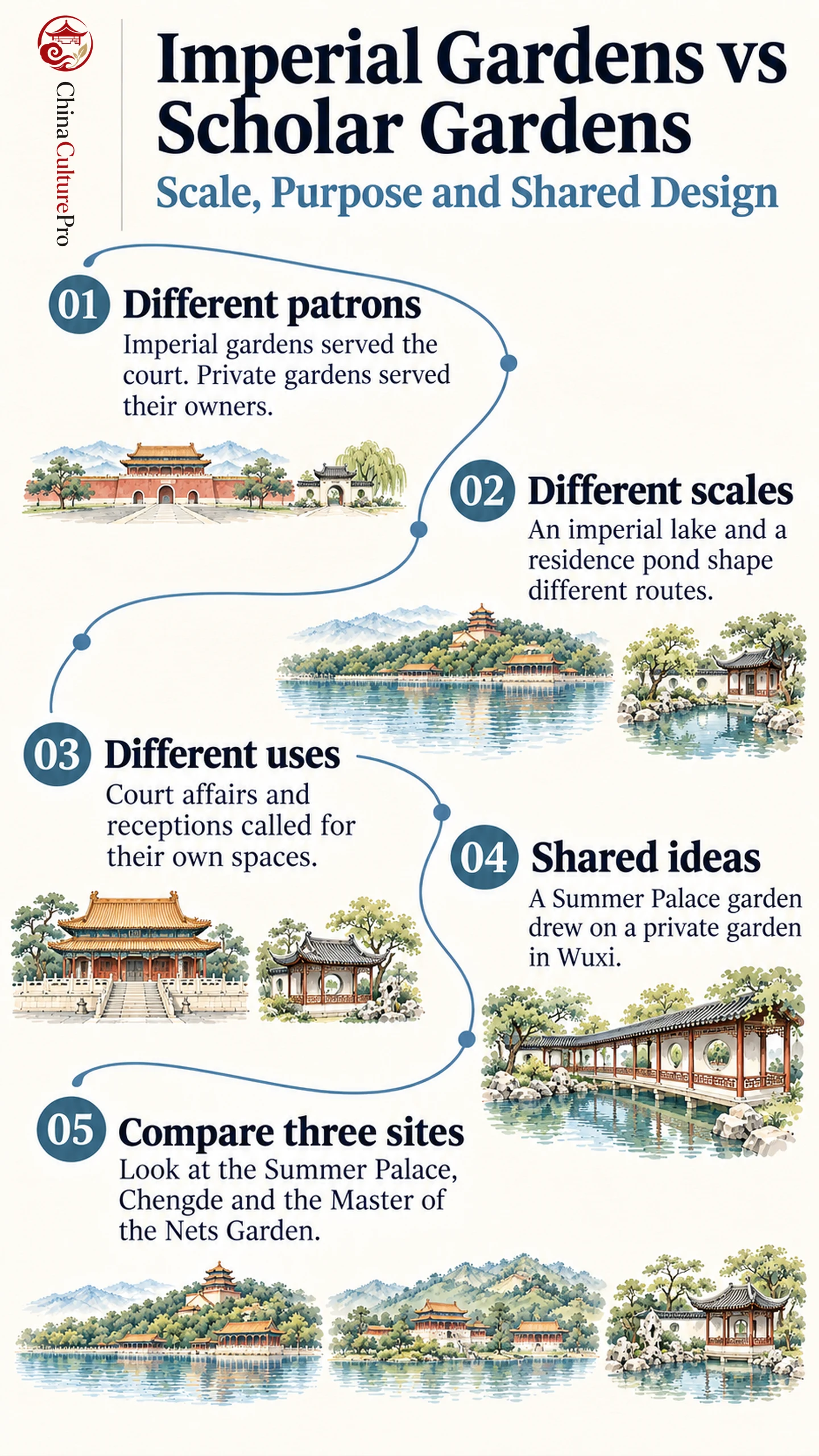
- The patron shaped what the garden had to do. At Chengde Mountain Resort (承德避暑山庄, Chéngdé Bìshǔ Shānzhuāng), Qing emperors also conducted state affairs and received visitors. [5]
- Scale shaped the route. An imperial lake could divide an estate into large zones. A domestic pond could bring several rooms into view. [1][4]
- Design ideas moved between settings. A small garden at the Summer Palace drew on a private garden in Wuxi. [6][7]
Compare who commissioned each garden and the activities its buildings supported.
A lake can be the center of an imperial estate or a pond can organize a few rooms in a city residence. The difference comes into focus when you see who used the garden, what they did there and how far they needed to move.
Who Commissioned the Gardens
Imperial and scholar gardens are ways of talking about patronage and use within the wider history of Chinese gardens. Qing rulers could commission complexes with residences, halls, temples, waters and extensive grounds. The site could accommodate many people and uses that a single household would have little reason to provide for. Gardens associated with the court are closely tied to Chinese palace architecture when halls and residences share the same landscape. [1][5]
Scholar gardens were associated with the ideals and activities of the literati. They could express a patron’s taste through the views, names and settings they offered. Owners of Suzhou gardens included people with different occupations and backgrounds. The label describes a cultural tradition rather than a rule about everyone who owned a private garden. [2][3][8][9]
Private ownership also left room for change. A garden could pass to another family and acquire a new name or layout. The site now called the Master of the Nets Garden has an earlier history and underwent substantial reworking in the Qing period. [4]
Scale and the Shape of the Landscape
Kunming Lake and Longevity Hill give the Summer Palace its large-scale framework. From a lakeside route, features across the water can remain in view for some time. The position of a building against the hill can also make it legible across a longer distance. At Chengde, lakes, slopes, woods and open land create different areas within one estate. [1][5][7]
In many Suzhou gardens, the available space was much tighter. At the Master of the Nets Garden, waterside buildings sit near one another and a visitor can take in parts of the opposite bank while still feeling close to the architecture. The Humble Administrator’s Garden has a broader pond-centered middle section, showing that private gardens also came in different sizes. [2][4][8]
In both settings, Chinese garden design can use water to open a view. The lake and hill give a large estate a framework for several routes. A small pond can give closely spaced rooms a shared outlook. [1][2][4]
What People Did in Each Setting
The Summer Palace had spaces for political and administrative work, residence, spiritual life and recreation. The East Palace Gate formed the approach to the Hall of Benevolence and Longevity, the main building in the administrative area. Separate residential buildings stood close to the hill, and roofed corridors linked these areas to other parts of the estate. The same complex could support formal arrival and quieter stretches of looking across the lake. [1][7]
At Chengde, emperors including Kangxi and Qianlong used the resort in summer and autumn to handle government and military affairs and receive leaders and envoys. Temples in different architectural styles form part of the larger landscape. Moving the court out of the capital also moved some of its work to the resort. [5]
A private garden served a household and its guests. A room facing water could provide a place to talk or look at paintings, and a pavilion could offer a view during a gathering. The scale of a scholar’s study brings the comparison down to one room and its objects. Rooms facing water and places to stop outdoors gave gatherings several settings in one residence. [3][4][9]
Where the Two Traditions Overlap
The Summer Palace includes the Garden of Harmonious Interests (谐趣园, Xiéqù Yuán), a compact garden within the imperial grounds. Beijing’s parks authority identifies Jichang Garden in Wuxi as its model. It originally took its name from Huishan, the area in Wuxi that contains Jichang Garden. After a rebuilding in 1811, the imperial garden received its current name. Its small scale and southern garden features show that court patronage could support a design with the intimacy of a Jiangnan garden. [1][6][7]
Both kinds of place could use Chinese pavilions to create places to pause and could use trees or built openings to frame the view. A view can also incorporate scenery beyond the area immediately around a building. That use of borrowed scenery can operate at the scale of a courtyard or a larger landscape. Shared techniques can serve different audiences and purposes. [1][2][3][7]
Three Gardens Compared
| Garden | Setting and historic uses | What to look at |
|---|---|---|
| Summer Palace | Qing imperial residence and government, ceremonial and scenic spaces | How Kunming Lake and Longevity Hill connect widely spaced buildings |
| Chengde Mountain Resort | Qing seasonal residence, administration and diplomatic reception | How lakes, open land and woodland form distinct parts of one estate |
| Master of the Nets Garden | Suzhou residence with spaces for leisure and company | How a compact central pond relates to rooms and covered walks |
An imperial site may contain several kinds of landscape within one boundary. A Suzhou residence can create a sequence of views with much shorter distances. The comparison becomes clearer when you look at the size of the view and then ask what people did at the place from which it was seen. [1][5][2][4]
FAQs About Chinese Imperial and Scholar Gardens
Could an imperial garden contain a small private-style garden?
Yes. The Garden of Harmonious Interests within the Summer Palace took inspiration from the Jichang Garden in Wuxi. [6][7]
Were all private Chinese gardens scholar gardens?
Private gardens belonged to people with different occupations and interests. The label scholar garden reflects a connection with the activities and ideals of literati culture. [2][3][9]
Which is a good example of a scholar garden in Suzhou?
The Master of the Nets Garden gives an example of a compact residence with a pond, waterside buildings and several viewpoints linked by short routes. [2][4]
Sources
[1] UNESCO World Heritage Centre. Summer Palace, an Imperial Garden in Beijing
[2] UNESCO World Heritage Centre. Classical Gardens of Suzhou
[3] The Metropolitan Museum of Art. Chinese Gardens and Collectors’ Rocks
[4] Suzhou Bureau of Gardens and Landscaping. Master of the Nets Garden
[5] UNESCO World Heritage Centre. Mountain Resort and Its Outlying Temples, Chengde
[6] Beijing Municipal Administration Center of Parks. The Garden of Harmonious Interests at the Summer Palace
[7] Beijing Municipal Administration Center of Parks. Summer Palace
[8] Suzhou Bureau of Gardens and Landscaping. The Humble Administrator’s Garden
[9] The Metropolitan Museum of Art. Chinese Gardens