
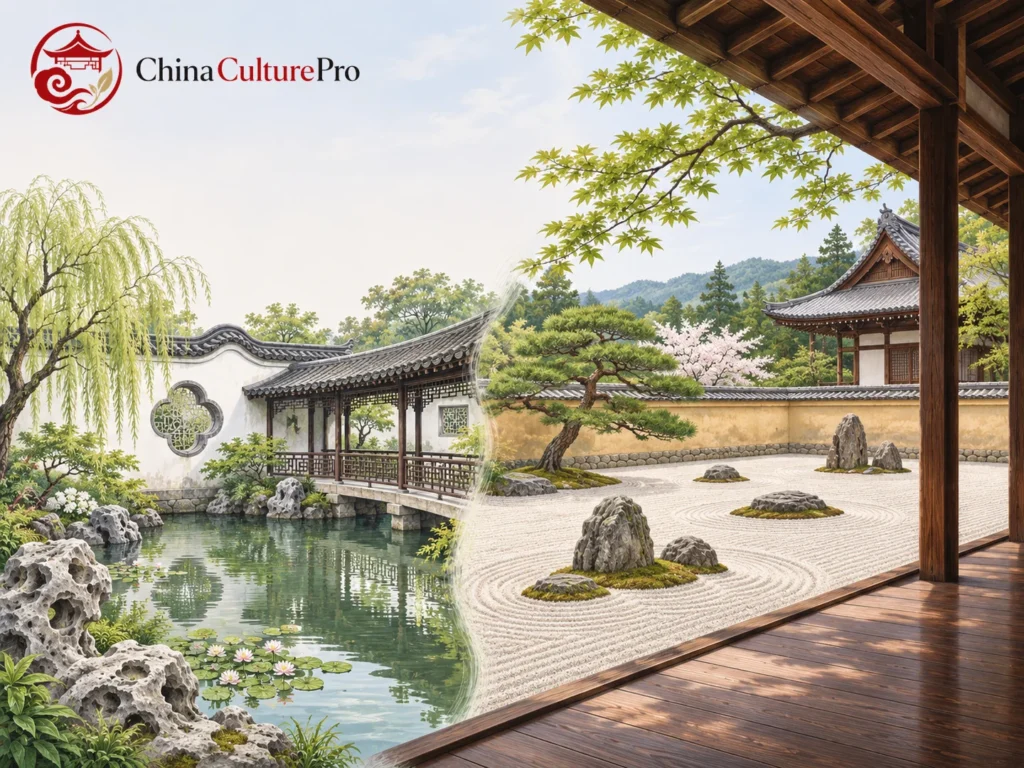

Quick Answer: How Do Chinese and Japanese Gardens Differ?
Compare gardens built for different uses. A Suzhou residence can offer changing views of a pond, a Kyoto temple can concentrate attention on rocks, and a Kyoto villa can reveal water and pavilions along a walking route. [1][2][3][4][5][6]
- A Suzhou residence garden can turn a small pond into a changing landscape. At the Master of the Nets Garden (网师园, Wǎngshī Yuán), passages change the view. [1][2]
- Ryōan-ji’s rock garden is designed for viewing from the temple hall. Fifteen stones sit in a field of gravel. A separate pond garden lies within the temple grounds. [3][4]
- Katsura Imperial Villa is a Japanese strolling garden. Its winding pond edge and teahouses create a series of places to pause and look. [5][6]
- Borrowed scenery (借景, jièjǐng) appears in both traditions. A designer can bring a pagoda or a mountain beyond the garden boundary into a view. [7][8]
Look first at where people stand or move. The design comes into focus when you follow a view from that position.

Picture three different moments in a garden: a glimpse of water from a covered walk, a group of stones seen from a veranda, and a pond that comes into view as you round a bend. Each scene asks you to look in a different way.
Suzhou: A Garden Unfolds Around a Pond
In Suzhou, private residence gardens brought landscapes into an urban setting. The Master of the Nets Garden is compact enough for the central pond to tie its principal spaces together. Buildings, rocks and planting gather along the banks, and openings let people see between one part of the garden and the next. [1][2]
The pond gives the eye somewhere to go even when a path runs close to a wall. From a waterside building, the facing bank and its roofline form a single view. Turn a corner or step under a roof and the angle changes. The same rock or tree can come into the foreground or fall out of sight. This is one of the ways the classical gardens of Suzhou use buildings and routes to make a limited area feel varied. [2][9]
The wider Chinese garden tradition includes private retreats and imperial parks. The features of one residence illustrate how Chinese garden design can work at household scale. Here the key relationship is between the edge of the water and the different places from which it is seen. [1][2]
Ryōan-ji: A Dry Landscape From the Veranda
The rock garden at Ryōan-ji in Kyoto puts most of its action inside a single rectangle. Fifteen rocks sit in five groups on light gravel, with earthen walls enclosing three sides. The veranda of the abbot’s quarters gives the viewer a long edge from which to take in the arrangement. From there, the gaps between groups carry almost as much weight as the stones themselves. [3][4]
The Japanese term karesansui (枯山水) describes a dry landscape garden. At Ryōan-ji, the absence of a pond inside the rectangle allows changes in the size, shape and spacing of the stones to come forward. You can shift along the viewing edge and see how one grouping overlaps another. Interpretations that see islands in water are one way to read the space. The spaces between groups also make it possible to appreciate the composition without identifying a subject. [3][4]
Rocks also mattered to the makers of Chinese gardens, as well as to collectors of Chinese scholars’ rocks. The better comparison asks how a particular rock is used. A Suzhou rock might project over water or mark the edge of a path. At Ryōan-ji, rocks of different heights and widths divide the expanse of gravel. Within the same temple grounds, a separate garden is organized around a real pond. [2][4]
Katsura: A Japanese Garden Built for Strolling
Construction of Katsura Imperial Villa began in the early seventeenth century as a retreat for a branch of the imperial family. A large pond lies between the main buildings and several garden pavilions. The shoreline bends, so a route along it keeps some parts of the garden out of sight until a walker reaches the next vantage point. [5][6]
At the Shōkintei teahouse, visitors look across the pond toward the main buildings and the Gepparō pavilion. A carefully arranged group of stones in the water evokes Amanohashidate, a famous coastal landform. That small scene adds a second scale to the view. Someone looking across the villa’s pond could also recognize an image of a faraway landscape. [10]
Guests could enjoy tea gatherings, boating and moon viewing. The shape of the route and the choice of stops reflect some of these uses. A visitor coming from a dry temple garden might notice that Katsura shares more with the Suzhou residence in how it makes the view change as people move. Each garden still has its own setting, scale and social purpose. [2][5][6]
Borrowed Scenery and Framed Views
A frame picks out part of a scene. A window can frame a tree already inside the garden, and a veranda can direct attention toward a rock arrangement. Borrowed scenery incorporates a view from beyond the grounds in the composition. The Japanese reading of the same characters is shakkei. The Ming designer Ji Cheng (计成, Jì Chéng) discussed borrowing in The Craft of Gardens (园冶, Yuányě). [9][11][12]
The North Temple Pagoda is a documented feature in a borrowed view from Suzhou’s Humble Administrator’s Garden. The Lower Villa garden at Shugakuin in Kyoto uses a mountain range as a background. In both cases, a feature outside the property enters a view from within. The stones at Katsura that evoke Amanohashidate do something different. They represent another place through an arrangement made inside the garden. [7][8][10]
Look for the viewing position before you look for a symbol. A porch, gap in a wall or bend in a walk often explains why a distant feature comes into focus from one place. At smaller scales, garden paths and windows can create sequences out of foreground details without a distant landmark. [9][6][12]
Three Gardens Compared
| Garden | Historical setting | Main landscape in this example | How you encounter the view |
|---|---|---|---|
| Master of the Nets Garden | Private Suzhou residence | Central pond and a closely spaced group of buildings and banks | Move among passageways and waterside rooms |
| Ryōan-ji rock garden | Kyoto Zen temple | Stone groups and gravel inside a walled rectangle | Look across the dry garden from the hall’s veranda |
| Katsura Imperial Villa | Kyoto imperial-family retreat | Irregular pond, curving shoreline and pavilions | Follow a route from one pond view to another |
Comparing the two Kyoto sites reveals a difference between a fixed viewing edge and a route that changes the scene. Comparing Katsura with the Suzhou residence shows how a similar design question can arise in different settings: how do you give the same water a different character at each stop? The contrast between Chinese imperial and scholar gardens offers another way to see how patronage and purpose shape a landscape. [1][2][3][4][5][6]
FAQs About Chinese and Japanese Gardens
Do Japanese gardens always use gravel instead of water?
Many Japanese gardens have real ponds. Katsura has a large pond and a strolling route, and Ryōan-ji has a separate pond garden in addition to the dry garden beside its abbot’s quarters. [4][5]
Do Chinese and Japanese gardens both use borrowed scenery?
Yes. Suzhou’s Humble Administrator’s Garden uses an outside pagoda in a view, and the Lower Villa garden at Shugakuin incorporates a mountain range beyond its grounds. [7][8][12]
Can you walk through both kinds of garden?
Movement is part of the design in many gardens in both traditions. A path around Katsura’s pond and passages in the Master of the Nets Garden reveal a series of views. A specific composition such as Ryōan-ji’s rock garden can instead have a designated viewing edge. [2][3][6]
Sources
[1] UNESCO World Heritage Centre. Classical Gardens of Suzhou
[2] Suzhou Bureau of Gardens and Landscaping. Master of the Nets Garden
[3] Nara National Research Institute for Cultural Properties. Garden at the Abbot’s Quarters of Ryōanji Temple
[4] UNESCO World Heritage Centre. Historic Monuments of Ancient Kyoto
[5] Imperial Household Agency. Visitor Information: Katsura Imperial Villa
[6] Imperial Household Agency. Kyoto Imperial Palace and Other Imperial Palaces and Villas in Kyoto
[7] Shanghai Landscaping and City Appearance Administration. Borrowed Scenery in the Humble Administrator’s Garden
[8] Imperial Household Agency. Shugakuin Imperial Villa
[9] Suzhou Bureau of Gardens and Landscaping. Architecture in Garden Design
[10] Imperial Household Agency. Shōkintei
[11] Stanford Encyclopedia of Philosophy. Aesthetics in Chinese Philosophy: Painting and Calligraphy
[12] Nara National Research Institute for Cultural Properties. Borrowed Scenery