


Quick Answer: What Is Borrowed Scenery in a Chinese Garden?
Borrowed scenery (借景, jièjǐng) lets a garden take in something beyond its grounds, such as a pagoda, a mountain or water outside a wall. The designer works with the viewpoint and with what hides or reveals the feature. The Ming designer Ji Cheng (计成, Jì Chéng) also discussed seasonal and directional forms of borrowing in The Craft of Gardens (园冶, Yuányě). [1][2][3][4][5]
- A borrowed feature becomes part of a composed view. It might rise above a line of garden trees or appear across a foreground pond. [1][2]
- Framing and borrowing can overlap. A window can frame an object inside a garden or bring something outside into the scene. [1][4]
- Borrowing can work across short distances. Canglang Pavilion in Suzhou takes in water next to the garden’s edge. [6]
Look for the place where the garden and the farther scene appear together.
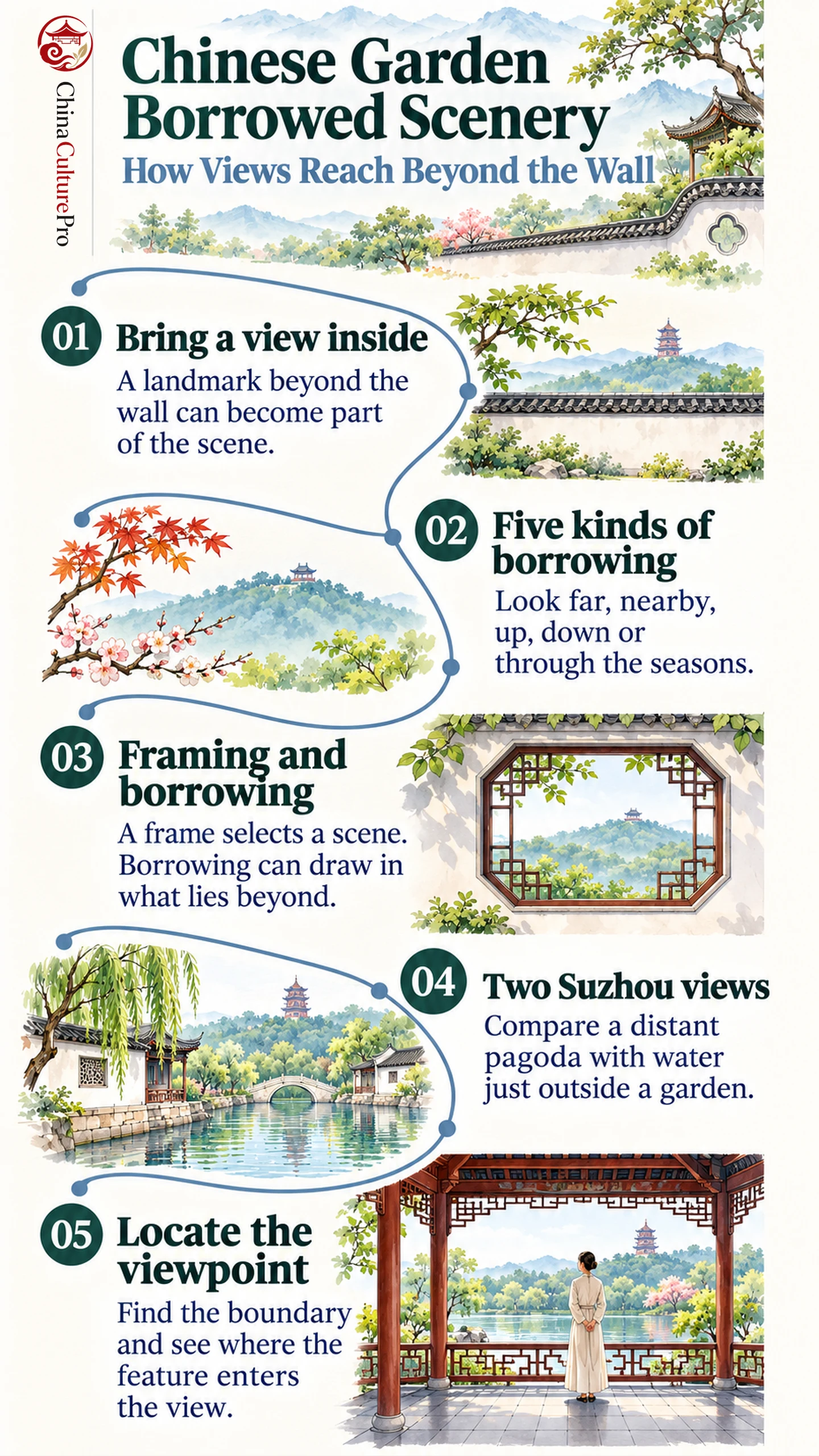
From inside a garden, a wall may disappear behind foliage while a pagoda roof remains in view. The landmark can seem close to the pond even when it stands well beyond the grounds. That impression starts with the place from which you look.
What a Garden Can Borrow
In Chinese garden design, a view can extend farther than the land that belongs to the garden. A pavilion or opening gives a particular place to look. Nearer trees and walls can hide the base of a distant feature or leave its upper part in view. The garden’s own elements then appear in the same composition as a landmark outside. [1][2][3]
The effect does not require a visible opening in a wall. From an open terrace, a line of roofs or trees can provide a low edge for the scene. A bend in a walk can hide the same feature until you reach a better view. Garden paths and windows can help direct this experience, but the relationship between the viewing position and what is borrowed matters most. [1][4][5]
Ji Cheng’s Five Ways of Borrowing
Ji Cheng wrote about borrowing in the seventeenth century. His garden treatise ends with a discussion that makes room for directions and seasons as well as fixed scenery. Scholars have traced changes in how the term was used. A present-day description centered on external landmarks captures one familiar use of the idea. [3][4][5][7]
- Distant borrowing draws on a feature farther away, such as the outline of hills.
- Nearby borrowing takes in elements close to the garden, such as a neighbor’s trees.
- Looking upward can bring the sky or birds into view.
- Looking downward attends to what lies below, such as water and fish.
- Seasonal borrowing makes use of changes that arrive with a season.
The last three categories show how attention can shift without adding anything to the garden. A sky can change during the day. The time when a tree flowers or a stand of garden plants changes color can affect which part of a scene catches your attention. [4][5]
Borrowed Scenery and Other Framed Views
A frame limits what you see. A moon gate might crop a planted courtyard already inside the garden. If a view instead connects a foreground and a hill beyond the property, it can be both framed and borrowed. The same idea appears in the Lower Villa at Shugakuin, a Japanese example where an external mountain range becomes the background. [1][8][4]
A garden can also suggest a place by building an image of it. At Japan’s Katsura Imperial Villa, a stone arrangement near the Shōkintei teahouse evokes Amanohashidate, a coastal landmark. The coast itself is elsewhere. This distinction matters when comparing Chinese and Japanese gardens. Both a borrowed view and an allusion can give a scene a larger geographical reach, but only one brings an actual outside feature into the view. [8][9]
Two Borrowed Views in Suzhou
At the Humble Administrator’s Garden, the North Temple Pagoda is a documented feature in a borrowed view. The pagoda stands beyond the grounds, but its upper portion can join the foreground vegetation in a single scene. Published descriptions record the relationship at a particular time. New growth or changes outside the garden can alter the sightline. [2][5]
At Canglang Pavilion the borrowed feature is much closer. Water runs alongside the garden outside its boundary, with a roofed gallery along the edge. The view can take in both the outside bank and parts of the garden behind the gallery. The water links these layers visually without bringing them inside the wall. These Suzhou gardens show how far a view can reach, from the garden’s immediate edge to a landmark across the city. [1][6]
How to Recognize the Viewpoint
Locate the part of the garden that gives you the view, then trace its foreground. A platform or an opening might line up with a distant feature. Look for what marks the garden’s boundary. A tree or wall can obscure it, so a landmark may appear to be closer than it is. [1][2][4]
A useful test is to change position. If the feature comes into focus from a particular stop, note what hides or reveals it along the approach. Chinese pavilions can supply places where a view settles into place. Garden plans, old images and site records help distinguish an intended view from one that happens to be visible today. [1][2][4][7]
FAQs About Borrowed Scenery
Does borrowed scenery need a window?
A window can frame a borrowed view, but a veranda, terrace or gap between trees can also bring an outside feature into the scene. [1][4][5]
Can borrowed scenery include something close by?
Yes. Nearby borrowing can use a neighboring tree or water at the garden’s edge. It works through the relationship between the viewpoint and the feature. [6][5]
Is jiejing the same as shakkei?
Shakkei is the Japanese reading of 借景 and can refer to incorporating scenery beyond a garden. Ji Cheng’s discussion of jiejing also takes in changing effects such as the sky and seasons. [8][4][5][7][10]
Sources
[1] Suzhou Bureau of Gardens and Landscaping. Architecture in Garden Design
[2] Shanghai Landscaping and City Appearance Administration. Borrowed Scenery in the Humble Administrator’s Garden
[3] Stanford Encyclopedia of Philosophy. Aesthetics in Chinese Philosophy: Painting and Calligraphy
[4] Wybe Kuitert. Borrowing Scenery and the Landscape That Lends
[5] Chris Paton, The Textbook of Architecture. Borrowed Scenery
[6] Suzhou Bureau of Gardens and Landscaping. The Inscription at Canglang Pavilion
[7] Hongjun Zhou, Ryohei Ono, and Akio Shimomura. The Evolvement and Variety of the Term of Borrowed Scenery in Chinese Gardening
[8] Imperial Household Agency. Shugakuin Imperial Villa
[9] Imperial Household Agency. Shōkintei
[10] Nara National Research Institute for Cultural Properties. Borrowed Scenery