

Quick Answer: What Is Huanxian Daoqing Shadow Play?
Huanxian Daoqing shadow play (环县道情皮影戏, Huánxiàn Dàoqíng Píyǐngxì) is a theater tradition from Huan County in eastern Gansu. It combines flat, articulated figures on a lit screen with Daoqing (道情, dàoqíng), a local singing and storytelling tradition. A lead performer can move the figures and voice several parts.[1][2][6]
- Screen: Light from behind makes the cut and colored figures visible to the audience.[1][6]
- Voice: A group of musicians can answer the lead singer.[1][2]
- Repertoire: Recorded plays include both familiar stories and regionally transmitted works.[1][5]
Watch the screen and listen for changes of voice. The audience can hear a change of character before the figure has moved very far.

The audience sees a figure turn or raise a hand while the person moving it stays behind the screen. Listening for a reply from the musicians adds another way to follow the scene.
What the Puppeteer and the Audience See
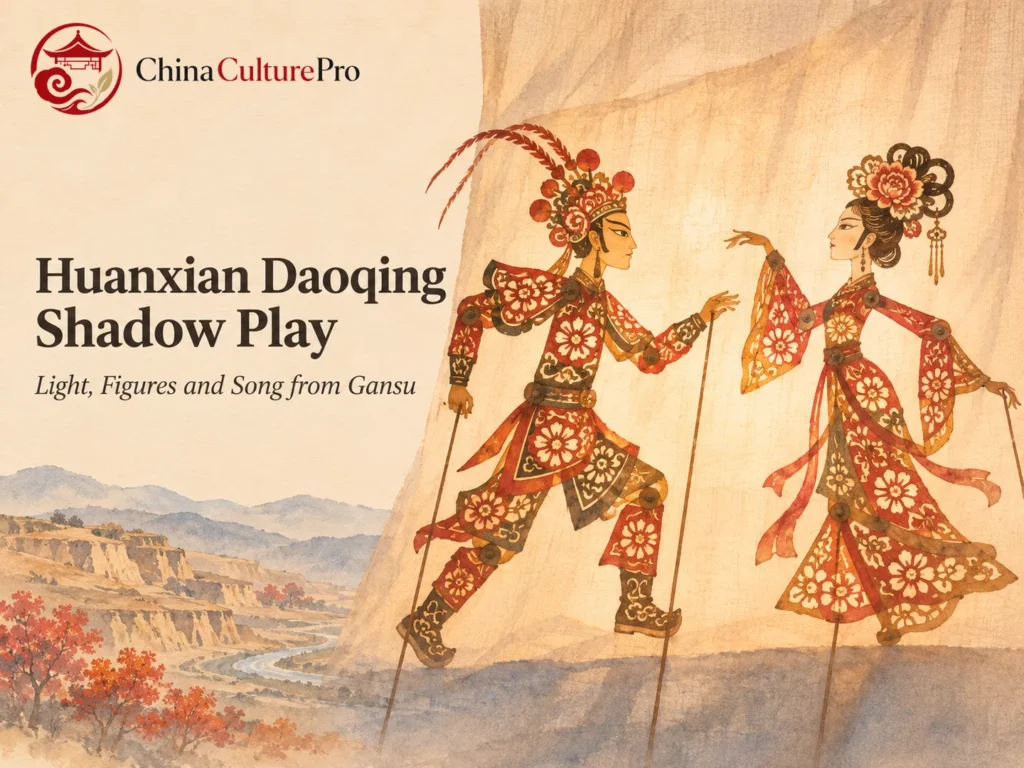
In Chinese shadow puppetry, performers work flat figures with rods behind a translucent screen. Light passes through parts of the colored surface and makes the outline and cut details visible. Surviving Huan County figures include pieces from the Qing dynasty with finely carved details.[1][6]
In a traditional Huan County troupe, one lead performer can operate the figures and supply the voices for the dialogue and songs. Musicians behind the screen handle the accompaniment and vocal responses. To follow the action, watch where the figure turns and listen for the shift in how the lead performer voices its part.[1][2]
How Daoqing Singing and the Chorus Work
The group response is known locally as mahuang (嘛簧, máhuáng). Listen for the point at which the lead line gives way to a fuller sound from the responding musicians.[1][2]
The traditional ensemble can include a four-string instrument, a tubular yugu drum (渔鼓, yúgǔ), and jianban (简板, jiǎnbǎn), percussion boards used to mark time. Some tunes have measured pacing and others move more rapidly. The pace can change the space between a sung phrase and the next movement.[1][2][3]
What Xie Changchun Changed
Xie Changchun (解长春, Xiè Chángchūn) helped reshape the local form around the end of the Qing dynasty. He adapted stories, drew on local tunes and added instruments, including a four-string instrument.[1][3][4]
Students including Jing Nailiang (敬乃梁, Jìng Nǎiliáng) went on to form troupes of their own. Their work helped the repertoire circulate beyond Xie’s own performances.[1][3]
How the Repertoire Has Been Recorded
A 2023 audiovisual collection included 29 plays, among them The Legend of the White Snake (白蛇传, Bái Shé Zhuàn) and White Dog Scroll (白狗卷, Báigǒu Juàn). A reader who knows the White Snake story from another genre can use it to hear the local singing and watch how the figures carry familiar action.[5]
In 1987, a Huan County troupe including Shi Chenglin (史呈林, Shǐ Chénglín) toured Italy, with performances in cities including Rome, Milan and Venice.[4]
FAQs About Huanxian Daoqing Shadow Play
Are the figures suspended by strings?
The shadow figures are worked with rods behind a lit screen. Marionettes are a different kind of puppet theater in which figures hang from strings.[1][6]
Is Huanxian Daoqing listed by UNESCO on its own?
Huanxian Daoqing shadow play entered China’s national heritage list in 2006. UNESCO inscribed the broader element Chinese shadow puppetry in 2011.[1][6]
Sources
[1] China Intangible Cultural Heritage Network. Huanxian Daoqing Shadow Play
[2] China National Radio. Shadow Puppetry by Lamplight
[3] China National Radio. Daoqing Shadow Play in Huan County
[4] Gansu Cultural Expo. Huanxian Daoqing Shadow Puppetry
[5] China Gansu Net. Publication of the First Huanxian Daoqing Shadow Play Audiovisual Collection
[6] UNESCO. Chinese Shadow Puppetry