

Quick Answer: What Are Huaiyang Ninigou?
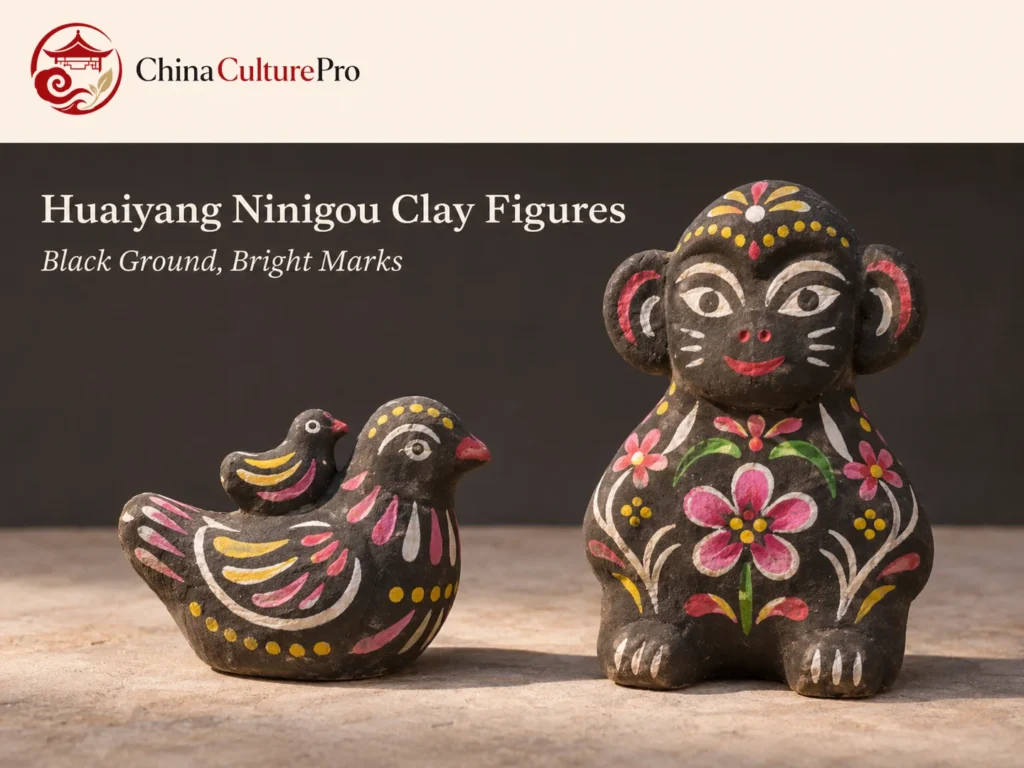
Huaiyang ninigou (淮阳泥泥狗, Huáiyáng nínígǒu) are clay figures from Huaiyang District in Zhoukou, Henan. The name covers dogs, birds and composite figures with features from more than one creature. They are known for colored marks on a black ground and their connection with the Taihao Mausoleum temple fair. [1][2][4]
- Shape: A figure can combine a human head and an animal body.
- Surface: White lines and colored dots stand out against the dark clay finish.
- Sound: Many traditional figures have a small opening that can be blown to produce a call. [1][3][4]
Look first at the body and then at the marks. Either can help identify the kind of figure.

On a ninigou figure, a few white curves can make a face stand out. A line of red or yellow dots follows the back or flank. Seen together with the silhouette, those marks give a small clay object a recognizable expression.
Clay, Black Ground and Painted Color
Xu Shuzhang describes working with fine local yellow clay. His account distinguishes hand shaping and molding according to the figure’s shape and size. A workshop account records preparing the clay, forming the piece, making openings where needed and adding color. The national register describes drying the shaped clay before darkening it in a dye bath. The black ground becomes part of the picture when the lighter colors go on. [1][3][5]
The register describes a traditional painting tool made from a sorghum stalk. White can establish the main outlines before red, yellow, green and pink marks build up the pattern. Xu has also used a brush. The district account names leaf, triangle and sun patterns. A series of dots can follow a curve on the flank and make its direction visible. [1][2][3]
Animal Shapes and Whistle Openings
The national register names a nine-headed bird and a dog with a human head. A report on Xu’s work describes a human-faced monkey whose small limbs leave attention on the face and torso. The names tell a viewer which details matter in forms that can look unfamiliar at first. [1][3][4]
Traditional figures with a sound opening can make a note when someone blows into it. The maker leaves the opening in the clay body before finishing it. The sound can be clear or low, depending on the form, while painted marks define the eyes or outline of the figure. [3][4]
Why the Taihao Mausoleum Fair Matters
The Taihao Mausoleum temple fair in Huaiyang is associated with honoring Fuxi as a culture ancestor. Local accounts also connect the figures with Nüwa. Pilgrims have acquired the figures as offerings or tokens of a wish for protection and good fortune. Local accounts also associate some shapes and marks with hopes for children and family continuity. The national register cites a local gazetteer for the fair’s traditional span from the second day of the second lunar month to the third day of the third month. [1][2][4]
In March 2026, local reporting recorded ninigou at stalls by Fuxi Cultural Square and demonstrations of the craft during the fair and cultural festival. The city’s report describes people joining in the making at a heritage display. The fair also gave visitors a chance to see different finished forms at the stalls. [6][7]
How Makers Pass On the Craft
Xu learned from his grandfather and father and later worked with his son Xu Pin. In his account, one of the first forms he tried was a clay monkey. People’s Daily reported that Xu brought materials into classrooms. The same report describes a different approach by Shao Bo and other makers, using a clay body suited to firing. That version adds a firing stage after the shaped clay dries. [3][5]
FAQs About Huaiyang Ninigou
Are ninigou all shaped like dogs?
Ninigou is a collective name. The Huaiyang tradition includes dogs, birds, fish and composite animals, such as the nine-headed bird. [1][2][4]
Are all Huaiyang ninigou fired in a kiln?
The national record describes drying, dyeing and painting traditional clay forms. A People’s Daily report describes Shao Bo and other makers adapting the craft to include kiln firing with a different clay body. [1][5]
When were Huaiyang ninigou nationally listed?
Huaiyang ninigou joined China’s national intangible cultural heritage list in 2014 as an extension of the clay sculpture entry. [1]
Sources
[1] China Intangible Cultural Heritage Network. Clay Sculpture: Huaiyang Ninigou
[2] Huaiyang District People’s Government. Ninigou of Huaiyang
[3] China National Radio. Xu Shuzhang and the Ninigou Craft
[4] People’s Daily Overseas Edition. Huaiyang’s Painted Clay Toys
[5] People’s Daily. Small Clay Figures and a Local Trade
[6] Li Ruicai, Zhoukou Daily via Zhoukou Municipal Government. Third Zhoukou Fuxi Cultural Tourism Festival
[7] Wang Ying and Wang Xiangqian, Henan Daily. Taihao Mausoleum Fair in 2026