
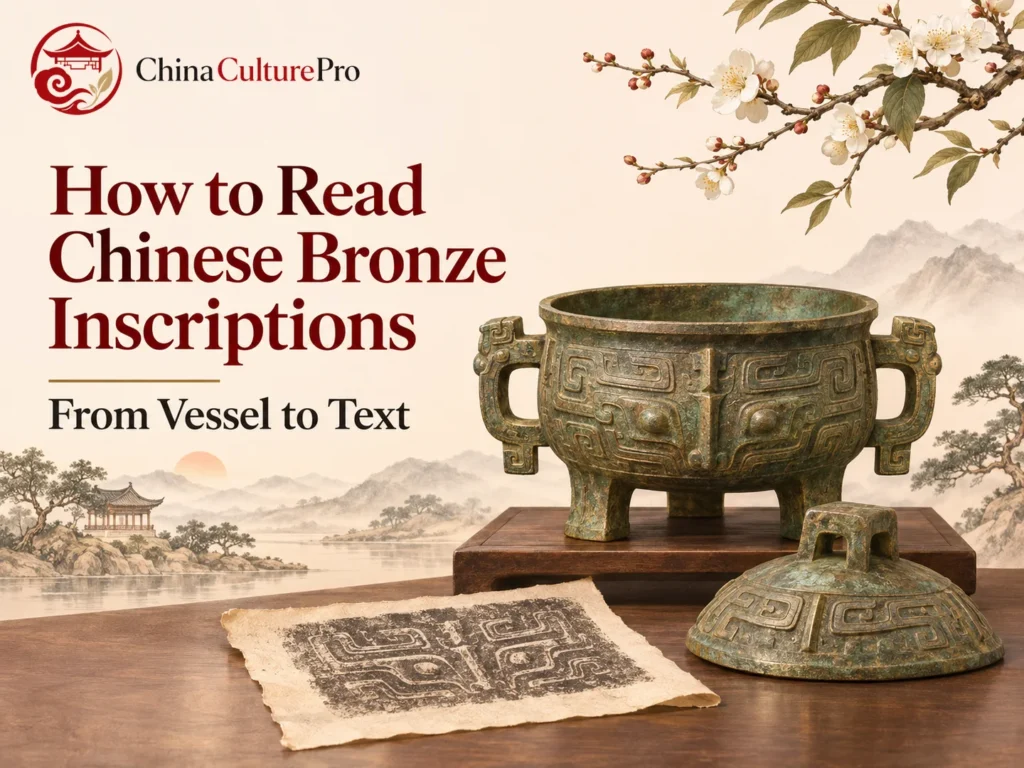

Quick Answer: How Do You Read a Chinese Bronze Inscription?
Chinese bronze inscriptions (金文, jīnwén) can record a dedication, a royal command or the reason a vessel was cast. Start with the museum’s record for the exact object, which should tell you where the writing is and may give a rubbing, a transcription or a translation.[1][2][3]
- Location. Look for writing on the inside, under the lid or in another spot shown in the record.[1][2]
- People. Keep the person who commissioned the vessel, the person it honors and anyone quoted in the text separate.[1][2]
- Evidence. Compare the image, rubbing and transcription. They preserve different aspects of the text.[2][4]
A translation gives one reading of the inscription. It helps to keep uncertain names, damaged signs and disputed readings visible in your notes.[3][4]

Writing on a bronze can be easy to miss when a photograph shows only the outside. A second view of a lid or interior may reveal the words that tell you who ordered the piece and why it was made. Start by matching the inscription to the object before trying to read individual characters.
Read a Bronze Inscription in Four Steps
- Identify the vessel and text location. Save the museum name and inventory number. Check which surface the catalog identifies and whether the lid also carries text.
- Match the image to the reading. Open the image or rubbing alongside the catalog transcription. Keep the order of the lines used by the catalog and note any missing or unclear signs.
- Identify who does what. In the translation, mark who speaks, who commissions the vessel and who receives the honor, gift or dedication. These roles can belong to different people.
- Write a bounded summary. Name the event or dedication the text records and keep the catalog’s uncertainties. Give the object date separately from any date stated in the text.
The object title can combine information from the inscription with a form name assigned by the catalog. If the title, date and credit line are unclear, start with how to read a Chinese museum label. The distinction between a vessel’s shape and its inscription is also useful when comparing Chinese bronze vessels.[1][2]
Three Inscriptions, Three Different Jobs
The first example is a grain serving vessel called a gui (簋, guǐ). An early ninth-century BCE example carries the same twelve-character inscription inside the vessel and lid. The catalog reads it as a dedication made by the Earl of San for Ji of Zhe. A reading note should record the commissioner and the recipient separately, and say that the inscription occurs twice on the surviving set.[1]
The Ding Cauldron of Duke Mao is a ding (鼎, dǐng), a type of bronze cauldron. In this case a much longer inscription records a royal charge to govern and gifts presented to the Duke. The vessel commemorates the honor for descendants. That narrative supplies a different kind of historical evidence from a short dedication on two matching surfaces. Related Chinese bronze ding can vary in purpose and inscription length.[2]
The He Zun, an early Western Zhou wine vessel of the zun (尊, zūn) form, records royal speech and a reward. Its text includes an early expression corresponding to 中國 (Zhōngguó), read in context as the central lands or center of the realm. Translating it as a modern country name would give the ancient statement a meaning it did not have. The timing and interpretation of some passages remain debated.[3]
| Object | What the reading emphasizes |
|---|---|
| Earl of San gui | Dedication and matching text on the vessel and lid. |
| Ding Cauldron of Duke Mao | Royal charge, gifts and commemoration. |
| He Zun | Royal speech and an early reference to the central lands. |
What a Rubbing and a Transcript Leave Out
A rubbing records the appearance of a surface on paper. A museum may catalog the rubbing as a separate object with its own identifier, as it does for the Duke Mao example. Its catalog transcription helps readers follow the signs, but the inscription on the bronze, the paper rubbing and a modern transcription are three different records.[2][4]
Reading reconstructed characters can hide features that are visible in the ancient forms. If the source offers alternate readings or bracketed reconstructions, keep those distinctions. A separately dated rubbing can preserve an ancient text while the sheet itself comes from a later period.[3][4]
FAQs About Chinese Bronze Inscriptions
Why is the writing often inside a bronze?
The interior or underside of a lid could carry a dedication or other record. Check the particular object entry for location. The Earl of San gui has matching text inside both the vessel and lid.[1]
Does a person named in the text identify the caster?
A named person could be the patron, recipient, ruler or ancestor. The text may identify who commissioned the vessel without recording who physically cast it.[1][2]
Can modern Chinese characters replace the original forms?
A transcription helps you follow the proposed reading. Keep a reference to the rubbing or object photograph when shape, damage or an uncertain identification matters.[3][4]
Sources
[1] The Metropolitan Museum of Art. Grain serving vessel, object 1988.20.3a, b
[2] National Palace Museum. Ding Cauldron of Duke Mao
[3] National Museum of China. He Zun and the bronzes of Baoji
[4] National Palace Museum. Rubbing of the Mao Gong Ding