

Quick Answer: What Are Dai Bamboo Houses?
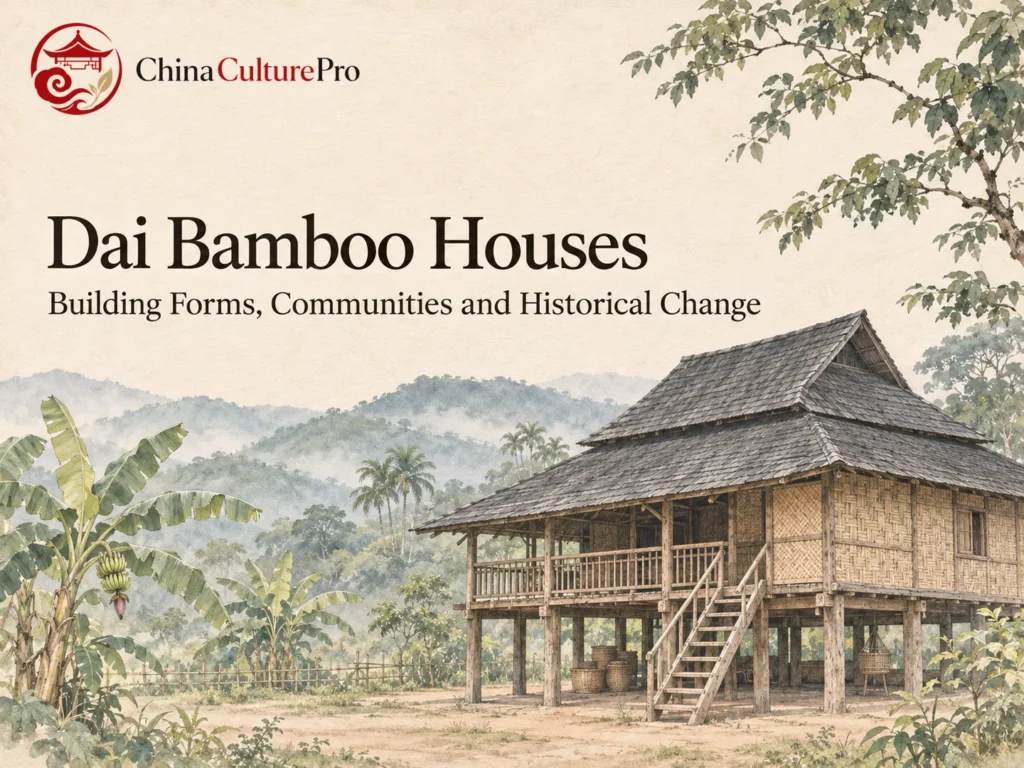
Dai bamboo houses (傣族竹楼, Dǎizú zhúlóu) are raised dwellings associated with Dai communities in Xishuangbanna (西双版纳, Xīshuāngbǎnnà), southern Yunnan. The family lives on a raised floor above a sheltered space between the posts.[6]
- Frame: Houses may use timber for their main supports and bamboo for floors, walls and other parts.[1]
- Roof: A steep pitch sheds rain, and the space underneath the house keeps living areas above the damp ground.[2][6]
- Use: The sheltered lower level has served for storage and animals. In some later houses it also provides space for neighbors to gather.[2][3]
The name describes a building tradition that can continue even when families use materials such as timber or concrete.[3]

On a Dai bamboo house, the stair usually leads past the sheltered ground level to an upper veranda or hall. That route helps explain which spaces are open to neighbors and where family life takes place.[1]
Why the Living Floor Is Raised
The Dai bamboo house is a form of Chinese stilt house known as ganlan (干栏, gānlán), with rooms raised on posts. The open lower level lets air pass beneath the occupied floor. In the wet valleys of southern Yunnan, this gap reduces contact with damp ground, while a pitched roof moves rain away from the rooms below.[2][6]
In one traditional form, timber posts and beams carry the house, while bamboo forms the floors and wall panels. Thatch or tile covers the roof.[1] Compare the frame and walls separately when reading other traditional Chinese houses. A comparison with Miao stilt houses can begin with the placement of the posts.
How the House Connects Family and Village Life
A stair leads to an upper corridor or terrace. The traditional hall could contain a hearth for cooking and receiving guests.[1] In houses documented in the field study, the veranda formed a transition to the hall, with the sleeping space farther inside.[3]
Livestock and household supplies could occupy the space below. The open frame also lends itself to new activities. In Manjing village, researchers documented a gathering below a timber house. In Mandiu, one household used its ground floor to sell souvenirs.[2][3]
What Changed When Builders Switched Materials
Dai houses differed even before the spread of concrete. Research on nineteenth-century Xishuangbanna identifies differences between the structural systems used in villagers’ houses and those used in elite dwellings and temples.[5]
Surveys document timber, timber-and-brick hybrids and reinforced-concrete structures. Some brick-and-concrete houses enclosed the ground floor and moved the kitchen and living area downstairs. Later concrete-frame examples restored part of the open lower level while retaining individual bedrooms upstairs.[3]
A comparison of Dai Lue houses across settlements found that dispersed communities in the study tended to retain older forms longer.[4] To see how a household uses its space, compare what happens on each floor as well as looking at the roof.
FAQs About Dai Bamboo Houses
Are Dai Bamboo Houses Made Entirely of Bamboo?
A traditional example can combine bamboo with timber and other materials. A timber frame can support bamboo walls and floors.[1]
Where Are Dai Bamboo Houses Found?
Xishuangbanna in southern Yunnan is a major center. Related Dai raised dwellings are also documented in Ruili in western Yunnan.[1]
Do Modern Dai Houses Still Have Open Ground Floors?
Some do. Field surveys document concrete-frame houses with a partly open lower level and enclosed rooms above.[3]
Sources
[1] ChinaCulture. Bamboo Buildings of the Dai Ethnics
[2] ChinaCulture. The Dai Ethnic Group’s Great Wisdom: The Bamboo House
[3] Jiayue Hao and Hiroyuki Shinohara. Continuity through change: community-led adaptation of Dai bamboo houses under modernisation
[4] Thanick Muenkhamwang and Kreangkrai Kirdsiri. The Dynamics of Dai Lue Vernacular Houses
[5] Yun Gao. On the Development of the Houses of the Dai Villagers and Aristocrats
[6] Yun Gao and Adrian Pitts. Impacts of Changes to Traditional Buildings and Materials in a Tropical Rain Forest Area in Southwest China