

Quick Answer: How Do Chinese and Western Zodiacs Differ?
The Chinese zodiac(生肖,shēngxiào) and the Western zodiac use different ways of assigning signs. The familiar Chinese animal is associated with a birth year in a twelve-year cycle. A Western Sun sign identifies the Sun’s position within a zodiac at birth.
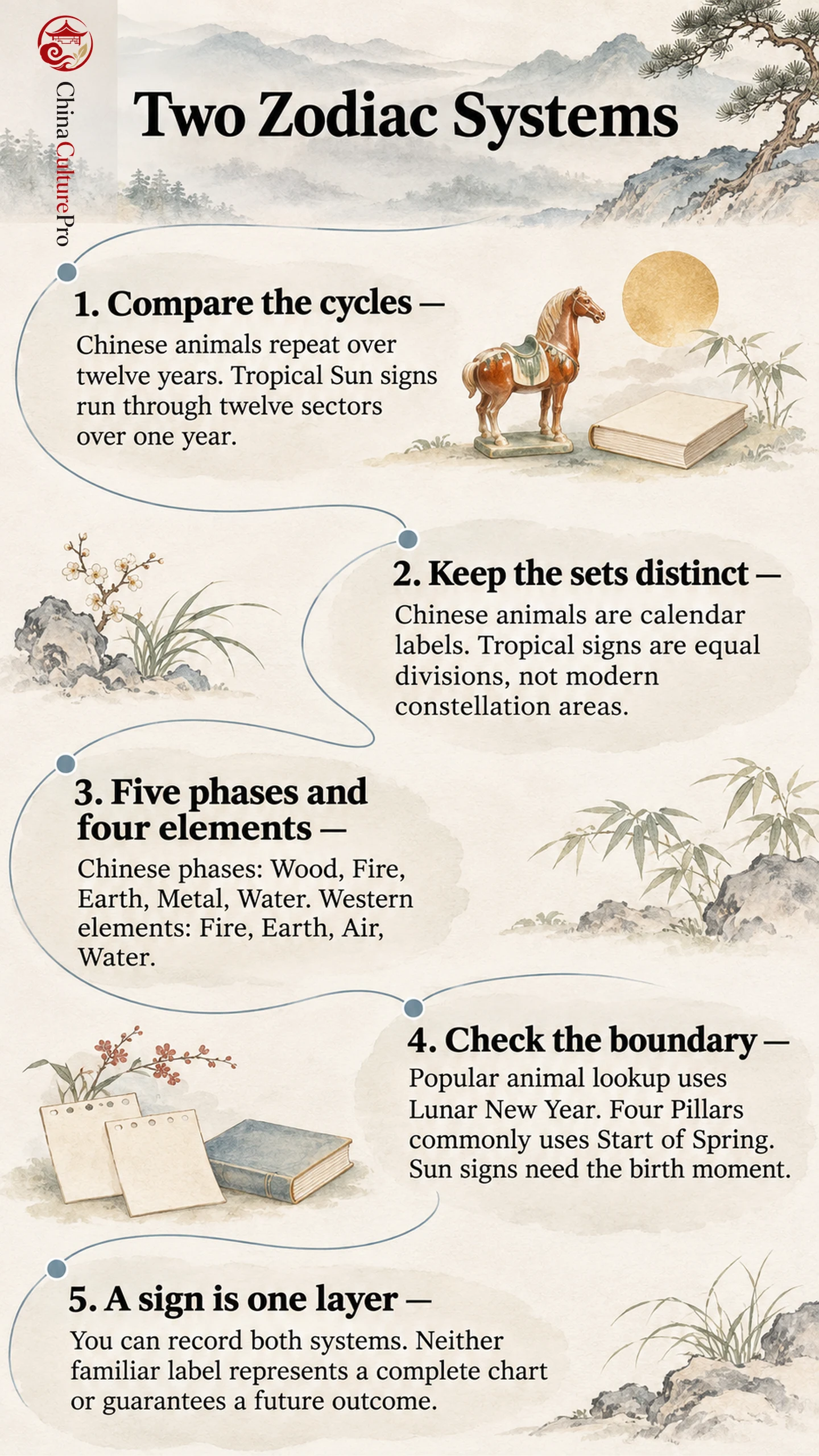
- Different cycles: A Chinese animal returns every twelve years; the Sun passes through the Western signs over one year.
- Different categories: Chinese year labels can combine an animal and a five-phase classification; Western signs use a four-element scheme.
- Different boundaries: A calendar year, a solar term and a Sun-sign transition are separate reference points.
This comparison focuses on popular Chinese birth-year animals and the Western tropical zodiac. Neither familiar sign label represents a complete birth chart.
Two people can share a Chinese animal sign and have different Western Sun signs. People born in different years can share the same Sun sign. Check what each label measures and which convention produced it.
The Main Differences at a Glance
The table compares the common entry points. It does not make a Chinese animal the equivalent of a Western sign.
| Feature | Chinese birth-year animal | Western tropical Sun sign |
|---|---|---|
| Basic cycle | Twelve named animal years | Twelve signs traversed by the Sun over one year |
| Basis of the familiar label | The animal associated with the birth year | The Sun’s zodiacal longitude at birth |
| Main boundary to check | The stated convention for changing the year | The instant the Sun enters the next sign |
| Relationship to the sky | Animal labels correspond to a calendrical sequence | Equal sectors measured from the March equinox |
| Common shortcut to avoid | Every January birthday belongs to the printed Gregorian year | Every calendar month corresponds to exactly one sign |
The animal-year sequence and the tropical division are different structures. Sharing the number twelve does not create a conversion table between them.[1][2]
Animals, Signs and the Meaning of Twelve
The Chinese animals correspond to the twelve Earthly Branches(地支,dìzhī). Their familiar order is Rat, Ox, Tiger, Rabbit, Dragon, Snake, Horse, Goat(羊,yáng), Monkey, Rooster, Dog and Pig. The eighth animal also appears in English as Sheep or Ram. Those labels do not add another position to the cycle.[1]
The tropical zodiac divides a full circle into twelve equal thirty-degree signs, beginning with Aries at the March equinox. Its signs carry familiar names associated with celestial figures, but the equal divisions are not identical to the unequal areas occupied by modern astronomical constellations.[2]
An animal label therefore does a different job from a tropical sign. Knowing someone is a Tiger does not establish whether their Sun sign is Aries, Cancer or any other Western sign. An online list pairing the twelve Chinese animals with twelve Western signs is an analogy someone has constructed, not a conversion built into either system.
Five Chinese Phases and Four Western Elements
Chinese year designations use the ten Heavenly Stems(天干,tiāngān) alongside the twelve branches. Together they form Gan-Zhi(干支,gānzhī) notation. Advancing the two sequences together produces the sexagenary cycle(六十甲子,liùshí jiǎzǐ), a repeating set of sixty pairs.[3]
Wuxing(五行,wǔxíng) names five phases: Wood, Fire, Earth, Metal and Water. These belong to a Chinese framework of change and relationships. The phase attached to a year label adds a layer beyond the animal; it is not the same classification as a Western sign’s element.[4] The Chinese Five Elements and sixty-pair cycle explain those layers in more detail.
Western tropical astrology groups its twelve signs into four elements:
- Fire: Aries, Leo and Sagittarius.
- Earth: Taurus, Virgo and Capricorn.
- Air: Gemini, Libra and Aquarius.
- Water: Cancer, Scorpio and Pisces.
These are traditional sign groupings. Air is part of this scheme; Metal and Wood are not. Familiar shared words such as Fire or Water do not make the two classification systems interchangeable.[5]
Birth Dates: New Year, Start of Spring and Sign Boundaries
For an ordinary Chinese birth-year animal lookup, check the Lunar New Year date for the actual birth year. January 1 is not the start of that traditional calendar year. A different convention is used in Four Pillars(八字,bāzì) practice: the year pillar commonly changes at Start of Spring(立春,Lìchūn), a solar term. Popular festival usage and this astrological convention can therefore give different labels for a birth near the boundary.[6]
For example, Lunar New Year’s Day fell on February 17 in 2026. A birthday earlier in that Gregorian year does not automatically belong to the new festival animal year.[7] This is a date-checking example, not a rule to reuse for every year. The Chinese and Gregorian calendars describe years differently.
For a Western Sun sign, establish whether the zodiac is tropical or sidereal: the former uses the equinox, the latter a stellar reference. Check the Sun’s position at birth within that system. Near a transition, approximate printed dates need checking against the actual year and birth moment.[2]
Using Both Systems without Mixing Their Rules
You can record a Chinese animal and a Western Sun sign side by side. State which conventions produced them rather than inventing a single blended calculation. A combined nickname may be personally meaningful without becoming an ancient classification shared by both traditions.
A Four Pillars chart and a Chinese year animal also differ in scope. The former considers year, month, day and hour designations.[3] Likewise, Western chart interpretation can involve planets and other points across several signs, rather than the Sun alone.[5]
Treat descriptions of character, compatibility and fortune as traditional interpretations. A sign label does not establish someone’s abilities, determine a relationship or guarantee a future event. Understanding the calculation is a clearer starting point than trying to decide which culture has the more accurate personality label.
FAQs About Chinese and Western Zodiacs
Can I have both a Chinese and a Western zodiac sign?
Yes. They are labels calculated within different systems, so having one does not replace the other.
Is a Chinese animal equivalent to a particular Western sign?
No. There is no inherent one-to-one conversion between the two sets of twelve.
Why do two Chinese zodiac calculators disagree?
They may use different year boundaries, especially Lunar New Year and Start of Spring. Check the convention and the actual birth date.
Are Western signs the same as astronomical constellations?
Tropical signs are equal thirty-degree divisions. Astronomical constellations occupy unequal areas and are a different classification.
Sources
[1] Hong Kong Observatory. The 12-Year Animal Cycle
[2] Astrodienst. The Three Zodiacs in Astrology
[3] Hong Kong Observatory. Heavenly Stems and Earthly Branches
[4] International Dunhuang Programme, British Library. Astrology and Astronomy
[5] Astrodienst. The Four Elements and the Signs
[6] Hong Kong Government News. Discussion of New Year and Zodiac Boundaries
[7] Hong Kong Government. General Holidays for 2026