
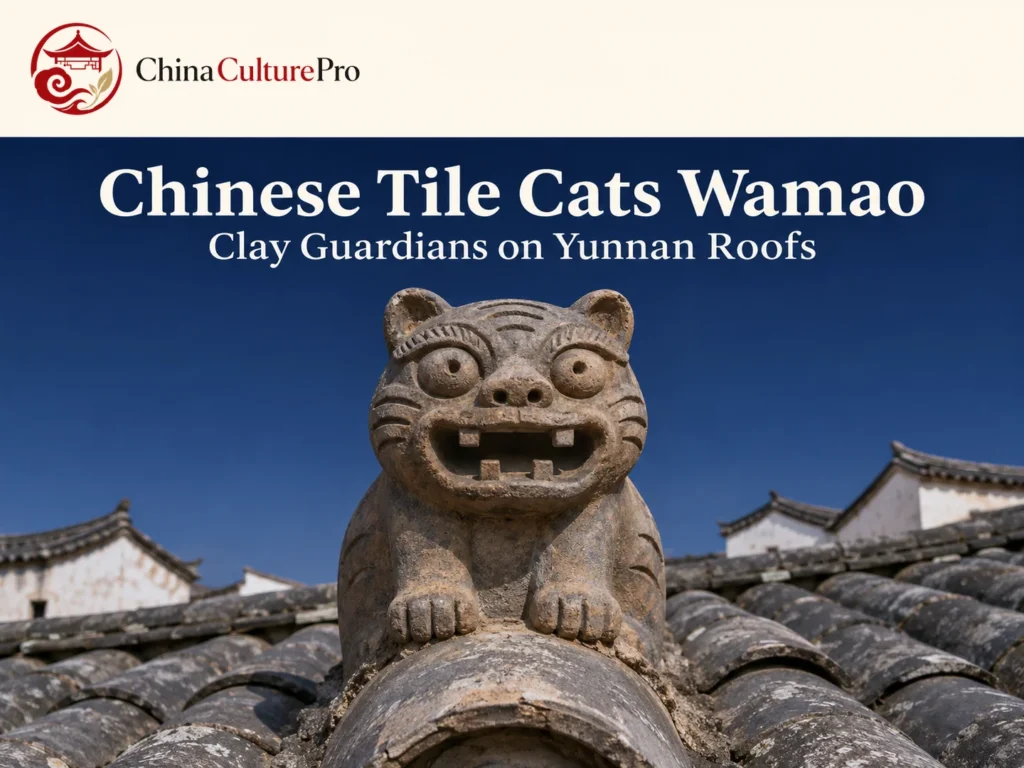

Quick Answer: What Is a Yunnan Tile Cat?
A tile cat (瓦猫, wǎmāo) is a guardian figure found on traditional houses in Yunnan. Many are shaped in clay and fired, while some are carved from stone. The figure often has round eyes and an exaggerated open mouth. Households placed it above the home to express hopes for protection and good fortune. [1][2][3]
- Place: Often on the ridge of a tiled roof, with other positions documented locally.
- Form: A catlike or tigerlike face above a curved tile base.
- Material: Fired clay is common. Some places use stone. [1][2][3]
Look at the base as well as the face. Its shape can reveal how the figure belonged to the roof.
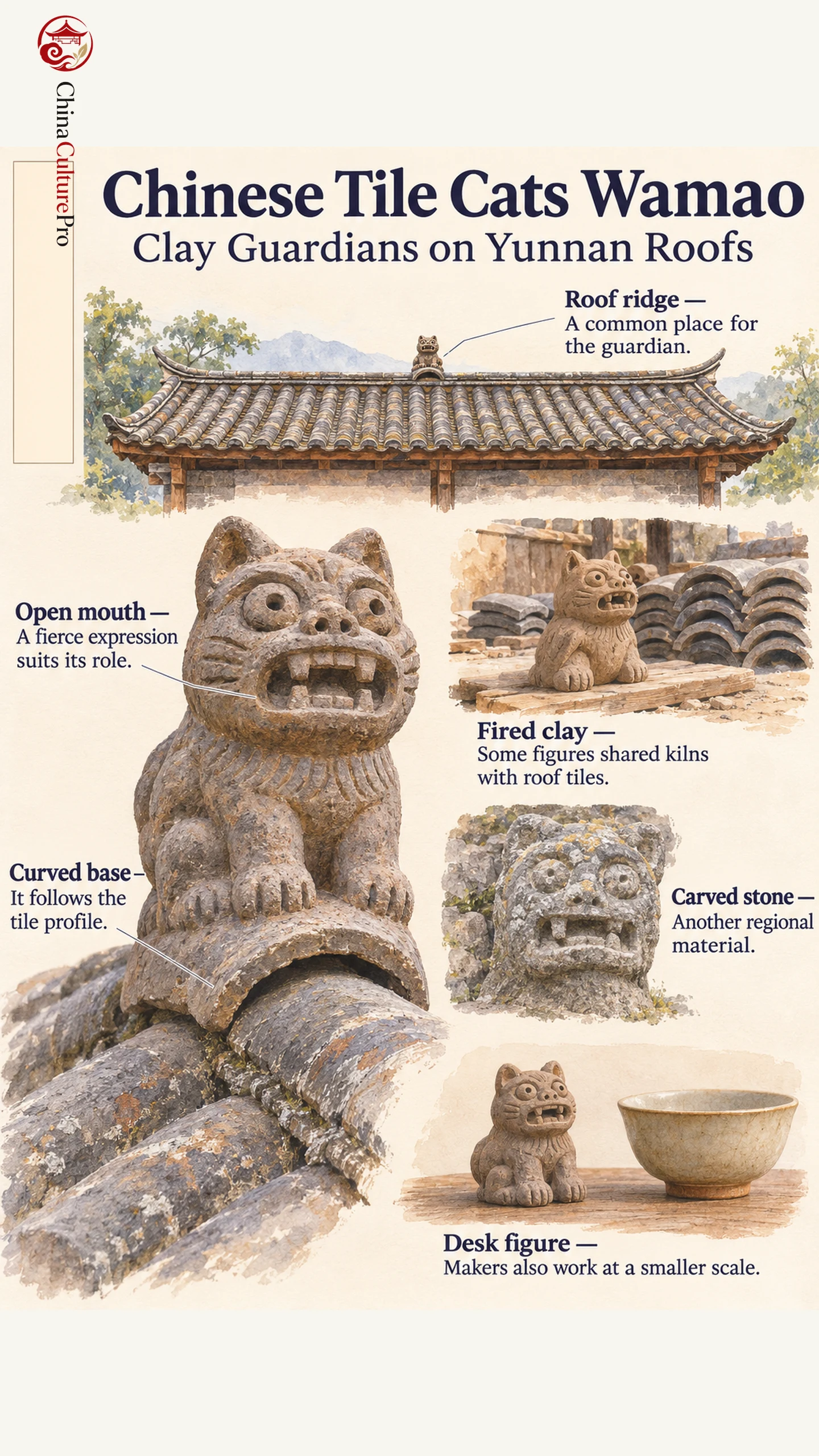
A tile cat seen from the street is usually a silhouette against the sky. Bring it down to eye level and other details come forward. The base may follow the curve of a roof tile, and the body may show the roundness of a pot or the uneven lines of hand modeling.
Why the Figure Sits Above the House
A typical clay figure sits on a curved tile section. The curved underside follows the tile profile. Above it, the torso and head interrupt the line of the ridge so the figure can be seen from below. A study of Naxi houses documents a clay tile cat made from the same material as the roof tiles and set in the center of the ridge. The ridge is the highest meeting line of the slopes on many traditional Chinese roofs. [1][2]
The Longquan Tile Cat Museum occupies a courtyard house in Kunming’s Panlong District. One figure sits at the center of its ridge with its mouth open and facing outward. An open mouth and a fierce expression express the idea of a guardian facing what is outside the house. Roof edges and entrances were also used in some places. [1][3][6]
From Kiln Clay to Carved Stone
The provincial heritage center’s profile of Gao Jinfu describes a Heqing tile-kiln tradition. Kiln workers made roof figures alongside bricks and tiles. Gao learned from tile maker Li Yuanzhi. His figures are shaped by hand, and the absence of a mold leaves room to vary the size and expression. [4]
Clay can also be turned into a vessel-like body and modeled further. In Chenggong, artist Zhang Hang relates the rounded symmetry of some old tile cats to pottery made in a jar form. Luo Haoyang’s work illustrates how a potter can throw a body and then model the face and other details. In stone examples, the maker cuts the details into the surface instead of shaping wet clay. [3][5]
What Changes from One Place to Another
The Longquan museum’s director describes Dali figures with raised heads and horns between the ears. He contrasts these with some figures from Wenshan, where makers used carved stone. The museum collection also contains figures with fish scales, wings and different kinds of teeth. An unfamiliar figure is easier to interpret when its place of collection or its original roof setting is known. [3]
The museum reports names associated with cats in Kunming and names translated as ridge-taming tiger or auspicious tiger in parts of Dali and Lijiang. Some tigerlike examples have the character for “king” on the forehead. The wording and the faces connect differently to the shared idea of a figure guarding the house. [1][3][4][6]
Where the Craft Continues
Yunnan’s fifth provincial intangible heritage list, announced in December 2022, includes Yongsheng tile cats. At the Longquan museum, older roof pieces are displayed alongside recent work by makers. A 2026 report describes visitors shaping figures in clay there, where they can see the relation between the old profile and the material in their hands. [6][7]
In a separate workshop, China National Radio documents Luo Haoyang adapting the form into small objects for a desk or tea table. Those pieces retain some of the familiar eyes, mouth and pose at a scale suited to the room. Like other Chinese clay figurines, their proportions and finish depend on where they will be seen. [5]
FAQs About Chinese Tile Cats
Why is it called a tile cat if it looks like a tiger?
Tile cat is a common name for the roof figure. In several local traditions the face borrows from a tiger to express the role of a strong guardian. [1][3][4]
Are all tile cats glazed pottery?
Tile cats include fired clay and carved stone examples. A fired figure can retain a plain, tile-like surface. Glaze and finish vary by workshop, and carved stone has a different surface again. [1][3][4]
Do tile cats always sit at the middle of a ridge?
The center of the ridge is a common position in documented examples. Figures can also appear by a roof edge or above an entrance, depending on local practice. [1][2][3][6]
Sources
[1] Ma Jia, Yunnan Academy of Social Sciences. Tile Cats: The Meeting of Folk Practice and Craft
[2] Journal of Architecture and Urbanism. Naxi Vernacular Architecture and Settlements
[3] Zhang Chi, People’s Daily Overseas Edition. Yunnan Tile Cats Enter Daily Life
[4] Yunnan Intangible Cultural Heritage Protection Center. Gao Jinfu
[5] China National Radio. A Young Maker Brings Tile Cats Into City Life
[6] Yunnan Daily. The Tile Cat Museum in Longquan
[7] Yunnan Intangible Cultural Heritage Protection Center. Yunnan’s Fifth Provincial Intangible Cultural Heritage List