


Quick Answer: What Is Chinese Tin Ware?
Chinese tin ware (锡器, xīqì) includes tea caddies, pitchers, candlesticks and decorative objects made with tin as a principal material. Pewter is a tin-based alloy. Metalworkers can shape sheet, cast parts, join pieces and then decorate the surface. [1][2][3][4]
- Shape: A vessel can use hammered sheet, cast sections or both.
- Finish: Smooth areas and incised details show different stages of work.
- Examples: Yongkang and Gejiu have distinct recorded workshop practices. [1][3][4]
The rim, base and joints can tell you about construction. The design on the face can tell you about the finishing work.
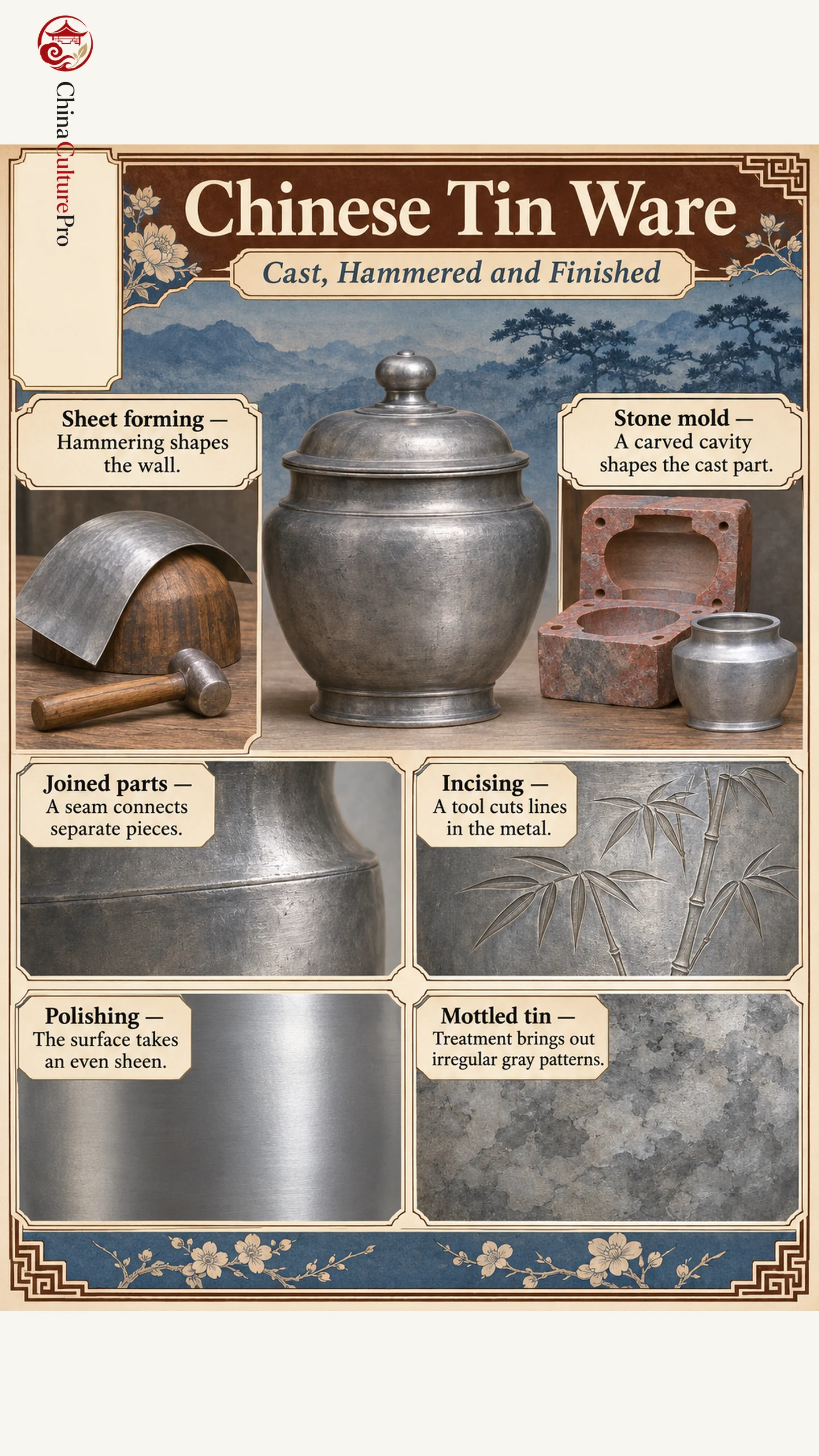
An even metal surface can conceal a series of joins, while a shallow mark can make one part of it stand out. Chinese tin ware includes both effects. A vessel can be shaped for use and finished so that its inscription only appears when the piece is turned or separated from its pair.
How Tin Vessels Are Shaped and Joined
The Yongkang heritage record describes making sheets and shaping, cutting and joining the metal. Tin’s softness makes it possible to shape a blank with a hammer over a support. A maker can work several pieces for one vessel. A curved wall, base and spout can be formed separately. After the pieces are joined, the maker files, scrapes or polishes the seam. A smooth wall can still have a separately made foot or rim. [1][4]
In Gejiu in Yunnan, a documented casting method uses a carved and polished siltstone mold. The mold gives the metal a shape as it cools. A cast blank still needs trimming and finishing. If the mold carries a pattern, that detail comes from the prepared mold surface. A line cut on the finished metal is a separate operation. [3][4]
What the Surface Reveals
Polishing gives a surface an even sheen. Incising cuts recessed lines. Hold an incised detail in grazing light and the groove may appear as a fine shadow, even when the wall around it is polished. This helps explain why a design can be quiet from a distance and clear up close. Gejiu’s terminology also distinguishes surface treatment that creates irregular black, white and gray mottling. [3][4][6]
That mottled finish, known as bānxī (斑锡), can appear across an area of a vessel, while an incised pattern follows specific outlines. Lai Qingguo trained with Gejiu maker Li Zongze. The Journal of Honghe University describes how Lai and his team developed ways to control the mottled appearance and used it on tea wares and display pieces. On a finished piece the patches can make the light change across a single surface. [3][4][8]
Reading Two Museum Examples
The Met catalogues two matching seventeenth-century pewter tea caddies attributed to Shen Cunzhou. The sides that face one another carry incised texts, and the bases carry poems. The inscriptions come into view when the caddies are moved apart. Turning each one over reveals another text. The Met attributes the pair to Shen, so the maker’s name in the catalogue is an attribution. [5]
A hexagonal teapot dated to the late nineteenth or early twentieth century in the same collection has poems, plants, animals and references to ancient bronze inscriptions on its faces. Here the angular body gives the design a series of faces to follow as the vessel turns. The Met identifies the Chen Wanfeng workshop in Jiaxing by marks on the base and lid. It lists pewter, copper and brass as the materials. [6]
Yongkang and Gejiu as Living Traditions
Yongkang’s tin craft entered the national intangible cultural heritage list in 2008. The record describes workshops making wine vessels, powder boxes and sets of wedding dressing articles as well as pieces for ritual use. Those objects required different kinds of joining and finishing. A small box needs a fitted lid, for example, while a candlestick balances its upright shape over a base. The register records Ying Yegen beginning his apprenticeship at thirteen and learning to cut, shape, assemble and engrave tin. His work included a crane candlestick held by the National Museum of China. [1][7]
Gejiu’s tin-making tradition entered Yunnan’s provincial list in 2009. The prefectural account describes both shaping sheet and casting in stone molds. A local terminology standard now distinguishes practical pieces, ornamental pieces and tin combined with other materials. These categories show how the same metal serves different jobs within Chinese traditional crafts. [1][3][4]
FAQs About Chinese Tin Ware
Is Chinese tin ware the same as pewter?
Tin ware is a broad craft term. Pewter identifies an alloy whose main ingredient is tin. A museum may use pewter for one vessel and list additional metals separately for another. [2][5][6]
Are all Chinese tin vessels cast in molds?
Some tin forms are cast, and others are worked from sheet. A workshop can shape or cast different components and then join them. [1][3][4]
What is the mottled finish on some Gejiu tin ware?
Mottled tin has an irregular pattern on the surface, often in shades from black to white. Gejiu’s local terminology distinguishes that finish from the lines made by a cutting tool. [3][4][8]
Sources
[1] China Intangible Cultural Heritage Network. Tin Craft: Yongkang
[2] The Pewter Society. About Pewter
[3] Honghe Prefecture Bureau of Culture and Tourism. Gejiu Tin Crafts
[4] Honghe Prefecture Administration for Market Regulation. DB5325/T 107–2023: Terms for Gejiu Tin Ware
[5] The Metropolitan Museum of Art. Pair of Inscribed Tea Caddies
[6] The Metropolitan Museum of Art. Hexagonal Teapot
[7] China Intangible Cultural Heritage Network. Ying Yegen
[8] Journal of Honghe University. Lai Qingguo’s Tin Ware and Mottled Tin Technique