

Quick Answer: What Are the Chinese Stone Drums?
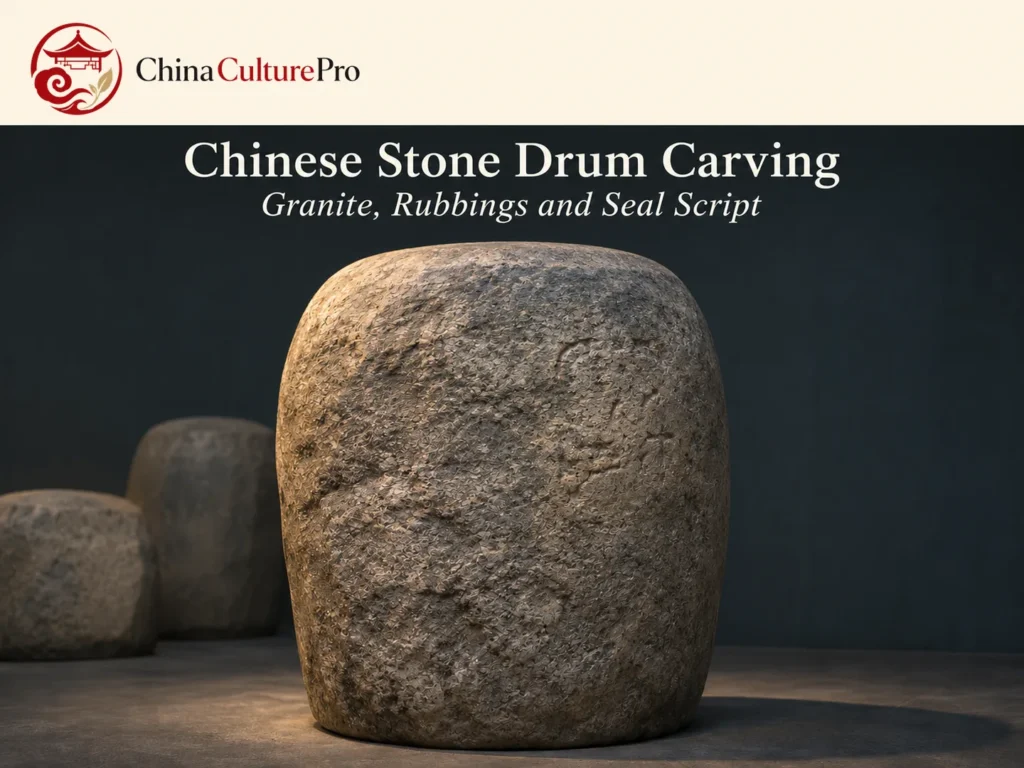
The Chinese Stone Drums are ten drum-shaped granite stones carved with poems. Their writing is known as the Stone Drum inscriptions (石鼓文, shígǔwén). The stones are generally associated with the ancient state of Qin. Exact dating remains debated. Paper rubbings retain strokes that are now hard to see on the rock. [1][2][3]
- Material: Granite shaped into broad rounded forms.
- Writing: Incised seal script, including verses about fishing and hunting.
- Survival: Rubbings and brush copies carry the forms onto paper. [1][2][4][6]
The carved groove, the ink rubbing and a later brush copy each give a different view of the writing.

On a worn Stone Drum, a change in the light can make a faint stroke reappear. On a rubbing taken centuries ago, the same stroke may still be sharp. A calligrapher can study that paper impression even when the carved surface has become hard to read.
How the Poems Were Cut in Granite
The Palace Museum catalogues the Zuoyuan drum as granite, about 90 centimeters high and 60 across. The rounded mass gives the stones their English name. The poems are cut into the sides. Their verse lines typically have four characters. The museum uses the first two characters of each poem to name its stone. A catalogue entry such as Zuoyuan can refer to both a particular stone and the poem on it. [1][2]
The verses include hunting, travel and fishing. The lettering preserves rounded forms and relatively even strokes. The Met sees it as transitional between older writing on bronze vessels and the standardized small-seal script of the Qin dynasty. The lettering was cut into the rock, so the width and direction of the grooves carry the forms. Compare its curves with later Chinese calligraphy styles to see which shapes survived as writing practices changed. [1][2][3]
Why the Qin Date Is Still Debated
Records place the discovery near present-day Baoji in Shaanxi in the early Tang period. The Palace Museum places the carvings in the state of Qin, but notes competing estimates. The Met uses a fifth-century BCE date. The Palace Museum also records Tang Lan’s proposal of 374 BCE. Hou Yili’s study reviews earlier proposals and explains why the script, content and historical associations leave room for more than one dating. [1][2][3][5]
The objects moved more than once after discovery. They reached Kaifeng under the Northern Song. The Jin later took the drums to Yanjing, now Beijing. As the stone surfaces wore, paper records became more valuable to anyone trying to read the inscriptions. [1][2][3]
How Rubbings Preserve Worn Strokes
In Chinese stone rubbings, damp paper conforms to a carved surface. Ink applied to the exposed surface darkens the paper over the higher areas. The paper in the grooves stays pale. The result can preserve the shape of an incised stroke even after the paper is lifted. [3][4]
The Palace Museum identifies three surviving early sets as Song rubbings. Its own Ming album already shows losses. The eighth drum is missing from that album. On several other drums only one or two characters per column survived in the impressions. For instance, the Palace Museum notes that the character for carp remains legible in the Qianyi drum impression, along with most of another character that is damaged in later copies. The state of those strokes helps identify the album as an early Ming impression. [2]
From Later Carving to Living Calligraphy
A later set of carved drums can carry a different version of the text. In 1790 the Qianlong emperor ordered new drums with poems rearranged from the characters then preserved. Hou Yili’s study also identifies smaller court versions of the Qing recutting. Their shape recalls the old drums. Their reorganized poems show how the Qing workshop used surviving forms to make a new version. [5]
Wu Changshuo used the inscriptions as a model for brushwork. The Smithsonian holds a scroll he made in 1917 from the third Stone Drum poem. Kyoto National Museum has another work with four stanzas based on several drums. Kyoto’s catalogue says Wu studied an early rubbing. In his scrolls the ancient forms become brush lines with his own spacing and pressure. The contrast between the darker brush line and the pale line of a rubbing helps show which surface each image came from. [6][7]
FAQs About Chinese Stone Drum Carving
Were the Stone Drums musical instruments?
The name describes their rounded drum-like form. The surviving objects are stone monuments carrying carved poems. [1][2]
Where are the original Stone Drums kept?
The ten originals are in the collection of the Palace Museum in Beijing. Other museums may hold paper rubbings, later inscriptions or brush copies. [1][2][3][5][6]
Does every Stone Drum rubbing come from the ancient stones?
A rubbing may come from an original stone or from a recarved version. A catalogue can identify which surface the paper was taken from and when the copy was made. [2][4][5]
Sources
[1] The Palace Museum, Beijing. Stone Drums with Poetry: Zuoyuan
[2] The Palace Museum, Beijing. Ming Rubbing Album of the Stone Drum Inscriptions
[3] The Metropolitan Museum of Art. Inscriptions on the Stone Drums
[4] Field Museum. Chinese Rubbings Collection
[5] Hou Yili, National Palace Museum Research Quarterly. Reinterpreting the Stone Drums Under the Qianlong Emperor
[6] Smithsonian National Museum of Asian Art. Excerpt from the Third Stone Drum Poem, in Large-Seal Script
[7] Kyoto National Museum. Four Stanzas from Shigu Wen