
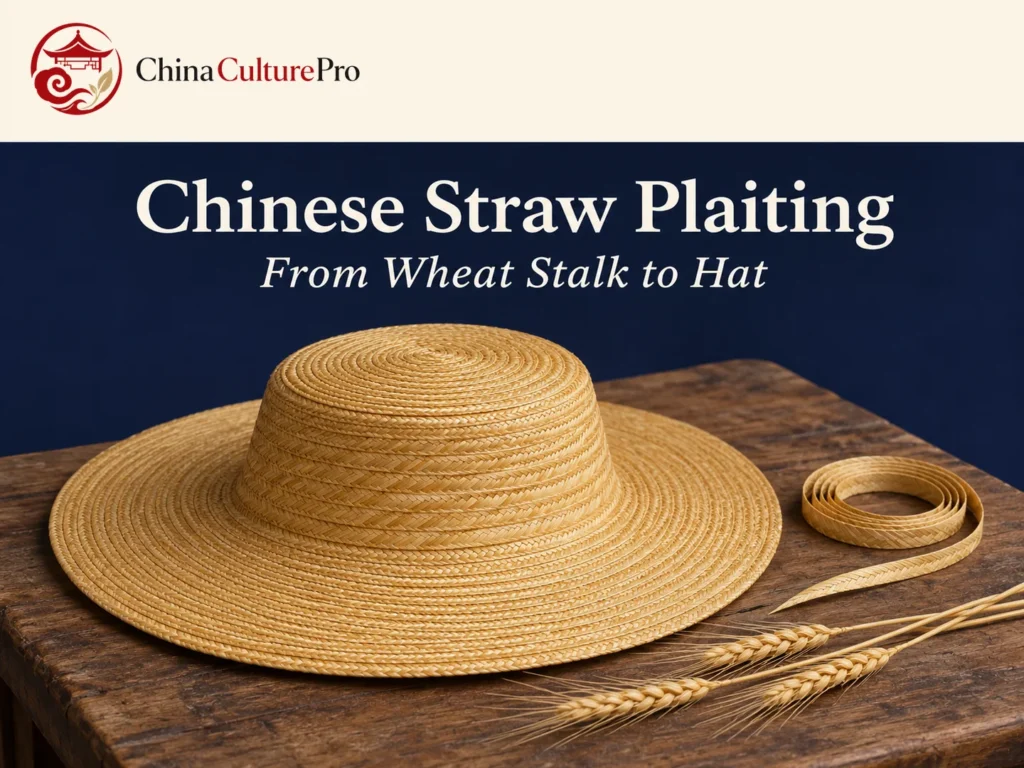

Quick Answer: What Is Chinese Straw Plaiting?
Chinese straw plaiting interlaces stalks or strips of straw into a long, narrow band called a straw plait (草辫, cǎobiàn). Laizhou in Shandong is known for making these bands from wheat straw. They can be used as a material for hats and other objects. [1][2]
- Strands: Whole stalks give a rounded element. Split stalks give flatter, narrower strips.
- Band: Repeated crossings build a long strip with its own edges.
- Object: Adjacent turns of the strip can be stitched together to make a hat. [1][2][5]
Follow the crossings inside a band first. Then look for the seam where that band joins another turn.

Before a straw hat takes shape, a hat maker can hold much of its surface in a bundle of narrow plait. The band can be made in one workshop and sewn into a hat in another. That division of work connected rural households in Shandong with hat makers overseas.
Whole Stalks and Split Straw
The Laizhou heritage account distinguishes a plait made from whole wheat stalks from one made from split straw. For the second type, a splitting tool cuts a stalk lengthwise. Splitting produces several flatter strips from a single stem. A maker can select narrower strips for a fine pattern. With whole straw, more of the stem’s rounded profile remains visible at each crossing. [1][3]
The national register describes Laizhou plaits made with three, five or seven strands. A maker pinches the straw, lifts a strand and presses it across the others. Repetition produces a pattern along the strip. The plait grows along its length, with edges formed by strands turning back into the pattern. That is why a loose piece of plait can be handled or wound up on its own before it is stitched to anything else. [2]
How a Plait Becomes a Hat
A plait has a finished edge before it becomes part of a hat. A hat maker can lay one turn against the next and sew them together. The Coggeshall Museum describes building a hat in a spiral from the crown outward toward the brim. After sewing, shaping over a form gives the hat its profile. [5]
Inside the crown, the stitches that link neighboring rows may be easier to see. The crossings within the braid stay on either side of each join. When the plait turns outward at the brim, the seams flatten into rings. The same narrow braid can be shaped differently depending on how the maker places the adjacent turns. [1][5]
Why Straw Bands Were Traded on Their Own
A finished plait can be shipped before anyone chooses the shape of the hat. The Yantai gazetteer records that a factory established in Ye County, now Laizhou, in 1890 sorted and packed plaits that traders bought. The gazetteer lists export varieties such as Shahe White and Laizhou Flower. Those names were used for kinds of braid sold to buyers, so the strip itself was a finished product for the plait maker. [1][3]
Historian Chinyun Lee traces how rural producers around Laizhou took part in a nineteenth-century straw braid trade that passed through Chefoo, now Yantai. In England, the Coggeshall Museum records milliners working with imported plait from China and Japan. The stage at which the material changed hands matters. Laizhou households could supply a braided strip and buyers elsewhere could shape and trim it for a different market. The shape of the resulting hat alone cannot tell you where the straw was plaited. [4][5]
How Laizhou Makers Use the Plait Today
Laizhou straw plaiting entered China’s national intangible cultural heritage list in 2008. An exhibition reported by Laizhou in June 2025 showed bags, storage boxes and pictures made with straw alongside older objects. Some exhibits used straw plait in pictures of landscapes, flowers or birds. There the color and direction of the bands helped build an image. In a hat or storage box, similar choices can be seen where the band follows the curve of the object. [1][6]
Laizhou’s account also distinguishes wheat-straw plaiting from products made from corn husk and other plants. Those products sit alongside the older hat braid in the wider family of Chinese traditional crafts. [1][2]
FAQs About Chinese Straw Plaiting
Is straw plaiting always done with wheat straw?
Wheat straw is characteristic of the Laizhou plait described here. Other plaited plant crafts may use different materials. For a particular hat or other object, the maker or collection record can identify the plant material. [1][2][3]
Why do Laizhou plaits use different numbers of strands?
The strand count changes the available crossing patterns and the resulting strip. The Laizhou register describes three, five and seven-strand versions. [2]
How can I tell if a straw hat is made from plait?
Look for a narrow repeating strip and a seam where its edges meet on successive turns. Trace the seam across the brim or around the crown to distinguish it from the smaller crossings inside the braid. [2][5]
Sources
[1] Laizhou Municipal Bureau of Culture and Tourism. Intangible Heritage: Laizhou Straw Plaiting
[2] China Intangible Cultural Heritage Network. Grass Weaving: Laizhou Straw Plaiting
[3] Shandong Local Gazetteer Archive. Yantai Gazetteer: Straw Crafts
[4] Chinyun Lee, Far East. The Entry into the World Market of Chinese Straw Braids
[5] Coggeshall Museum. Straw Plaiting
[6] Laizhou Municipal Bureau of Culture and Tourism. The Art at the Fingertips: Laizhou Straw Plait Exhibition