


Quick Answer: What Are Chinese Salted Duck Eggs?
Chinese salted duck eggs(咸鸭蛋,xiányādàn)are duck eggs preserved by salt curing. After cooking, the white is salty and the yolk can be rich, grainy and oily. They are eaten as an accompaniment or used as an ingredient in other foods. [1][2][9]
- Preparation: Salt curing and cooking are separate stages. [9]
- Forms: Whole eggs and separated yolks are sold; some products are already cooked. [3][4]
- Texture: The yolk’s characteristic oiliness develops from changes in its own fats during curing and heating. [1]
- Uses: Whole cooked eggs accompany porridge, while yolks appear in pastries, rice dumplings and sauces. [2][4]
Check the cooking status on the label: “salted” alone does not mean ready to eat.
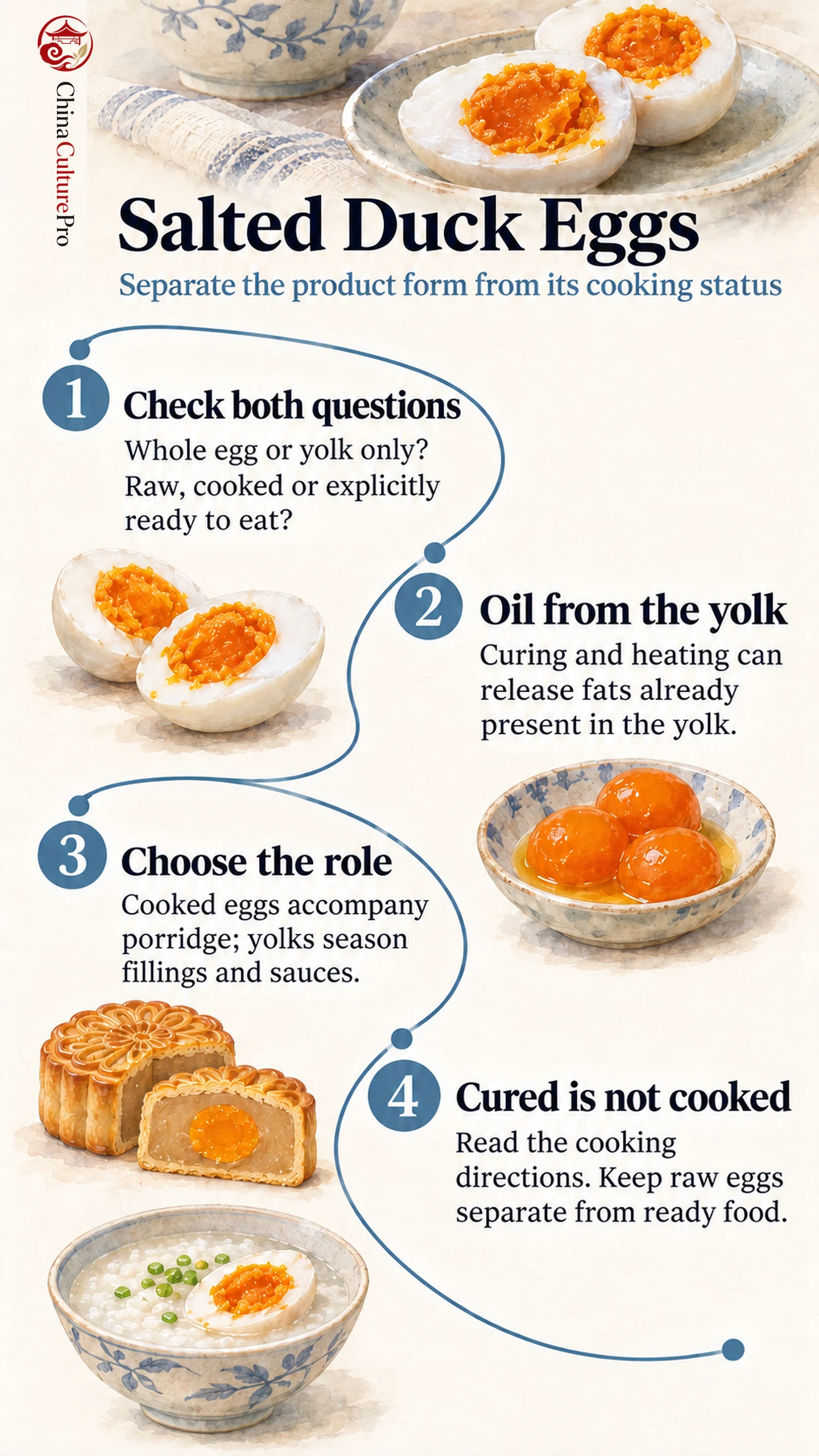
An orange yolk inside a mooncake and a halved egg beside porridge represent different uses of the same preserved ingredient. Buying it successfully starts with two questions: do you need the whole egg or just the yolk, and is the product raw or cooked?
Raw Cured Eggs, Cooked Eggs and Separated Yolks
Salted duck eggs are made through processes such as brining whole eggs or applying a salt-containing coating. Curing changes the egg’s structure and seasoning; a raw cured product still needs the cooking specified for its use. Separated yolks can also be processed as a distinct product. [9]
Look for both the form and the cooking status. A round, firm-looking yolk or a sealed packet does not answer both questions. Cooking instructions matter even when a product looks ready for a filling. [4]
| Product form | What it means for the cook or eater |
|---|---|
| Raw cured whole egg | The egg has been salted but still needs cooking; its yolk may be separated for a specified preparation. |
| Cooked whole egg | Both white and yolk are cooked; some products are explicitly labeled ready to eat. |
| Separated salted yolks | The white has been removed; check whether the yolks are raw or cooked and follow their directions. |
One supplier’s cooked whole eggs are vacuum-packed after cooking and expressly sold ready to eat. That is useful information about that product, not evidence that every vacuum-packed salted egg has the same status. [3]
Why the Yolk Becomes Firm, Grainy and Oily
The oil belongs to the yolk itself. Salt curing changes moisture and the structures that hold its fats, allowing some of those fats to separate. Heating can release additional oil. Oiliness therefore does not, by itself, show that a producer injected cooking oil into the yolk. [1]
The familiar grainy texture is connected with changes in the yolk’s small structural particles as well as the released oil. A cooked yolk can feel dense and finely crumbly while also leaving an oily richness on the tongue. That combination differs from the texture of a freshly boiled, unsalted egg. [1]
The white has a separate role. Its saltiness can be more apparent when eaten alone, while the yolk provides the richer bite. A whole cooked egg offers salty white alongside rich yolk, while a yolk-only filling concentrates on the latter. [2]
Whole Eggs and Yolks in Chinese Cooking
With congee, a cooked salted egg acts as a strongly seasoned accompaniment to a mild bowl of grain. Small bites of white and yolk can be eaten with spoonfuls of porridge. This use keeps the egg recognizable rather than blending it into a sauce. [2]
In mooncakes, a salted yolk may sit inside a sweet filling. A documented lotus-paste version encloses the yolk within the paste, so a cut section reveals an orange center. The yolk contributes a salty contrast to the sweet lotus seed paste and pastry; it is not the ingredient that makes the filling sweet. [7]
Zongzi(粽子,zòngzi)provide a savory example. One Cantonese-style rice dumpling combines sticky rice with pork, peanuts, sausage and pieces of salted duck egg yolk. The yolk becomes one concentrated part of a larger filling. Other rice dumplings can have different fillings, so the name does not guarantee an egg yolk inside. [8]
A sauce takes another approach: cooked yolks are broken down and combined with ingredients such as oil and sugar. A documented preparation uses this as a seasoning for foods including fried rice and stir-fries, while salted-yolk coatings also appear with pumpkin. A finished sauce is therefore a separate preparation, not simply liquid drained from a salted egg. [4]
Salted Duck Eggs and Century Eggs Are Different
Century eggs(皮蛋,pídàn)are produced using an alkaline treatment, whereas salted duck eggs are a salt-cured product. Both sit within the broad category of preserved eggs, but the processing descriptions identify different foods. [6]
Use that distinction when a recipe or menu calls for one of them. The broad English word “preserved” is insufficient to choose the right ingredient. A comparison of century eggs and salted eggs is more useful than assuming that any preserved duck egg supplies the same flavor and texture. [6]
Buying and Using the Right Product
Read the label for the egg type, whole-egg or yolk-only form, and cooking instructions. If the product is raw, cook it thoroughly before eating or use a preparation that fully cooks it. A ready-to-eat claim needs to come from the product’s labeling, not its packaging style. [3][5][7]
Handle raw egg separately from cooked or ready-to-eat food, using separate utensils and washing hands after contact. Appearance alone cannot establish whether an egg carries harmful bacteria. The general egg-safety advice is to cook thoroughly, with both white and yolk firm. [5]
Also check the completed food. A mooncake adds flour, oil and sweet filling; a sauce can add oil and sugar; a savory rice dumpling may include pork and peanuts. Knowing that the central ingredient is a duck egg does not identify every other ingredient in the dish. [4][7][8]
FAQs About Chinese Salted Duck Eggs
Can Salted Duck Eggs Be Eaten Straight from the Packet?
Only when the product is cooked and labeled ready to eat, following its directions. Raw salted eggs still require cooking; a sealed packet alone is not enough information. [3][5][7]
Is the White of a Cooked Salted Duck Egg Edible?
Yes. Both cooked white and yolk can be eaten with porridge. The white is salty, while the yolk supplies a richer flavor and texture. [2]
Does an Oily Salted Yolk Mean Oil Was Injected?
No. Curing and cooking can release fats already present in the yolk. Visible oiliness alone does not prove that oil was added. [1]
Sources
[1] K M Lai, W H Chung, C L Jao and K C Hsu. Oil exudation and histological structures of duck egg yolks during brining (2010)
[2] Judy Leung. Salted Duck Eggs: original kitchen observations
[3] Dasoon. Cooked Salted Egg: original ready-to-eat product
[4] Judy Leung. Salted Egg Yolk Sauce: original preparation
[5] Singapore Food Agency. Salmonella and Eggs: handling and cooking
[6] Hong Kong Centre for Food Safety. Preservatives and Antioxidants User Guidelines (2024), category10.3
[7] Judy Leung. Lotus Mooncakes with Salted Egg Yolks
[8] Judy Leung. Cantonese-Style Zongzi: original family recipe
[9] Tseng-Hsing Wang. Salting Yolks Directly Using Fresh Duck Egg Yolks with Salt and Maltodextrin (2016)