


Quick Answer: What Is a Red Egg and Ginger Celebration?
A red egg and ginger celebration welcomes a baby into a Chinese family and its wider circle. Red-dyed eggs and ginger carry celebratory meanings, while a meal, gifts or shared food give relatives a way to congratulate the parents.
- Purpose: Welcome the child and share the family’s happiness.
- Food: Red eggs are a familiar symbol; ginger and other dishes depend on the family’s tradition.
- Timing: One month is a common milestone, but some families celebrate later, including around one hundred days.
- Participation: Follow the invitation, ask about useful gifts and let the parents guide contact with the baby.
The English party name does not describe every Chinese baby celebration. There is no universal menu, guest gift amount or compulsory ceremony.
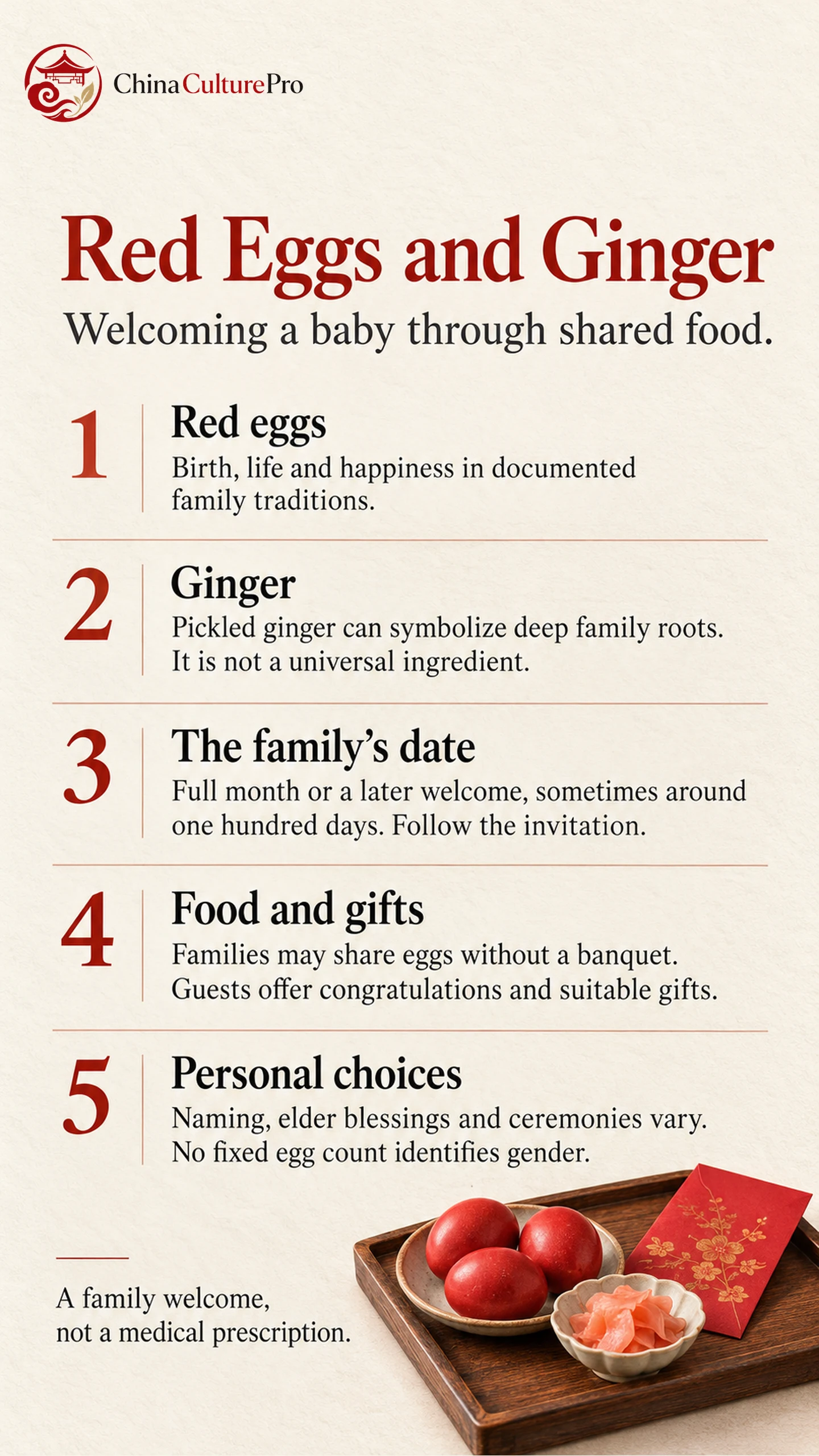
A bowl of red eggs can announce a birth even when there is no large party. In other families, the same welcome brings several generations together for a banquet with ginger, speeches and gifts.
These celebrations are easiest to understand as acts of sharing. Food conveys news and gratitude, guests offer congratulations, and older relatives may pass a family custom to a new generation. The details belong to the household and community, so two invitations can describe quite different events.
What Red Eggs Mean at a Baby Celebration
Hongdan (红蛋, hóngdàn) are red-dyed eggs shared on celebratory occasions. At a baby welcome, the combination of an egg and a festive color makes an ordinary food into a shared expression of joy.
A Chinese Historical Society of Southern California newsletter explains the eggs through birth, life and fertility, with red conveying happiness and good fortune. These are cultural associations, not claims that eating an egg can influence the child’s future.[1]
The explanation is not identical everywhere. Taiwan’s Ministry of Agriculture educational platform describes parents distributing red eggs and savory rice to share first-month happiness. It also records an association between the red egg and a red-topped official’s hat: a wish for the child’s future standing. That is one documented interpretation rather than the only meaning of a red egg.[2]
| Food term | Meaning in this article |
|---|---|
| Hongdan | Red-dyed eggs shared on celebratory occasions |
| Pickled ginger | Ginger prepared in a pickling liquid and served with some baby celebrations |
| A food announcement gift | Food sent by the family to share news and thanks |
The celebration eggs described in these accounts are cooked. Their red shells should not be confused with tea eggs, whose color and flavor come from a different preparation. This article explains the custom rather than giving a dyeing recipe or food-storage instructions.
Why Ginger Appears Beside the Eggs
Pickled ginger is a recognizable partner in some Chinese American celebrations. The historical society’s account connects it with a family’s deep roots and the continuation of the family through grandchildren. A firsthand Bay Area family account gives the same roots explanation.[1][4]
That imagery is a helpful way to understand the pairing: the eggs welcome a new life while the ginger links the child to a family extending across generations. It is a symbolic reading used in those accounts, rather than proof of a single origin shared by all Chinese communities.
Ginger also appears in discussions of postpartum food. That does not make the party dish a medical treatment or establish that every new mother should eat it. The history of Zuo Yue Zi postpartum customs is a related subject, with different questions from the food served to guests.
If you receive red eggs without ginger, the gift is still understandable as a baby announcement. The English phrase “red egg and ginger party” should not be used to erase regional versions that feature rice, cakes or other foods instead.
Full Month, Hundred Days and the Family’s Date
The Chinese full-month celebration marks the completion of the baby’s first month. Many red-egg celebrations connect with that milestone, but the foods do not establish an exact age on their own.
A Bay Area parent’s account describes celebrations occurring from one to three months or at the hundred-day milestone. The Southern California historical society newsletter discusses a later gathering, around three to six months, while emphasizing one hundred days. These accounts demonstrate variation within Chinese American practice; they should not be combined into a rule that every family must wait a particular number of days.[1][4]
Use the invitation’s date. If relatives discuss a full-month gathering and a hundred-day event, clarify whether they mean two celebrations or have chosen one occasion for the welcome. A first-birthday Zhuazhou activity is a separate custom, involving symbolic objects rather than simply the presence of red eggs.
The baby’s age may shape the arrangements, but a party date is not a medical milestone or evidence that postpartum recovery is complete. Parents can choose a scale and schedule that suit their circumstances.
Sharing Food and Welcoming Guests
A USC folklore interview preserves a Taiwanese family memory in which the grandmother’s family could not afford a grand party. They distributed red eggs to neighbors instead. The same informant remembered red eggs at older relatives’ birthdays, illustrating that the food is not exclusive to newborn celebrations.[3]
The distinction between sharing food and hosting a banquet matters. A birth can be acknowledged through a modest gift, and receiving eggs does not automatically mean the recipient should visit the family’s home. Thank the sender and wait for an invitation.
When there is a gathering, guests may bring a red packet or a requested present. Ask a relative about local expectations rather than following a universal cash figure found online. A practical gift should fit the parents’ preferences; duplicate supplies or an unwanted keepsake can create extra work.
At the event, useful questions are simple: “Where would you like the gift?” “May I take a photograph?” “Would you prefer that we greet the baby later?” Congratulations do not need a formal ritual phrase. You can appreciate the food and the family’s custom without performing every action observed elsewhere.
Keeping the Celebration Personal
Elders may help welcome the child, announce a Chinese name or explain a family object. In the Bay Area account, the family combined red packets, an elder-led welcome and a Chinese name chosen by the grandfather. Those details form one family’s story, rather than mandatory steps for guests to copy.[4]
Historic and family accounts sometimes include rubbing eggs over a baby’s head, symbolic shaving or protective beliefs. Recording such a custom does not show that it changes the child’s appearance, health or hair growth. Parents can preserve the memory in another way, including photographs or an explanation of what an older relative remembers.
Avoid turning older gendered customs into a rule that only boys can receive a welcome. The foods and blessings can celebrate a daughter as warmly as a son. Likewise, no fixed number of eggs reliably identifies the child’s gender across all communities.
Seen within Chinese baby traditions, red eggs and ginger connect a new child with people who care about the family. Related Chinese birthday foods continue that language of shared good wishes at later milestones, with their own local meanings.
FAQs About Red Eggs and Ginger
Are the red eggs raw or cooked?
The celebration eggs described here are cooked eggs with red-dyed shells. The symbolism does not require using raw eggs.
Must the celebration happen on day thirty?
No. A full-month event marks the first month, but red egg and ginger celebrations may be held later, including around one hundred days. Follow the family’s invitation.
Do all Chinese baby celebrations include ginger?
No. Some include pickled ginger, while others emphasize red eggs, rice, cakes or a different family menu.
Are red eggs only for baby boys?
No. Some records describe gendered practices, but those do not restrict every family’s celebration. Red eggs can welcome any child and also appear at other birthdays.
Sources
[1] Chinese Historical Society of Southern California. News ’n Notes, April 2005: Red Egg and Ginger tradition
[2] Taiwan Ministry of Agriculture. Eggs: food education and full-month customs
[3] USC Digital Folklore Archives. Chinese Red Eggs, family account recorded in 2020
[4] Jessica Gavin. Red Egg and Ginger Party for Baby James, a family account