


Quick Answer: What Are Guan Li and Ji Li?
Guan Li(冠礼,guànlǐ)is the traditional male capping rite; Ji Li(笄礼,jīlǐ)is the corresponding female hairpin rite. In classical ritual models, both marked a transition toward adult social responsibilities.
- Visible signs: A cap or hairpin, changed dress and formal acknowledgment made the transition recognizable.
- Classical ages: Twenty for males and fifteen for females are familiar textual benchmarks, rather than a record of identical practice in every household.
- Modern use: Families, schools and cultural groups may adapt these forms to celebrate growing responsibility.
Read each ceremony in its historical or contemporary setting. A classical ritual ideal is not a universal birthday rule. [1]
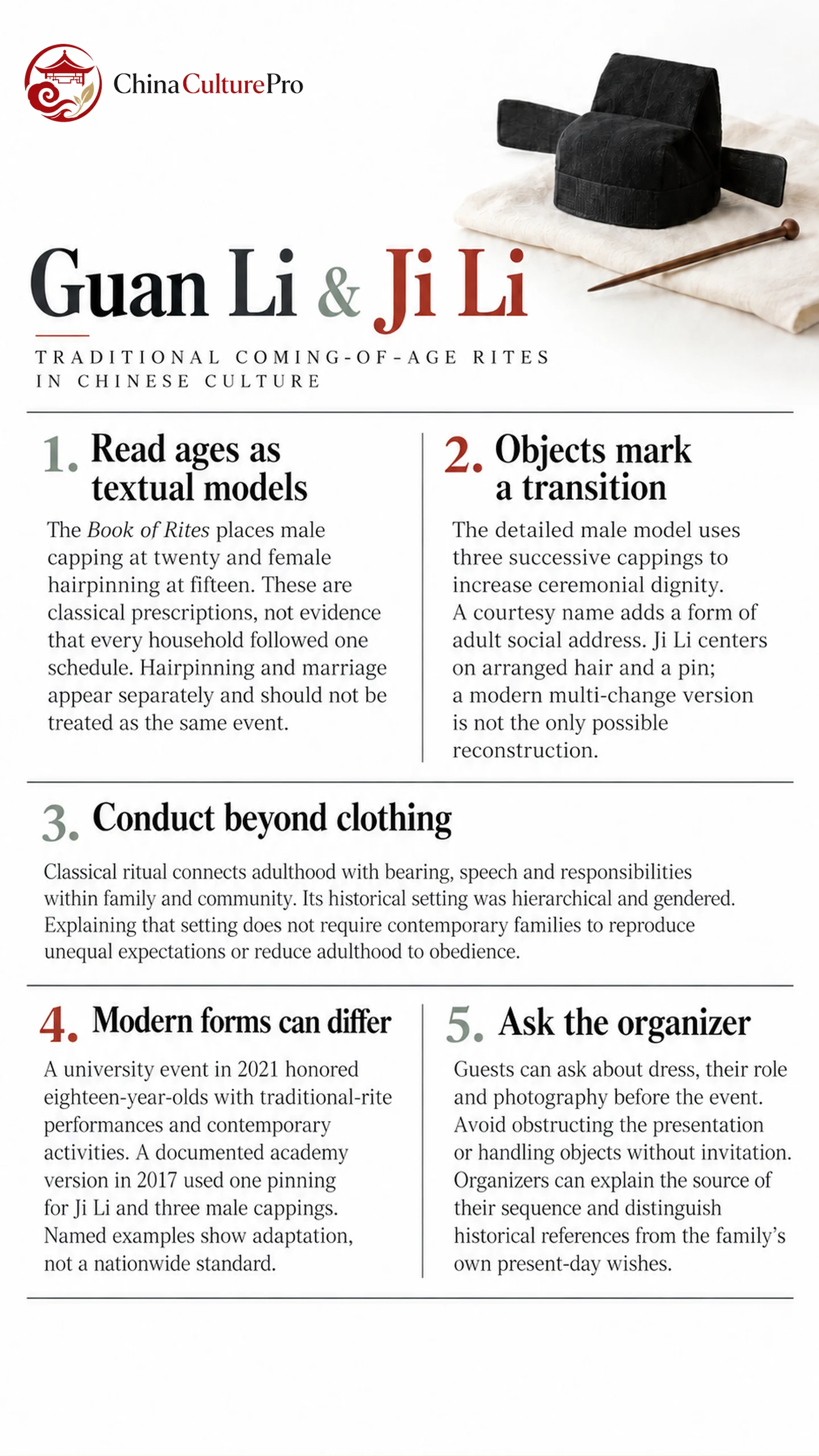
A cap placed on a young person’s head can seem like a small gesture. In a coming-of-age ceremony, it changes how the assembled family and guests recognize that person. The hairpin carries a related message. These rites connect clothing, speech and public acknowledgment within the wider world of Chinese family traditions.
Classical Ages and the Limits of the Evidence
The Liji(礼记,Lǐjì), commonly called the Book of Rites, provides an important starting point. Its “Inner Regulations” chapter places male capping at twenty and female hairpinning at fifteen. The same chapter discusses marriage separately, so hairpinning and a wedding should not be collapsed into one event. [1]
| Classical model | Central marker | Familiar textual age | Interpretive limit |
|---|---|---|---|
| Guan Li | Receiving an adult cap | Twenty | A ritual model does not describe every historical male life |
| Ji Li | Hair arranged and secured with a pin | Fifteen | Hairpinning does not itself constitute marriage |
These are prescriptions within a structured social world, not survey results. Elaborate arrangements presume resources, recognized roles and a community able to stage the rite. They cannot establish that everyone across China, throughout its history, followed the same schedule or possessed the same ceremonial wardrobe.
Read an age statement alongside its source and purpose. A text describing an ideal life course is doing different work from a modern school announcing a celebration for a particular cohort.
Caps, Hairpins and Courtesy Names
The detailed capping model gives clothing a central role. In the “Meaning of Capping” chapter and its commentary, three successive cappings increase ceremonial dignity. The changing headwear accompanies an increasingly formal presentation of the recipient. This is a sequence of acknowledgment, rather than a succession of unrelated outfits. [2]
The ceremony also connects adulthood with a courtesy name, zi(字,zì). This is an additional form of social address, distinct from the person’s given name. In the ritual setting, receiving it signals a changed relationship with others; it is more than choosing an attractive nickname.
Ji Li centers on a different object. A hairpin secures the arranged hair and makes a transition visible. However, a modern three-change hairpin ceremony should not automatically be described as the single surviving ancient script. Different reconstructions can select and combine elements differently.
Objects acquire meaning through actions and relationships. A cap displayed on a shelf is not, by itself, a completed Guan Li. The important questions are who presents it, what is said, how the recipient responds and how the gathering acknowledges the change.
What Adulthood Meant in the Ritual Setting
Classical capping is concerned with conduct as well as appearance. Correct bearing, speech, respect for family relationships and the obligations of a junior adult form part of its meaning. The ancestral setting connects an individual transition with continuity across generations. [2]
Within Confucian ethical traditions, the rite can be understood as a way of making responsibility tangible. Formal dress and deliberate movements require attention; elders and guests witness an expectation that behavior will change. Scholarly analysis relates this discipline to reverence and respect, while also recognizing the hierarchical social setting of the classical rite. [3]
That historical framework included unequal gender and status expectations. Explaining it does not require presenting those expectations as rules that contemporary families should reproduce. A present-day ceremony can emphasize self-respect, care for others, learning and responsibility while openly acknowledging that its historical models arose in a different society.
The connection with filial piety is therefore a useful interpretive link, but it should not reduce adulthood to unquestioning obedience. The ceremony’s meaning depends partly on how a community understands responsibility now.
Modern Revivals and Adapted Ceremonies
Today, traditional-looking rites can form part of a school celebration, a family milestone or a cultural reconstruction. Interest in Hanfu(汉服,hànfú), or traditional Han Chinese dress, can accompany these revivals, but wearing historical-style clothing and completing a coming-of-age rite are different activities.
A documented university celebration in 2021 honored students turning eighteen and included performances of capping and hairpin rites alongside speeches, gifts and other contemporary activities. This is a concrete example of adaptation, rather than evidence that the classical age benchmarks now govern all students. [4]
Another documented academy ceremony in 2017 explicitly adapted the milestone to eighteen. Its hairpin rite used one pinning, while its male sequence had three cappings. This matters because an elaborate online reconstruction with several changes of dress is one possible arrangement, not a universal requirement for Ji Li. [5]
Ask which version you are seeing: a reconstruction based on a named text, an institution’s adapted ceremony, or a family’s personal celebration. Each can be meaningful without being presented as an unchanged practice shared by everyone.
Attending or Planning a Ceremony Respectfully
For a guest, the organizer’s explanation is more useful than a generic list of supposed taboos. Ask about the dress expectation, your place during the ceremony and whether photography is welcome. Keep the central presentation unobstructed, and wait for an invitation before handling a cap, hairpin or other ceremonial object.
For a family or cultural group, identify the source of the chosen sequence and explain any adaptations. Separate witnessing from active participation, and make expectations about bows, speeches or offerings clear beforehand. A young person should understand what the actions mean rather than simply copy unfamiliar movements for photographs.
A concise program can help distinguish the rite’s historical references from the family’s present-day wishes. The strongest celebration makes the transition intelligible to its participants, instead of measuring authenticity by the number of garments or accessories involved.
FAQs About Chinese Coming-of-Age Ceremonies
At what age were Guan Li and Ji Li held?
Twenty for males and fifteen for females are familiar classical benchmarks. Historical circumstances and modern organizers can produce different arrangements.
Is Ji Li a wedding ceremony?
No. Hairpinning marks a life-stage transition; marriage is a separate rite, even where historical expectations connected the two.
Do all Chinese people have a capping or hairpin ceremony?
No. These rites are not universal contemporary family practices. Some communities revive or adapt them, while others mark adulthood differently.
Must a modern ceremony copy every historical detail?
No. Organizers can adapt the form, but should distinguish a contemporary choice from a claim about the original textual model.
Sources
[1] Book of Rites, via Wikisource. Inner Regulations
[2] Book of Rites and commentary, via Wikisource. The Meaning of Capping
[3] Religions. Reverence and respect in the traditional Chinese capping ritual
[4] Tsinghua University. Qiuzhen College’s first coming-of-age celebration
[5] Chungengyuan Academy, via Rujiazg. A documented 2017 coming-of-age ceremony