

Quick Answer: What Do Chinese Mourning Clothes Show?
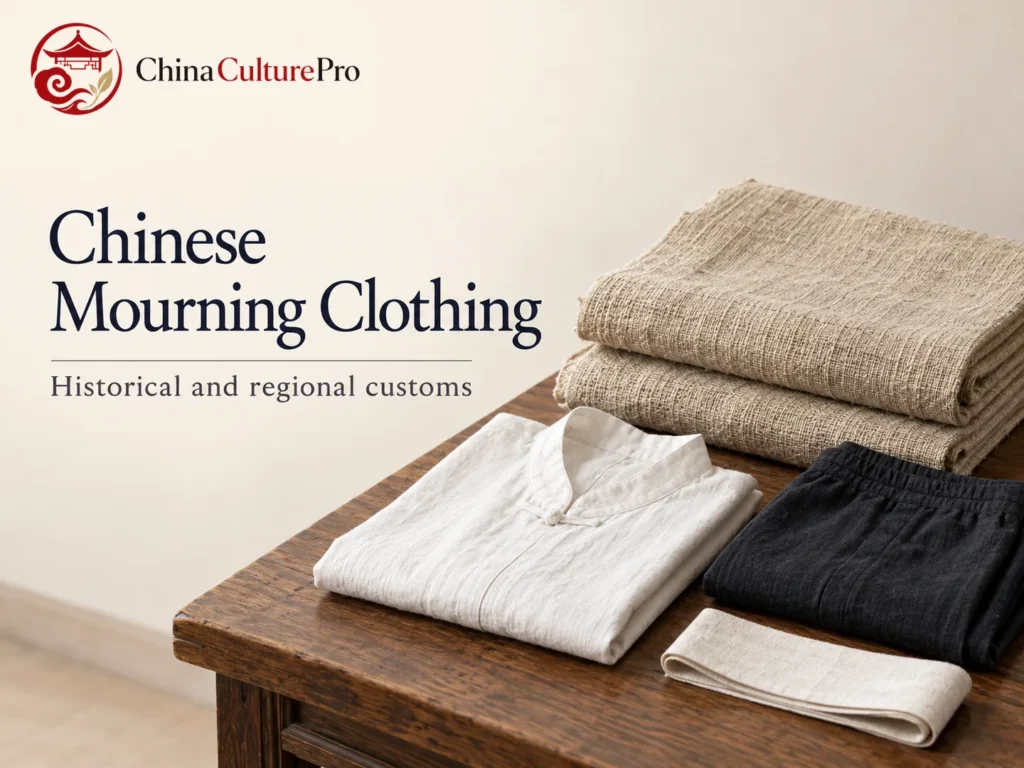
Chinese mourning clothing can make grief and a person’s relationship to the deceased visible. White or undyed fabric is familiar, but material, garment form, patches and local rules can matter as much as color.
- Mourning status: Special clothing or a small marker can identify someone observing a family death.
- Material and color: Coarse hemp, plain cotton and subdued modern clothing appear in different settings.
- Family relationship: Historical grades and some local markers distinguish mourning obligations within a family.
- Local choice: Region, religion, generation and household decisions shape the clothes actually worn.
A traditional family garment is not a universal guest uniform. Do not infer a mourner’s precise relationship, beliefs or depth of grief from one color without local context.
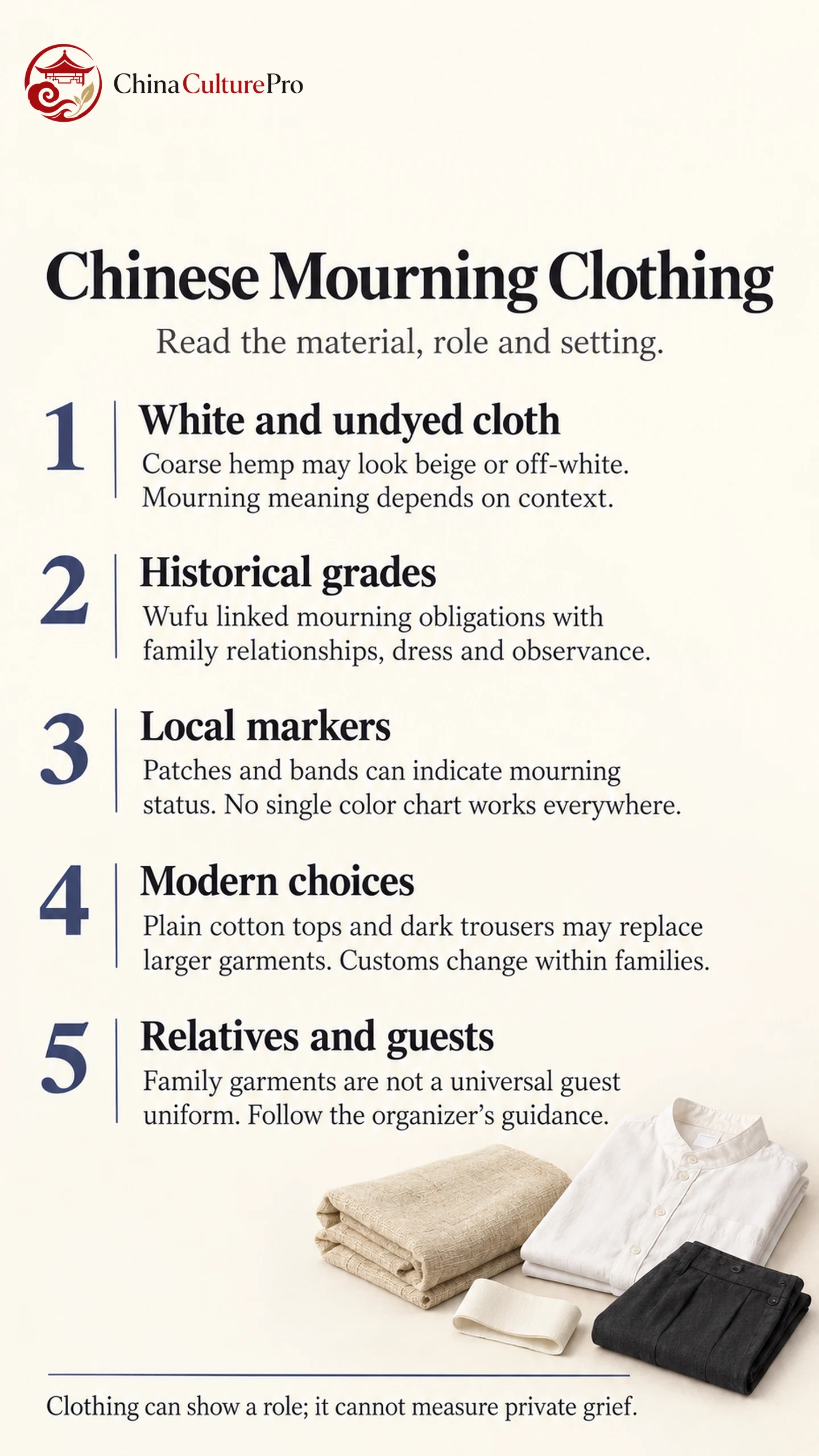
A photograph of a Chinese funeral may show rough pale robes, white shirts, dark trousers or small colored patches. These details can belong to different periods and communities, or even to different roles at the same event.
Understanding the clothing requires more than the phrase “white is the color of mourning.” The relevant questions are who is wearing it, what the garment or marker signifies in that family and whether the example is historical or contemporary.
Why White and Undyed Cloth Appear
Sangfu (丧服, sāngfú) means mourning clothing. In traditional settings, plain or coarse material could visibly separate a mourner from ordinary dressed life. An undyed hemp garment may look beige or off-white rather than a uniform bright white.
A firsthand account of a Teochew family’s 1989 funeral describes direct descendants wearing coarse hemp over plain white clothes, while a different group of grandchildren wore dark blue. The contrast shows why a color needs its family context: several garments and relationships appeared within the same remembered event.[3]
The material also communicated something. Roughness and a lack of ordinary adornment could make mourning visible beyond the selection of a pale color. A modern white cotton T-shirt can carry a related family purpose while being materially different from a traditional hemp garment.
None of this means every white object in Chinese life signifies death. Clothing at a funeral has a particular setting. Interpreting a color apart from that setting can turn a useful observation into an overly broad cultural rule.
The Historical Five Grades of Mourning
Wufu (五服, wǔfú), the traditional mourning categories, linked obligations to relationships. Anthropologist David K. Jordan’s account explains how distinctions could be expressed through clothing and the period of formal observance. His detailed charts follow a particular eighteenth-century Fujian ritual manual, with local variation explicitly noted.[1]
| Term | Meaning in this guide |
|---|---|
| Sangfu | Clothing worn to mark mourning |
| Wufu | Traditional categories of mourning obligations expressed through dress and observance |
This was a system of social relationships, not simply five fashionable colors. Generation, descent and marriage could affect how obligations were classified. A historical chart therefore needs to be read with its assumptions and source identified, especially where it treats men’s and women’s relationships differently.[1]
For a reader, the useful principle is that a garment could communicate a socially defined position in mourning. It should not be turned into a modern instruction that a person must withdraw from work or wear one fabric for a prescribed number of months.
Historical kinship categories also connect with family genealogy. They tell us how a community organized relationships, while the way a living family recognizes those relationships may have changed.
Regional Markers and Family Relationships
A small cloth patch can carry information that would otherwise be expressed by a larger garment. Singapore’s funeral-practices research records colored patches used to indicate mourning status, alongside white cotton tops and dark trousers in contemporary arrangements.[2]
The presence of a patch does not supply a national decoding chart. Its color, shape, placement and significance need to be understood within the relevant family or local practice. A rule encountered at one funeral should not be applied confidently to another.
| What you see | What it may help identify | What still needs context |
|---|---|---|
| A distinctive family garment | A mourner’s role in the observance | Which relatives wear it in that tradition |
| A cloth patch or band | A local mourning marker | Its color, placement and intended duration |
| Pale and dark clothing together | Different roles or a modern clothing arrangement | Whether color actually distinguishes relationships |
| A brighter element | A particular family or ceremonial choice | Its local explanation, rather than an assumed exception |
Singapore’s research also records variations connected with a deceased elder’s longevity. That supports asking about context; it does not support a universal rule that red becomes appropriate at every funeral above a particular age.[2]
If you are looking at an old family photograph, ask relatives what the garments meant at that event. Record their explanation with the date and place. A remembered local account is more informative than replacing the photograph’s details with a generic color chart.
Modern Clothing and Different Service Settings
A family may preserve a mourning marker while simplifying the rest of the outfit. The same Teochew family account contrasts the 1989 hemp clothing with a grandmother’s 2013 funeral, when children wore white T-shirts and black trousers. This is evidence of change within one family, with no national rate of change implied.[3]
The Singapore research similarly describes practical adaptations, including changing clothes for work and using a patch when returning to the wake. These examples show that a visible mourning role can continue even as daily arrangements change.[2]
Religion is another reason to identify the actual service. A garment worn by a ritual specialist should not automatically be read as a family member’s kinship marker. Likewise, the clothes chosen for a religious service and the markers used by relatives can answer different questions.
The wider Chinese funeral traditions guide explains that diversity. A photograph alone may not tell you the person’s role, the household’s beliefs or whether a garment was worn throughout the funeral or only for one part.
Simplification should not be equated with indifference. A plain modern outfit may be exactly what the family has chosen to make participation manageable and appropriate.
Family Mourners and Guests Need Different Guidance
Close relatives should ask the person coordinating the funeral whether a garment or marker will be supplied and how it is used. Do not order a historical costume independently unless the family has agreed that it belongs to their observance.
Guests need a different starting point. Follow the invitation or ask a family helper about suitable clothing. A subdued modern outfit can be appropriate without imitating the closest mourners. The funeral guest etiquette guide covers that practical decision in more detail.
For photographs or heritage displays, describe what is documented. “This family used a blue garment for these grandchildren” is more precise than “Blue always means grandchildren.” Avoid guessing a person’s family position merely to complete a caption.
Within Chinese family traditions, clothing can make a relationship and a period of observance visible. It cannot measure private grief. Later ancestor remembrance may continue after the special clothing is put away, through different objects and occasions.
FAQs About Chinese Mourning Clothing
Does white always mean death in Chinese culture?
No. White or undyed clothing has important mourning uses, but meaning depends on the object and setting. A funeral association should not be extended to every white garment or object.
Must every relative wear hemp mourning clothes?
No. Some families use traditional garments, while others choose modern clothing or small markers. Follow the arrangements for the particular funeral.
Can a colored patch identify the same relationship everywhere?
No. Marker systems vary. Ask about the local meaning rather than using one family’s color chart as a national rule.
Does a modern dark outfit show less respect?
No. Respect is not measured by how closely an outfit resembles an older garment. A modern outfit can fit the family’s chosen observance.
Sources
[1] David K. Jordan, University of California San Diego. The Traditional Chinese Mourning Categories
[2] Chinese Funeral Practices in Singapore research team. The Wake: Funeral Wear
[3] Eileen Teo. Take a Look at Traditional Chinese Funeral Mourning Clothing