
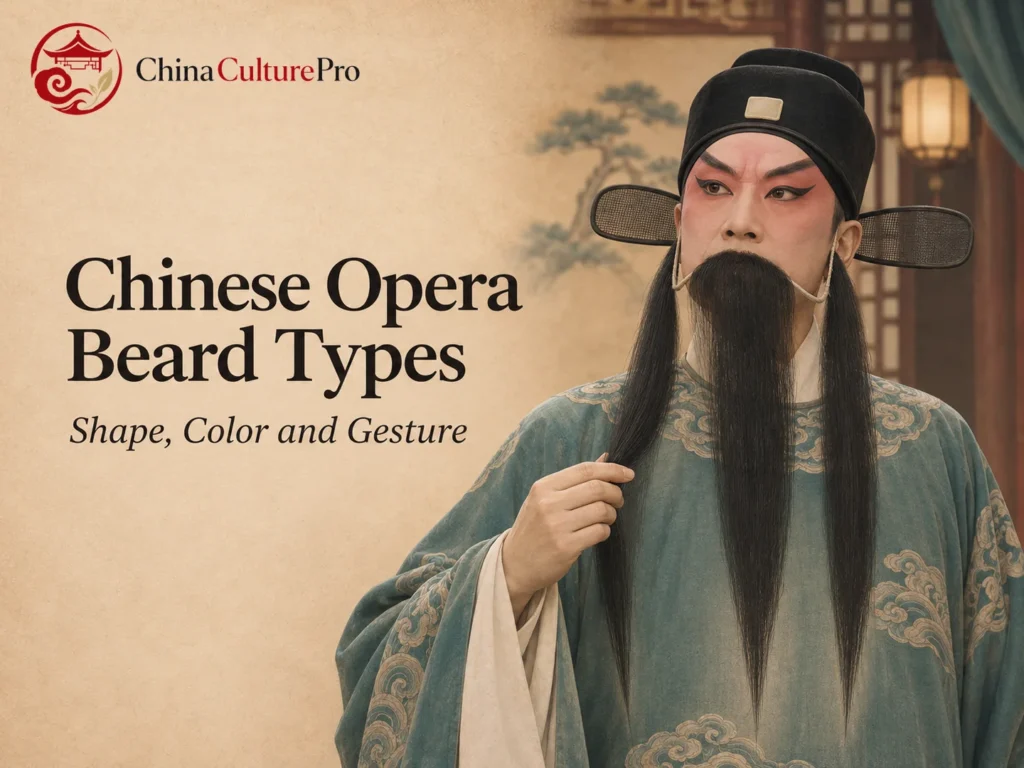

Quick Answer: What Is a Chinese Opera Beard?
A rankou (髯口, ránkǒu) is a false beard worn by a Chinese opera performer. In Peking opera, its outline and color give clues about a male character’s role and age. The performer can also move the beard deliberately as part of the acting.[1][2][3]
- Shape: Look for three hanging sections, one dense curtain, an opening at the mouth or a small moustache.[1][3]
- Color: Black, grizzled gray and white commonly suggest a progression in age.[1][4]
- Movement: A stroke, lift or toss can add meaning to a line or pause.[3][4]
The examples below use Peking opera for the detailed classification and Cantonese opera for one named character.

An opera beard changes the silhouette of a face before the actor speaks. It can also draw the audience’s eye to the exact moment when a character stops to think. Separating those two jobs makes a still photograph and a moving performance easier to read.
Beard Shapes and the Roles That Wear Them
The laosheng (老生, lǎoshēng) represents mature or older men, the jing (净, jìng) is a painted-face role, and the chou (丑, chǒu) is a comic role category. These role categories help explain why a thick beard and a tiny moustache can appear in the same production.[1][3]
| Form | How to recognize it | Typical use in Peking opera |
|---|---|---|
| Three-strand beard (三绺, sānliǔ) | Three hanging sections from the two cheeks and beneath the chin. | Often worn by a laosheng playing a mature dignitary or scholar.[1][3] |
| Full beard (满髯, mǎnrán) | A continuous dense shape that can cover the mouth. | Used in both laosheng and jing roles.[1][2] |
| Full beard with a mouth opening | A broad shape with a gap for the mouth and chin. | Used for some bold or impetuous jing characters.[1] |
| Short moustache | A compact upper-lip shape, sometimes with upturned ends. | Used in some chou roles, including agile comic characters.[1][3] |
Begin with the overall outline before trying to identify a character. If two characters wear the same beard shape, check their headwear and robe for further cues in the opera costume.[1][2][3]
What Beard Color Can Tell You
Compare beards of the same shape to isolate what the color contributes. A grizzled three-strand beard (黪三, cǎnsān) uses the same divided outline as the black or white version. The mixture of gray and dark hair can suggest a character older than one wearing a black beard, while white commonly suggests advanced age.[1][4]
Some characters wear red, purple or blue. In the museum’s examples, Sun Quan (孙权, Sūn Quán) wears a purple full beard in Ganlu Temple (甘露寺, Gānlù Sì), while Zhao Gao (赵高, Zhào Gāo) wears a grizzled full beard in The Cosmic Sword (宇宙锋, Yǔzhòu Fēng). A viewer comparing the two costumes can recognize the same beard form in different colors.[1][2]
How a Beard Moves in a Scene
The practice of handling the beard is known as beard skills (髯口功, ránkǒu gōng). A character can gather or hold the strands while thinking, or toss the beard in a burst of anger or frustration. The weight of the gesture depends on how it sits next to the speech, singing and body movement.[3][4]
Try watching where the hand arrives before the beard moves. A slow stroke during a pause focuses attention on the face and gives the audience time to read the character’s reaction. A toss draws the beard away from its resting position and can mark a much sharper change in mood.[3][4]
Guan Yu in Cantonese Opera
In Cantonese opera, the general Guan Yu (关羽, Guān Yǔ) is recognized as Lord Guan through a combination of red facial makeup, green robes and a long beard. Stroking or throwing back the beard is part of the role’s established movement. A narrowed gaze is another recognizable part of the role’s expression.[5]
When watching one of the films, notice when the actor holds his gaze after handling the beard. The pause gives the viewer time to take in the expression and the long outline of the beard together.[1][5]
FAQs About Chinese Opera Beard Types
What are Chinese opera beards made of?
Workshop materials have included horsehair, yak hair, human hair and nylon. Fibers are fixed to a wire frame to form the stage beard.[2]
Does a red opera face mean the beard is red?
Beard color and face-painting color are separate choices. Lord Guan’s red face belongs to an overall costume and makeup design that also includes a long beard.[1][5]
Sources
[1] China National Peking Opera Company. Which Peking Opera Characters Wear Beards?
[2] Chinese Opera Museum. What Do Opera Performers’ Beards Mean?
[3] TaipeiEYE Theatre Exhibition. Rankou: Beard
[4] National Centre for the Performing Arts. An Opera Workshop on Stroking the Beard
[5] Hong Kong Film Archive. Cantonese Opera Films: The Legend of Guan Gong