
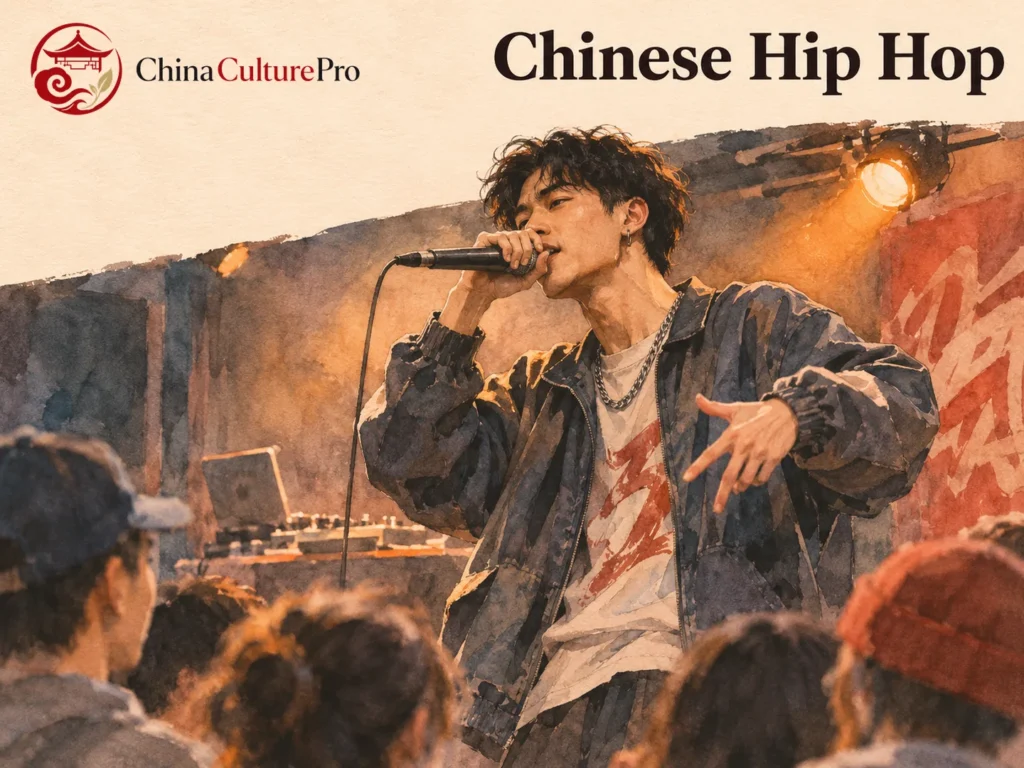

Quick Answer: What Shapes Chinese Hip-Hop?
Chinese hip-hop grew from local music and performance scenes that adapted a form with roots in Black American culture. In mainland China, rappers have worked in Mandarin, regional speech and mixed-language verses. Chengdu’s Higher Brothers and the 2017 streaming competition The Rap of China (中国有嘻哈, Zhōngguó yǒu xīhā) illustrate different routes to a large audience.[1][2][3]
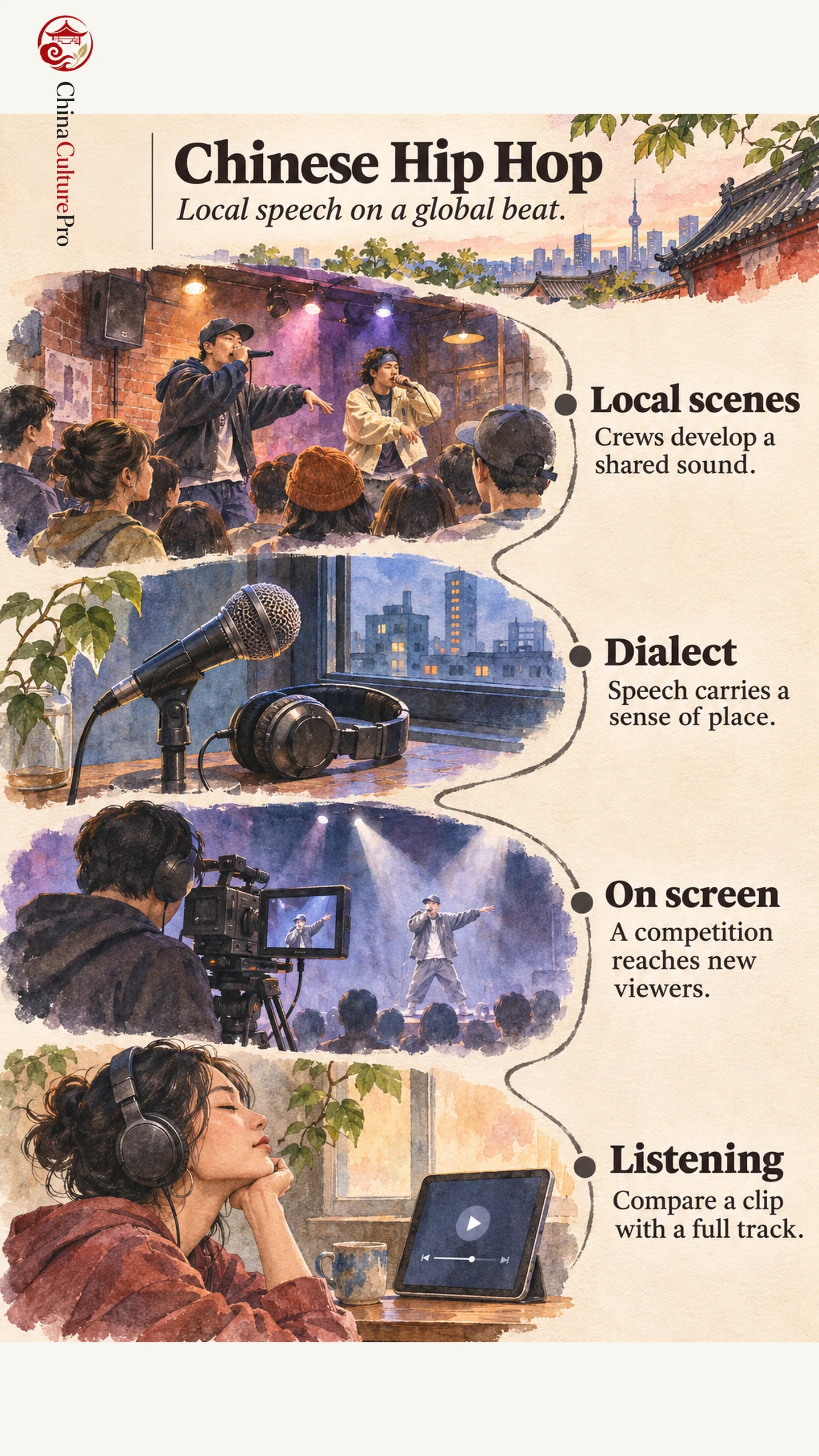
- Local scenes: Artists develop a sound through venues, crews and recordings.[2]
- Language: Local pronunciation and vocabulary can carry a sense of place.[1]
- Distribution: Streaming and television reshape how audiences discover performers.[2][3]
The music can travel far without losing its local voice.
A line that sounds familiar to someone in Chengdu may catch another listener’s attention through its rhythm alone. A verse can make a local connection even when it reaches people who hear only part of its meaning.[1]
How Rap Found Local Scenes in China
Hip-hop’s musical and cultural forms developed in Black American communities and were taken up internationally. Mainland Chinese performers adapted rap to local languages, shared interests and the performance spaces available to them. Crews and local scenes provided ways for performers to work together and for listeners to recognize their sound. Their activity preceded the large streaming competitions that later made rap a mainstream entertainment subject.[1][2][3]
A local scene can include several kinds of performance and listening at once. A venue, a crew release and a shared clip each reach different people. An artist may adapt a performance to the room or the recording.[2]
What Dialect Does in a Chengdu Verse
Higher Brothers, a quartet based in Chengdu, illustrate what happens when locally marked speech circulates internationally. The group’s verses can draw on Sichuan speech, Mandarin and English. Choice of language affects which rhymes stand out, who catches a joke and what sounds immediately familiar. A recording can address local listeners through its speech even as it circulates well beyond them.[1]
For someone hearing the music in translation, rhythm and delivery can remain audible even when a specific wordplay is lost. A translated line can tell you what was said. Listening to the original lets you hear where the rapper places the emphasis.[1]
How The Rap of China Changed the Audience
The 2017 streaming competition made rappers visible to viewers outside their earlier audiences. An audition, a reaction from a judge and a short edited performance can each give viewers a way to follow the competition. The program’s format also gives editors and producers a role in how the music is framed. That belongs to the broader history of Chinese reality television.[2][3]
Compare a performance clip from a competition with a complete artist recording. The clip can introduce a performer quickly. The recording gives more room to hear how the verse develops and what comes before or after it.[2][3]
How to Listen Across Scenes
Start with the performer, the city and the release. Listen for changes of register or language and for how the voice fits against the beat. Then try a full recording, a live set or another artist from the same scene. A performance at a Chinese music festival adds another setting in which delivery and audience response shape the experience.[1][2]
FAQs About Chinese Hip-Hop
Is Chinese Rap All in Mandarin?
No single language defines the scene. Artists can rap in Mandarin, regional speech or several languages in the same track. Higher Brothers provide a documented Chengdu example.[1]
Did The Rap of China Start Chinese Hip-Hop?
The 2017 program brought rap to a much wider viewing audience. Artists, crews and local scenes were already making and sharing music.[2][3]
Is Chinese Hip-Hop the Same as Chinese Rap?
Rap describes the musical practice of rhythmically delivering words. Hip-hop is a wider culture that can include DJing, dance and other forms of expression.[3]
Sources
[1] East Asian Journal of Popular Culture. Language, Identity and Unintelligibility: A Case Study of the Rap Group Higher Brothers
[2] Hong Kong Baptist University. Localization and Mainstream Emergence of Hip-Hop Music in China
[3] Language and Intercultural Communication. Culture, Communication and Hybridity: The Case of The Rap of China