

Quick Answer: How Do Chinese Games Use Traditional Music?
Chinese game music can combine traditional instruments, regional singing or storytelling, and orchestral writing. In Genshin Impact’s Liyue music, guest musicians recorded alongside symphony orchestras. The soundtrack credits for Black Myth: Wukong distinguish instrumental performers from regional storytelling and chanting.[1][2][3]
- Instruments: A lute, zither and flute offer different kinds of attack and sustain.[1]
- Performance: A regional vocal practice contributes a way of telling a story as well as a sound.[1]
- Placement: A soundtrack album gives the music a different listening context from the game.[2][4]
Identify what you hear by comparing the scene with the recording credits.

A short plucked phrase can stand out against a long orchestral line. A storyteller’s voice can change how a scene feels even before the player understands the words. The two effects come from different musical choices.[1][2][4]
Traditional Instruments and the Sound They Add
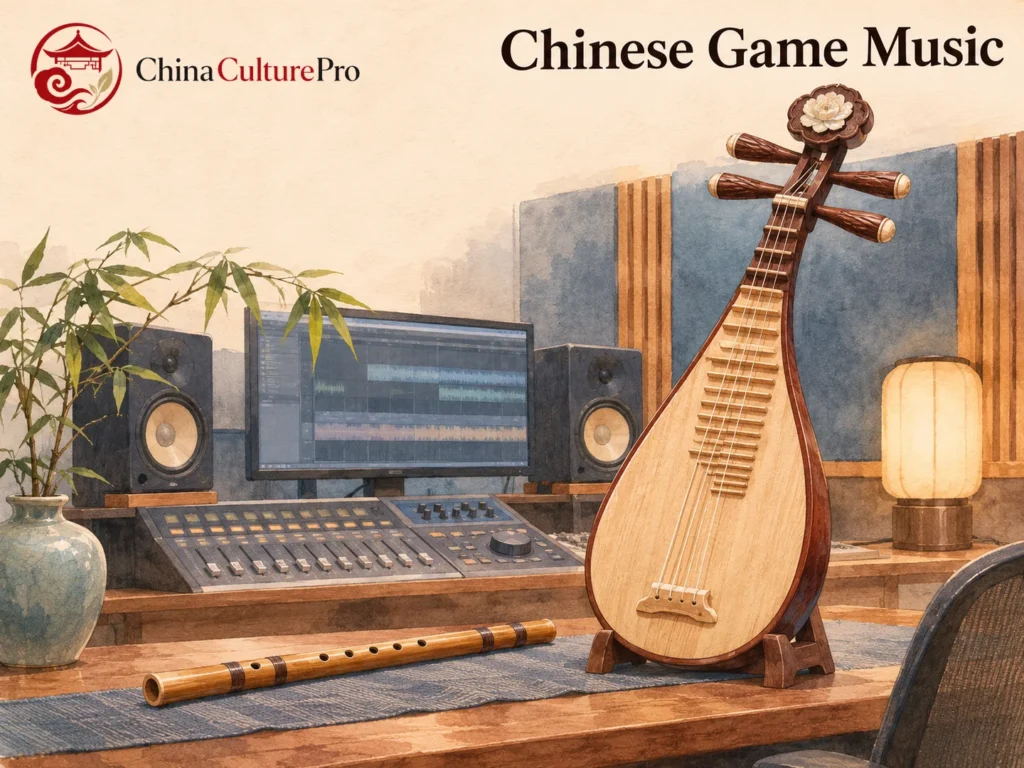
The pipa (琵琶, pípá) is a plucked lute. A quick run of notes can have a sharply defined start, and rapid repeated plucks can sustain a line. The guzheng (古筝, gǔzhēng) is a long zither with movable bridges. Its resonant strings allow a broad sweep across notes or a bend on a single note. The dizi (笛子, dízi) is a transverse bamboo flute, often recognizable by the bright buzz of its membrane. Black Myth: Wukong credits performers on all three.[1]
Treat these descriptions as listening clues. An exposed solo is easier to identify than a short note inside a large ensemble. A credit establishes who and what contributed to the recording without identifying the instrument in every moment.[1][4]
Liyue: Traditional Musicians and a Symphony Orchestra
The Liyue album Jade Moon Upon a Sea of Clouds brings together the London Philharmonic Orchestra, the Shanghai Symphony Orchestra and guest folk musicians. Its three discs group the region’s music into different listening settings, including battle music. Composer Yu-Peng Chen worked within a score whose orchestral foundation could incorporate sounds associated with different in-game regions.[2][3]
Listen for an instrument that introduces the melody, then notice who takes it up or fills the space behind it. A traditional instrument may supply a short color within a much larger arrangement. Its role can change when the same melodic idea returns.[3][4]
Black Myth: Wukong and Regional Performance
The soundtrack for Black Myth: Wukong credits Shanbei storytelling (陕北说书, Shǎnběi shuōshū), a narrative performance tradition of northern Shaanxi, as a separate category from studio recordings of individual instruments. It names Xiong Zhuying for this contribution. The same credits separately list Huayin Laoqiang and Buddhist chanting. Those credits distinguish named performance traditions from the instruments recorded for the score.[1]
The music belongs to a reimagined world. Chinese game adaptation explains how that world relates to Journey to the West. The credits help identify which parts of the score draw on particular living practices.[1][4]
How to Compare a Game Cue With Its Album Track
Choose a passage and listen to it in the game before playing the album track. In the scene, notice whether the music accompanies exploration, dialogue or a change of pace. On the album, follow the phrases without sound effects or player decisions drawing your attention elsewhere.[2][4]
A similar approach works for Chinese film music. The difference in a game is that the player’s path can affect when a cue is heard. The album puts the region’s tracks in a fixed listening order.[2][3][4]
FAQs About Chinese Game Music
Is a Pipa the Same as a Guzheng?
The pipa is a lute, while the guzheng is a zither. The long row of guzheng strings and the pipa’s neck make the instruments easy to distinguish visually.[1]
Are Traditional Instruments Used Alone?
They can be featured as solo instruments, placed in an ensemble or mixed with an orchestra. The recording context and the musical role vary by cue.[1][2]
Where Can I Check Who Played on a Soundtrack?
Look for the soundtrack’s official credit list or the publisher’s release notes. Individual performer credits can be more specific than a summary of the album’s style.[1][2]
Sources
[1] Game Science. Black Myth: Wukong Soundtrack Selection
[2] HoYoverse. Jade Moon Upon a Sea of Clouds
[3] Genshin Impact Music Team. Genshin Impact Music Creation Story 01
[4] Binger Hu and Chong Yew Yoong. Traditional Chinese Musical Resources in Chinese and China-Themed Games