

Quick Answer: Why Can Handwriting Look Different from Print?
Handwritten forms (手写体, shǒuxiětǐ) and printed forms (印刷体, yìnshuātǐ) can present the same Chinese character differently. Typeface design and regional glyph conventions affect appearance without necessarily changing character identity.[1][5]
- Style: Printed type can imitate handwriting.[1]
- Structure: Compare components and their positions before minor decorative details.
- Reference: Follow the writing model used by your course or regional standard.
A different appearance is a reason to check the form, not automatic proof that it is either correct or wrong.

A character learned from a textbook may look unfamiliar in a note or on a screen. Separate the writing medium, the typeface style and the character form. Use a handwriting model to decide which marks belong in your own writing.
Compare Structure Before Surface Details
Regular script (楷书, kǎishū) provides a useful model for learning clearly separated strokes. Kai typefaces preserve handwriting features while remaining printed fonts. Song-style print, by contrast, uses stroke contrast and decorated terminals.[1] Our Songti and Heiti guide explains those typeface features.
| Feature to compare | Useful reading question |
|---|---|
| Components | Are the same parts present in the same arrangement? |
| Proportions | Has a component become narrower or moved slightly? |
| Stroke endings | Is the difference a terminal design or a genuinely separate stroke? |
| Connections | Does the model show a deliberate connection, or only overlapping printed shapes? |
Use these questions to locate the difference before deciding whether it is acceptable. Some small differences identify another character; others reflect the font or regional convention.[5]
A Concrete Example: 木 and Its Component Form
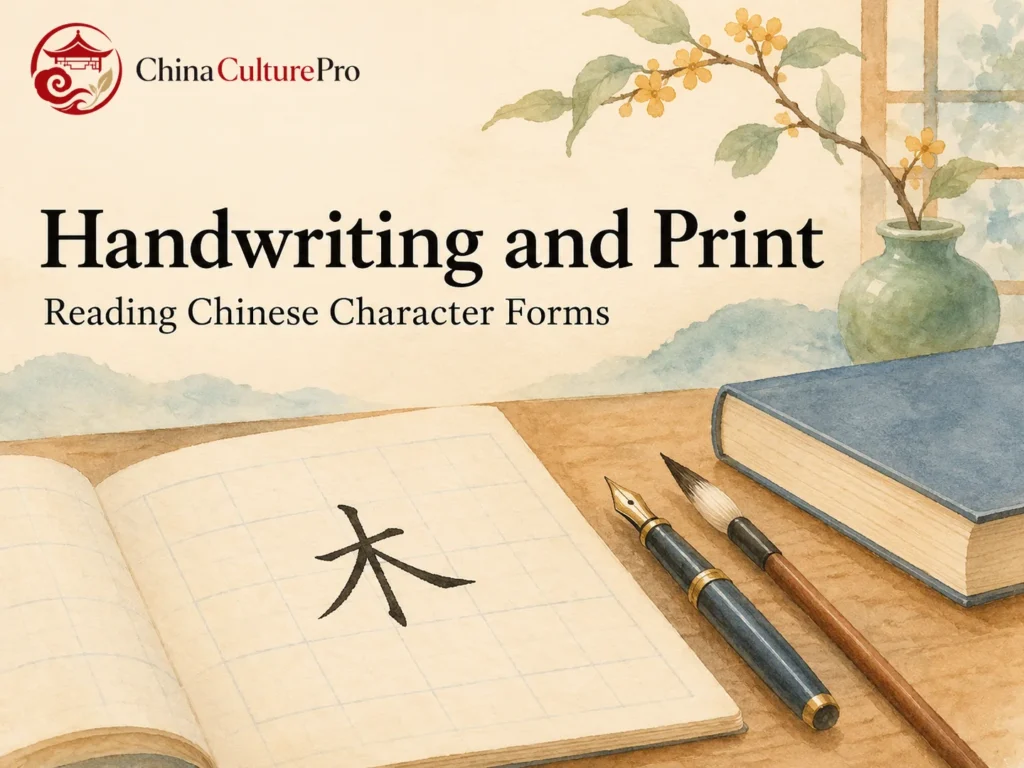
Taiwan’s Ministry of Education describes standalone 木 (mù, “wood”) with four strokes: horizontal, vertical, left-falling and right-falling. Its regular-script vertical stroke has no hook.[2]
In its description of 李 (lǐ, “plum”, also a surname), the upper 木 ends with a dot, and its unhooked vertical lightly meets the lower 子. This illustrates a component’s positional adjustment; it is not a conversion between handwriting and print.[3]
The lesson is to compare a component in its actual character, rather than enlarging and copying its standalone form mechanically. These descriptions follow the cited Taiwan reference; use the model appropriate to your learning context.
How to Check an Unfamiliar Form
- Identify the whole character from the word and sentence. Keep a copy of the original form for comparison.
- Check a reliable character reference matching your course or region. Confirm the character and its components rather than guessing from resemblance.
- Compare the stroke sequence with a handwriting model or animation. The Ministry of Education’s learning site provides animated stroke-order demonstrations.[4]
- Write the character slowly, then compare component placement and stroke connections with the model. Record the difference you were checking.
Keep simplified and traditional character choices separate from typeface and personal penmanship.
FAQs About Handwriting and Print
Should I copy every detail of a printed font?
Use a handwriting model for practice. Printed decoration and stroke contrast belong to type design; they need not become separate pen strokes.[1]
Is a different shape necessarily a mistake?
No. Fonts can follow different regional glyph conventions for the same underlying character. Verify the intended form rather than judging from unfamiliarity alone. Our encoding guide explains character identity and display.[5]
Is handwritten Chinese always cursive?
No. Clear regular-script handwriting is a useful learning model. Handwriting and cursive style are not equivalent categories; printed Kai can itself preserve handwriting features.[1]
Sources
[1] W3C Chinese Layout Task Force. Requirements for Chinese Text Layout: typeface styles, editor’s draft
[2] Ministry of Education. Dictionary of Chinese Character Variants: 木
[3] Ministry of Education. Dictionary of Chinese Character Variants: 李
[4] Ministry of Education. Standard Chinese Character Stroke Order Learning Site: User Manual
[5] Unicode Consortium. Chinese and Japanese FAQ