

Quick Answer: How Are Fractions and Decimals Read?
Mandarin fractions (分数, fēnshù) name the denominator before the numerator, joined by 分之 (fēn zhī). Decimals (小数, xiǎoshù) use a decimal point, 点 (diǎn), followed by individual digits.[1][2]
- Fraction: 3/4 is 四分之三, sì fēn zhī sān.[1]
- Decimal: 0.75 is 零点七五, líng diǎn qī wǔ.[2]
- Percentage: 75% is 百分之七十五, bǎi fēn zhī qīshíwǔ.[2]
Identify the notation before reading; the same value can have different spoken forms.

A fraction, a decimal and a percentage may describe the same amount. Their word order and digit grouping differ. Keep the number’s unit and surrounding sentence so that a correct pronunciation still conveys the intended quantity.
Fractions: Denominator First
The pattern is denominator + 分之 + numerator. In a written fraction, the denominator is below the bar; it is not necessarily the larger number.[1]
| Value | Mandarin | Pinyin |
|---|---|---|
| 1/3 | 三分之一 | sān fēn zhī yī.[1] |
| 2/5 | 五分之二 | wǔ fēn zhī èr.[1] |
| 7/4 | 四分之七 | sì fēn zhī qī.[1] |
In 7/4, the denominator four comes before the larger numerator seven. Follow the numbers’ roles rather than their relative sizes.
Decimals: Read Every Digit After the Point
Read the whole-number part normally, say 点 (traditional 點), then say the following digits individually from left to right.[2]
| Value | Mandarin | Pinyin |
|---|---|---|
| 12.34 | 十二点三四 | shí’èr diǎn sān sì.[2] |
| 0.06 | 零点零六 | líng diǎn líng liù.[2] |
For 12.34, the final digits are three and four, not thirty-four. In 0.06, the zero after the point matters: removing it gives 0.6, a different value.[2]
This digit-by-digit tail differs from reading an ordinary whole number. Date writing provides another context in which numeral reading depends on the number’s job.
Percentages and Equivalent Values
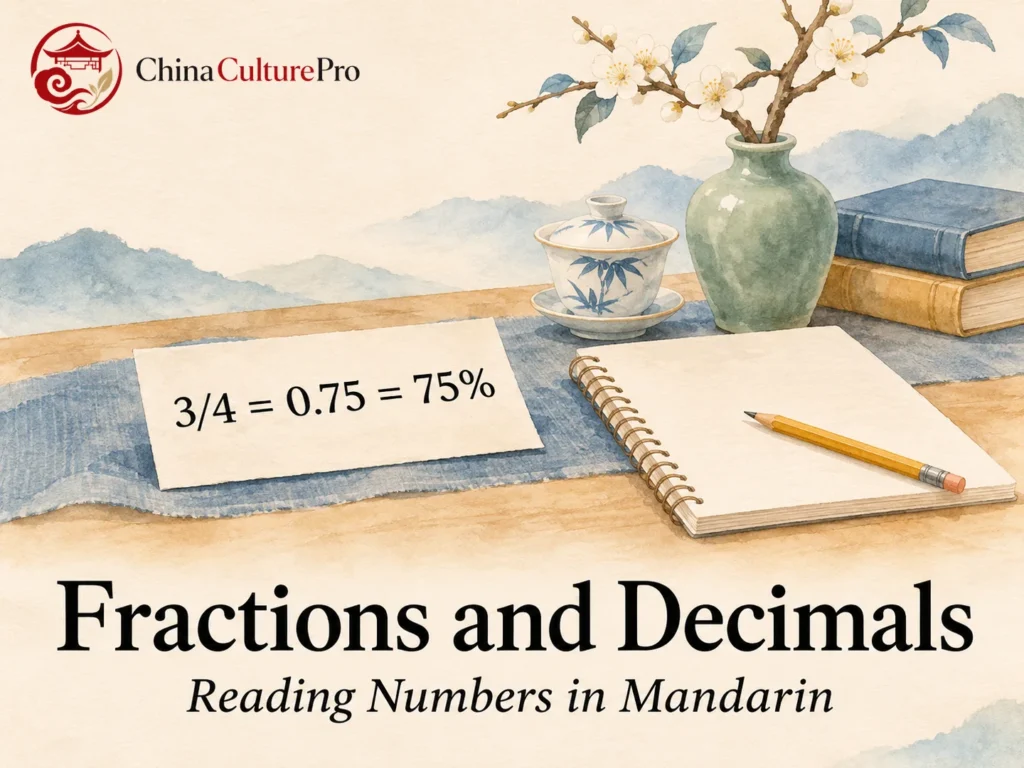
Percentages use 百分之 (bǎi fēn zhī), meaning a fraction with one hundred as denominator. In this constructed equivalence, 3/4 = 0.75 = 75%. The forms name the same value through different notation.[2]
Do not confuse 0.75 with 0.75%: the percent sign changes the quantity. Likewise, carry over any unit from the source sentence. A length and a share of a group are different kinds of reference even when their numerical digits match.
For noun quantities, measure words may also be needed. These reading patterns concern modern notation; Chinese mathematics history covers a broader subject.
FAQs About Chinese Fractions and Decimals
How do I say one half?
二分之一 (èr fēn zhī yī) follows the fraction pattern. 半 (bàn), “half”, and 一半 (yíbàn), “one half”, are also useful everyday forms.[1][3]
Can I omit zeros after the decimal point?
Read the digits that are written. Trailing zeros can leave the numerical value unchanged, as in 0.50 and 0.5; an internal zero, as in 0.05, cannot simply be removed.[2]
Does reversing 分之 keep the same value?
No. 三分之二 is 2/3; 二分之三 is 3/2. Reversing the two numbers changes numerator and denominator, rather than merely changing the wording.[1]
Sources
[1] Congze Xu. A Mixed Methods Study of Chinese Students’ Construction of Fraction Schemes
[2] Hong Kong Education Bureau. Explanatory Notes to the Primary Mathematics Curriculum, Key Stage 2
[3] Ministry of Education. Revised Mandarin Chinese Dictionary: 半