


Quick Answer: How Are Chinese Dates Written?
A full Chinese date normally runs from year to month to day: 2026年11月7日 means 7 November 2026. The markers are year (年, nián), month (月, yuè) and day (日, rì).[1]
- Order: Put the largest unit first.[1]
- Reading: Say a modern Gregorian year digit by digit.[1]
- Context: Preserve any calendar or era label.
Chinese characters alone do not identify the calendar being used.
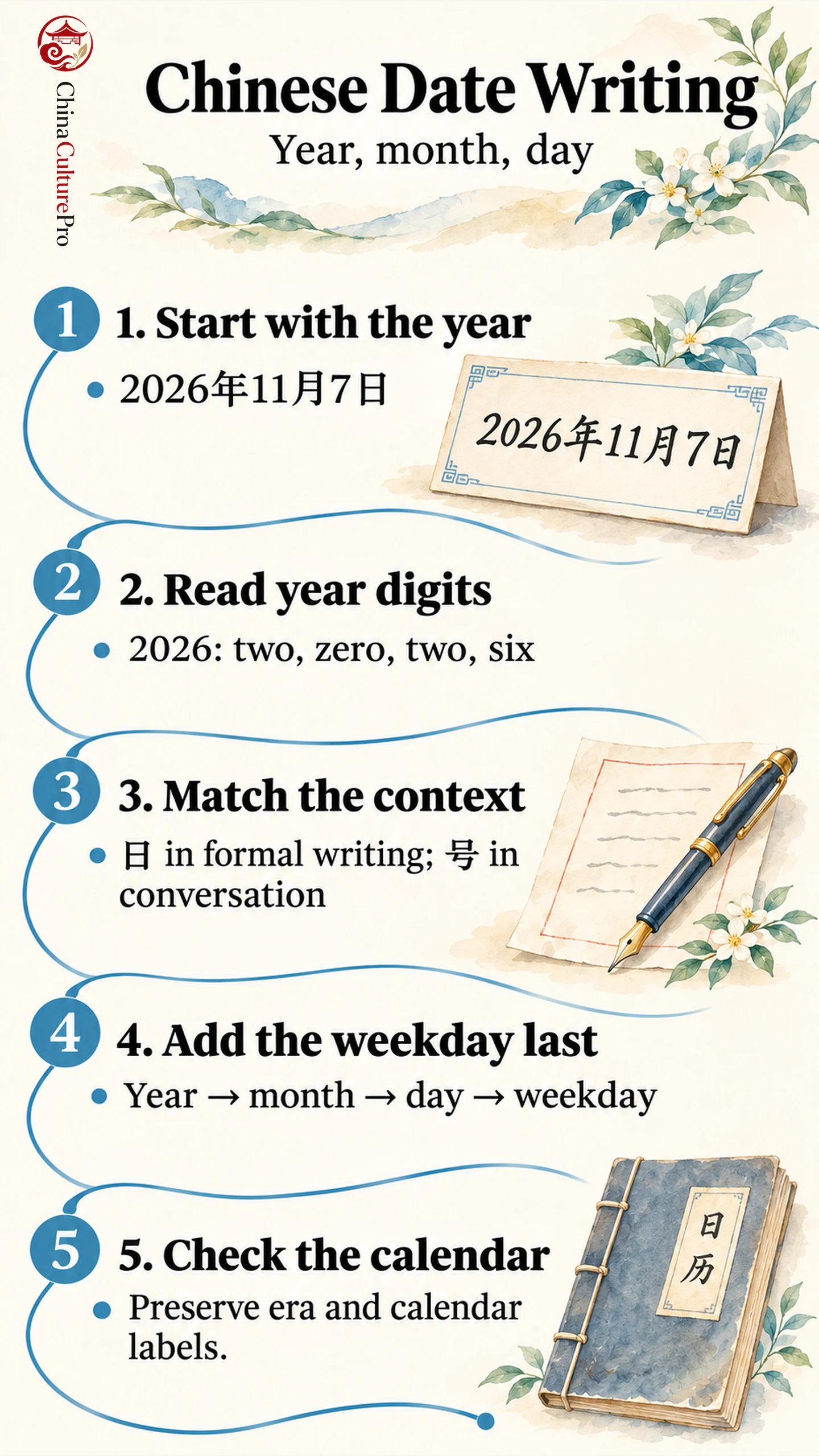
Dates appear in forms, letters, calendars and historical documents. First locate the unit markers, then check whether the year belongs to the Gregorian calendar or another dating system. Do not guess the order of an unlabeled slash date from the surrounding language alone.
Write and Read a Complete Date
Here is a constructed Gregorian example, broken into its three parts.
| Part | Written example | Mandarin reading |
|---|---|---|
| Year | 2026年 | èr líng èr liù nián.[1] |
| Month | 11月 | shíyī yuè.[1] |
| Day | 7日 | qī rì.[1] |
Together, read it as èr líng èr liù nián shíyī yuè qī rì. The year is a sequence of digits; the month and day use ordinary numbers. Months run from one to twelve; day numbers depend on the month.[1]
Chinese uses the day number directly; it does not need an added ordinal marker for “seventh”.
Chinese Numerals and Numeric Forms
The same example can be written 二〇二六年十一月七日. The mainland publications standard uses 〇 for zero in a year written with Chinese numerals. It distinguishes this from 零 used within numerical quantities.[2]
A full numeric form such as 2026-11-07 retains year-month-day order. The standard permits hyphenated full dates and discourages shortening years to two digits. Follow the receiving form’s labels and keep the chosen style consistent.[2]
A bare 11/7 lacks the unit markers that make 11月7日 clear. Add the year and labels when ambiguity matters.
Check the Calendar and Year Label
In Taiwan documents, Republic of China (民國, Mínguó) years may appear. The official correspondence table pairs 民國115年 with 2026. It does not mean the Gregorian year 115.[3]
Traditional Chinese calendar dates can include month names, leap-month markers or reign-era years. The publications standard retains Chinese numerals for such traditional dates. Changing their characters into Arabic digits does not convert them to Gregorian dates.[2]
For historical conversion, identify the era and any leap month first. The Academia Sinica converter has separate fields for these details. Read our Chinese and Gregorian calendar comparison before assuming two dates coincide.[4]
FAQs About Chinese Date Writing
Can I use 号 instead of 日?
The spoken date marker 号 (hào) is common in conversation; 日 is usual in formal writing. For this example, 十一月七号 is a conversational alternative to 十一月七日.[1]
Where does the weekday go?
After the date. Weekday (星期, xīngqī) takes 一 through 六 for Monday through Saturday; Sunday is 星期日 or 星期天.[1]
Does Chinese writing mean a lunar date?
No. Look for the calendar label and context. A Gregorian date can be written entirely with Chinese numerals. Traditional Chinese calendar months need their own interpretation.[2]
Sources
[1] SN Mandarin. HSK Level 1 Course Book, Lesson 3
[2] Standardization Administration of China, reproduced by Sichuan University of Arts and Science. GB/T 15835–2011: General Rules for Writing Numerals in Publications
[3] Department of Household Registration, Ministry of the Interior. Year Correspondence Table
[4] Academia Sinica. Chinese–Western Calendar Conversion