

Quick Answer: What Were Chinese Examination Cells?
Chinese examination cells, called haoshe (号舍, hàoshè), were individual spaces where candidates wrote and rested during major civil-service examinations. A cell belonged to a larger gongyuan (贡院, gòngyuàn), or examination compound, within the keju system (科举, kējǔ). The familiar rows of small cubicles are especially associated with the Ming dynasty (明朝, Míng Cháo) and Qing dynasty (清朝, Qīng Cháo).[7]
- Space: One candidate occupied a narrow compartment.
- Use: Movable boards could support writing, sitting and sleeping.
- Control: Isolation worked alongside searches and regulated handling of answer papers.[3][7]
These arrangements varied over time; they do not describe every examination in Chinese history.

Examination cells organized large numbers of candidates into separate workspaces. Their boards and lanes supported writing and daily needs, while administrative boundaries controlled the flow of people and papers. The cramped cubicle was one part of an institution whose demands began long before examination day.
Inside a Cell: Writing, Sitting and Sleeping
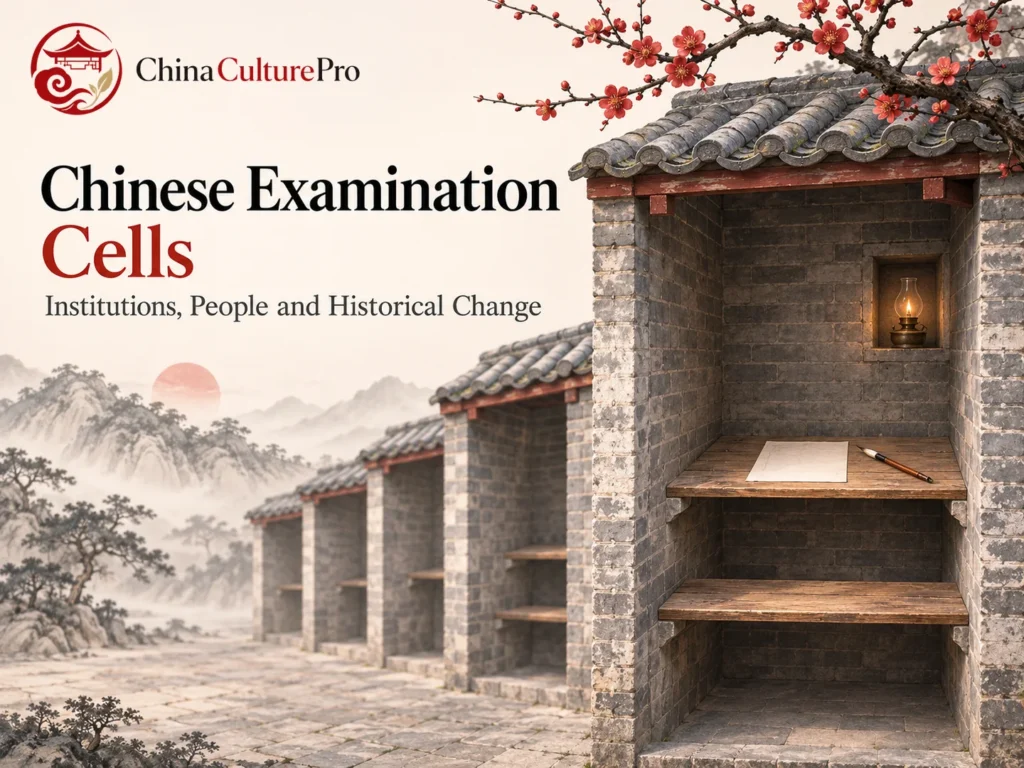
A Qing illustrated account shows a cell enclosed by three walls and open at the front, facing south. It measures four chi (尺, chǐ) deep and three wide. Chi was a historical length unit; converting every description into one exact modern floor area would imply a uniformity the evidence does not support.[1]
| Element | Use |
|---|---|
| Wall ledges and upper board | Supported the writing surface. |
| Lower board | Provided a place to sit. |
| Rearranged boards | Made a platform for resting or sleeping. |
A wall recess could hold a lamp and belongings. In the Nanjing account, brick partitions and tiled roofs separated the cells, while a candidate could hang an oilcloth curtain against wind and rain. An open front therefore did not mean a completely unroofed enclosure.[1][5]
Rain and maintenance could disrupt the system. Qing regulations record damaged walls and leaking cells, and authorize postponement when repairs and travel conditions made the scheduled examination impracticable.[8]
How Candidates Moved Through an Examination
The late imperial provincial examination (乡试, xiāngshì) and metropolitan examination (会试, huìshì) commonly comprised three sessions. Qing regulations scheduled sessions on the ninth, twelfth and fifteenth days of the relevant lunar month, with candidates admitted the day before each and released the day afterward. The familiar description of a nine-day ordeal refers to a sequence of sessions, not necessarily nine uninterrupted days in one locked cubicle.[8]
At Jiangnan Gongyuan (江南贡院, Jiāngnán Gòngyuàn) in Nanjing, candidates brought food and used the cells for meals as well as writing and rest. Rows were indexed with characters from the Thousand Character Classic (千字文, Qiānzì Wén). Lane entrances had lamps and water containers, and latrines stood at row ends. Lanes, water and sanitation supported the many individual workspaces.[2][5]
Security Extended Beyond the Candidate’s Cubicle
Officials checked candidates at entry to detect concealed material, impersonation and other violations. The compound also separated candidates and administrative staff from the examiners handling questions and assessment. Staff boundaries controlled access to questions and papers.[4][5][7]
After submission, mifeng (弥封, mífēng) concealed identifying information on the paper. Tenglu (誊录, ténglù) produced a new copy, commonly in red ink, so that the examiner did not simply recognize the candidate’s handwriting. Duidu (对读, duìdú) checked the copy against the original. Names, handwriting and copying errors were therefore different problems addressed by different procedures.[3]
These safeguards did not eliminate malpractice. Records describe collusion and prearranged textual signals, as well as the rules intended to stop them. [3][7]
Opportunity, Preparation and Unequal Resources
Candidates prepared through years of classical learning. Qing civil examinations drew on the Four Books (四书, Sì Shū) and Five Classics (五经, Wǔ Jīng), within a Confucian educational tradition. The eight-legged essay (八股文, bāgǔwén) was an important regulated form, alongside other questions; content and requirements changed over time.[7]
Travel, lodging, books and prolonged preparation required resources. Some scholars supported themselves through teaching, editing or advisory work. Attaining the provincial degree of juren (举人, jǔrén) could improve social standing and open opportunities, but examination success did not mean that a government post was immediately available. The repeated cubicles standardized the immediate workspace, while preparation remained unequal.[4]
From Working Compounds to Historical Evidence
Earlier examinations could use borrowed premises. Specialized compounds developed later, and their walls, temporary shelters and seating continued to change through the Ming and Qing periods. The brick cubicle was an evolving solution to managing candidates.[6]
Jiangnan Gongyuan began in 1168 and expanded greatly in later centuries, eventually accommodating more than twenty thousand cells. That scale belongs to this particular site. After the examinations were abolished in 1905, compounds faced demolition and reuse, and attempts to preserve parts of them had uneven outcomes.[5][6]
At Nanjing, Mingyuan Tower (明远楼, Míngyuǎn Lóu) and Feihong Bridge (飞虹桥, Fēihóng Qiáo) are surviving historical elements. Restored cells help explain lost working spaces. Plans, photographs, regulations and inscriptions provide complementary evidence, with original fabric distinguished from reconstruction.[6]
FAQs About Chinese Examination Cells
Were examination cells prison cells?
Their purpose was examination, not punishment. Candidates faced strict restrictions during sessions, but the compartments were part of a recruitment institution.[4]
Were candidates locked inside for nine uninterrupted days?
Do not assume that. The common late imperial pattern consisted of three separate sessions, each with controlled entry and exit, rather than one universal nine-day confinement.[8]
Are the cells displayed in museums all original?
No. A reconstructed cell can explain historical arrangements without being original building fabric. Check the interpretation for the particular structure or display.[6]
Sources
[1] Museum of the Institute of History and Philology, Academia Sinica. Perspective Drawing of the Cells at the Provincial Examination Compound
[2] Nanjing Imperial Examination Museum. Experiencing an Examination from the Past
[3] Nanjing Imperial Examination Museum. A History of Jiangnan Examination Compound
[4] Museum of the Institute of History and Philology, Academia Sinica. Ladder of Success: Life of Imperial Examination Candidates in the Qing Dynasty
[5] Nanjing Imperial Examination Museum. Jiangnan Examination Compound: A Distinctive Witness to the Examination System
[6] Nanjing Imperial Examination Museum. Examination Compounds: Traces of a Thousand-Year Institution
[7] Draft History of Qing, chapter 108. Civil and Military Examinations
[8] Imperially Authorized Examination Regulations, volume 1. Examination Dates and Exceptional Postponements