
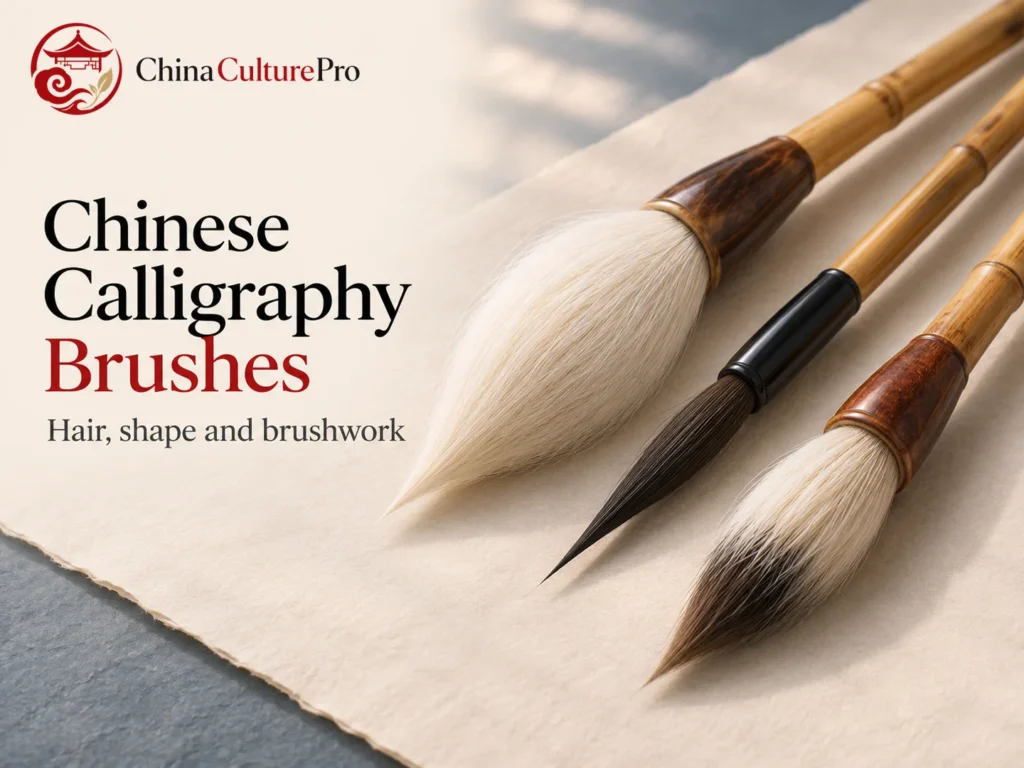

Quick Answer: What Makes a Chinese Calligraphy Brush Different?
A Chinese calligraphy brush has a flexible bundle that can gather into a point and spread under pressure. Hair choice affects how much ink the head holds and how readily the tip gathers again after a stroke. Its size and shape also affect what you can do with it. [1][2][3]
- Hair: Softer heads can hold plenty of ink, while firmer heads often recover their shape more readily. [1][2]
- Shape: Look for a defined point, an even bundle and a head sized for the characters you plan to write. [2]
- Control: The amount of ink, the movement of your hand and the writing surface all change the mark. [2][3]
A material name is a starting clue. Check how the actual brush responds on paper. [1][2][4]
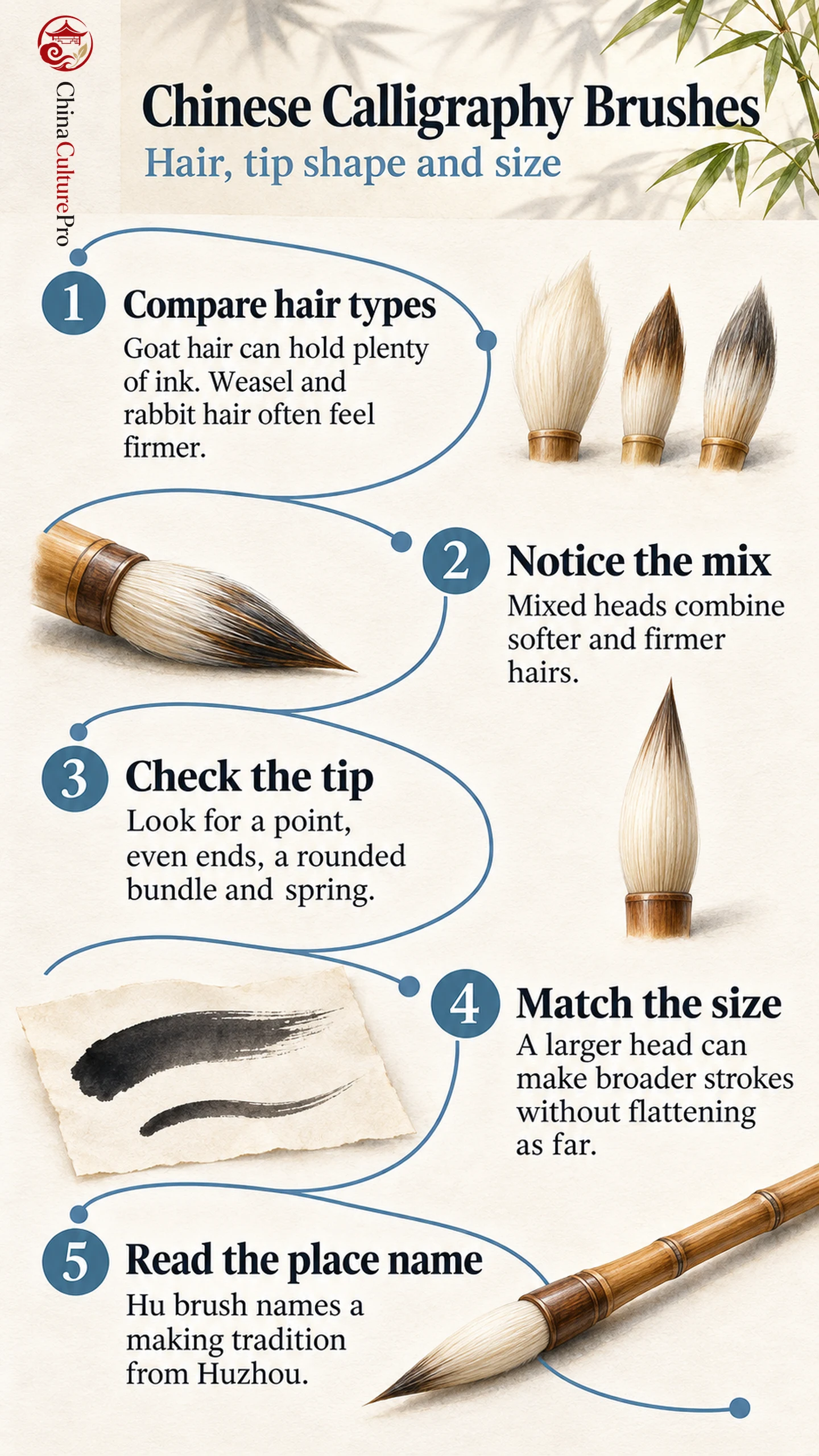
A brush can leave a thin line, a broad patch or a dry-looking edge on the same sheet. Its hairs and shape help explain the change. For the wider relationship between brush, ink and paper, see the Four Treasures of the Study.
Goat, Weasel, Rabbit and Mixed Hair
| Hair type | General response | What to look for |
|---|---|---|
| Goat hair (羊毫, yángháo) | Often soft, with good ink capacity | Notice how a fuller head feeds ink as you spread and lift the tip. [1][2] |
| Weasel hair (狼毫, lángháo) | Often firmer and springier | See how readily the tip gathers again after you release pressure. [1][2] |
| Rabbit hair (紫毫, zǐháo) | Dark rabbit or hare hairs are a traditional choice for a firmer head | Compare its return to a point with a softer brush of similar size. [1][2] |
| Mixed hair (兼毫, jiānháo) | Combines softer and firmer hairs | A firm center may give support while softer outer hairs carry ink. [1][4] |
These categories describe materials. Makers select hairs by length and quality and assemble them into different heads. Two brushes with the same hair label can feel different because of the bundle and its construction. [1][4]
Tip Shape, Size and the Four Traditional Qualities
Traditional brush teaching describes four qualities: a pointed tip, even ends when the wetted hairs are flattened, a full rounded bundle and resilience after pressing. A new brush may look pointed because the hairs have been held together with sizing. A wetted head can show whether the point forms by itself. Once the hairs are wetted, their behavior under pressure matters more than the initial appearance. [2][5]
Match head size to the scale of the writing. A small head gives you room to work inside small forms. A larger head can lay down broader strokes without requiring the same degree of flattening. Head length and fullness also matter. Compare brushes of similar size when you want to judge differences in spring. [1][2][3]
Choose a Brush for the Marks You Want
If a calligraphy copybook has fine turns and pointed hooks, look for a tip you can bring back together cleanly. An example with broad, rounded forms can be an occasion to try a fuller brush. Chen Hongshou’s album of poems shows what an accomplished writer could do with a slender, resilient brush, using quick movements to join angular turns and hooks. [2][6]
A useful comparison is to write the same simple stroke with two brushes on the same paper. Look at the edge, the width at maximum pressure and the shape as you lift. With a new brush, learn how much ink it holds before deciding that it feels too soft. Dampen the hairs before loading ink. Rinse the head when finished so dried binder does not make the hairs stick together. A full session is laid out in Chinese calligraphy for beginners. [2][3]
The Hu Brush Tradition
The Hu brush (湖笔, Húbǐ) is associated with Shanlian in Huzhou, Zhejiang. Its production involves selecting and sorting hairs, preparing them in water, forming the head and fitting it to the handle. Makers in that tradition use several hair categories, including combinations. The place name points to a tradition of making brushes, while the hair label tells you something about the head itself. [1][5]
FAQs About Chinese Calligraphy Brushes
Does Wolf Hair Come From a Wolf?
In traditional Chinese brush terminology, the label commonly translated as wolf hair usually refers to hair from the weasel’s tail. It names a traditional brush material. [1]
Is a Mixed-Hair Brush Good for Beginners?
A mixed head can offer both support and ink capacity. The balance depends on the hairs and how they are arranged, so compare its point and response on the same paper you plan to use. [2][4]
Can You Use the Same Brush for Calligraphy and Painting?
Yes. Pressure and lifting matter in both. A head suited to small characters may carry too little ink for a wide wash. Choose for the scale and kind of mark you want. [2][3]
Sources
[1] China Intangible Cultural Heritage Network. The Making of a Hu Brush
[2] Tsinghua University Press. Basic Knowledge of Chinese Calligraphy
[3] The Metropolitan Museum of Art. Chinese Calligraphy
[4] University of Hong Kong teaching collection. Mixed Hair Brush
[5] China Intangible Cultural Heritage Network. Hu Brush Making
[6] The Metropolitan Museum of Art. Chen Hongshou’s Calligraphy Album