

Quick Answer: What Are Chinese Book Title Marks?
Chinese book title marks (书名号 / 書名號, shūmínghào) identify the names of works mentioned in running text, including books and many other kinds of written or artistic works.[1][2]
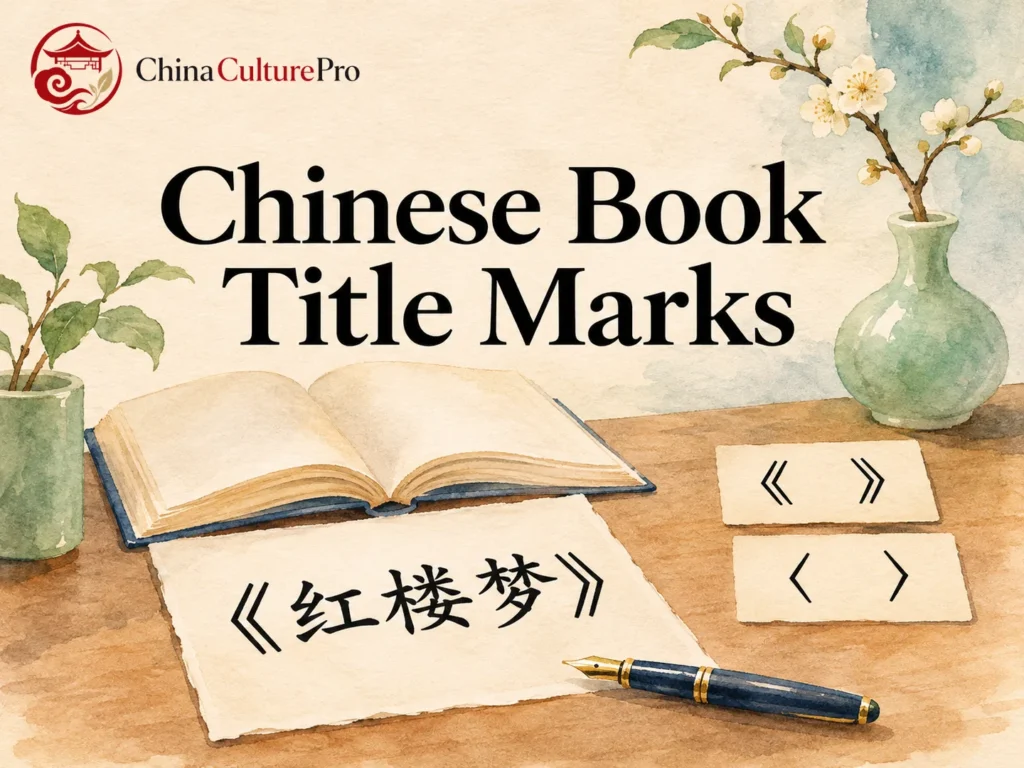
- Double form: 《》 is a pair of Chinese title marks.[1]
- Single form: 〈〉 is another pair, whose use depends on the convention being followed.[1][2]
- Reading clue: The enclosed wording names a work; it is not necessarily quoted dialogue.[3]
Check the publication’s regional or house style before treating one convention as universal.

Title marks help you find where a work’s name begins and ends inside a sentence. Their shapes are easy to recognize, but their single-versus-double distinction needs more care when reading publications from different regions.
What the Marks Identify
These marks can identify titles of books, articles, newspapers, documents, songs, films and visual art.[2] The name “book title marks” therefore describes a broader function than books alone.
They are not general decorations for anything with a name. The mainland standard excludes names of institutions, courses or activities when these are not being treated as works.[1] Ask what the expression refers to before surrounding it with brackets.
Two Regional Conventions to Recognize
These examples illustrate the distinction in the mainland standard and Taiwan’s official punctuation handbook.
| Convention | Book title | Article or essay title |
|---|---|---|
| Mainland GB/T 15834 | Usually double marks, such as 《红楼梦》 | Also double marks, such as 《岳阳楼记》.[1] |
| Taiwan handbook, angle-bracket form | Double marks, such as 《紅樓夢》 | Single marks, such as 〈岳陽樓記〉.[2] |
The novel is 红楼梦 (Hónglóumèng), known in English as Dream of the Red Chamber. The essay title is 岳阳楼记 (Yuèyánglóu Jì).
Taiwan’s handbook also records a wavy-underline form; this guide uses angle brackets. Regional style cannot be inferred from character simplification alone.[2][3]
A Title Inside Another Title
Under the mainland convention, a title already enclosed in double marks uses single marks for another title inside it.[1]
Constructed example: 《读〈红楼梦〉》 (“Reading Dream of the Red Chamber”). The outer pair marks the complete essay title; the inner pair marks the novel’s title.
When reading a Chinese literary discussion, trace the matching opening and closing pair before deciding how much wording belongs to a title.
Choosing Symbols and Keeping Boundaries Clear
Use the Chinese punctuation characters: U+300A and U+300B for 《》, and U+3008 and U+3009 for 〈〉. They are different characters from the less-than and greater-than signs on an English keyboard.[3] See Chinese character encodings for the distinction between a character and its software representation.
In horizontal layout, avoid leaving an opening mark at a line’s end or a closing mark at the next line’s beginning.[2] Check the rendered text after changing a Chinese font or column width.
FAQs About Chinese Book Title Marks
Are these marks only for books?
No. Their scope includes many other works, such as articles, films, songs and documents. The relevant convention determines the form used.[1][2]
Do single marks always mean a nested title?
No. That is their nesting role under the mainland convention, but Taiwan’s handbook also uses single angle brackets for article titles on their own.[1][2]
Can I use keyboard comparison signs instead?
Use the actual Chinese punctuation characters. The double pair is 《》 and the single pair is 〈〉; visually similar mathematical or keyboard signs are not interchangeable character choices.[3]
Must a title on a cover include these marks?
No. Taiwan’s handbook allows displayed titles on book labels, headings, mastheads and posters to appear without these marks.[2]
Sources
[1] General Administration of Quality Supervision, Inspection and Quarantine and Standardization Administration of China. GB/T 15834–2011, General Rules for Punctuation, reproduced by Shanghai Jiao Tong University School of Medicine
[2] Ministry of Education, Taiwan. Revised Punctuation Handbook: book title marks
[3] W3C Chinese Layout Task Force. Requirements for Chinese Text Layout: Group Note Draft, book title marks and regional conventions