

Quick Answer: What Are Chinese Antonyms?
Chinese antonyms (反义词, fǎnyìcí) are words with contrasting meanings. Their relationship depends on the particular sense being used, not just the written character.[1]
- Everyday pairs: 大, dà, “big”, contrasts with 小, xiǎo, “small”.[3]
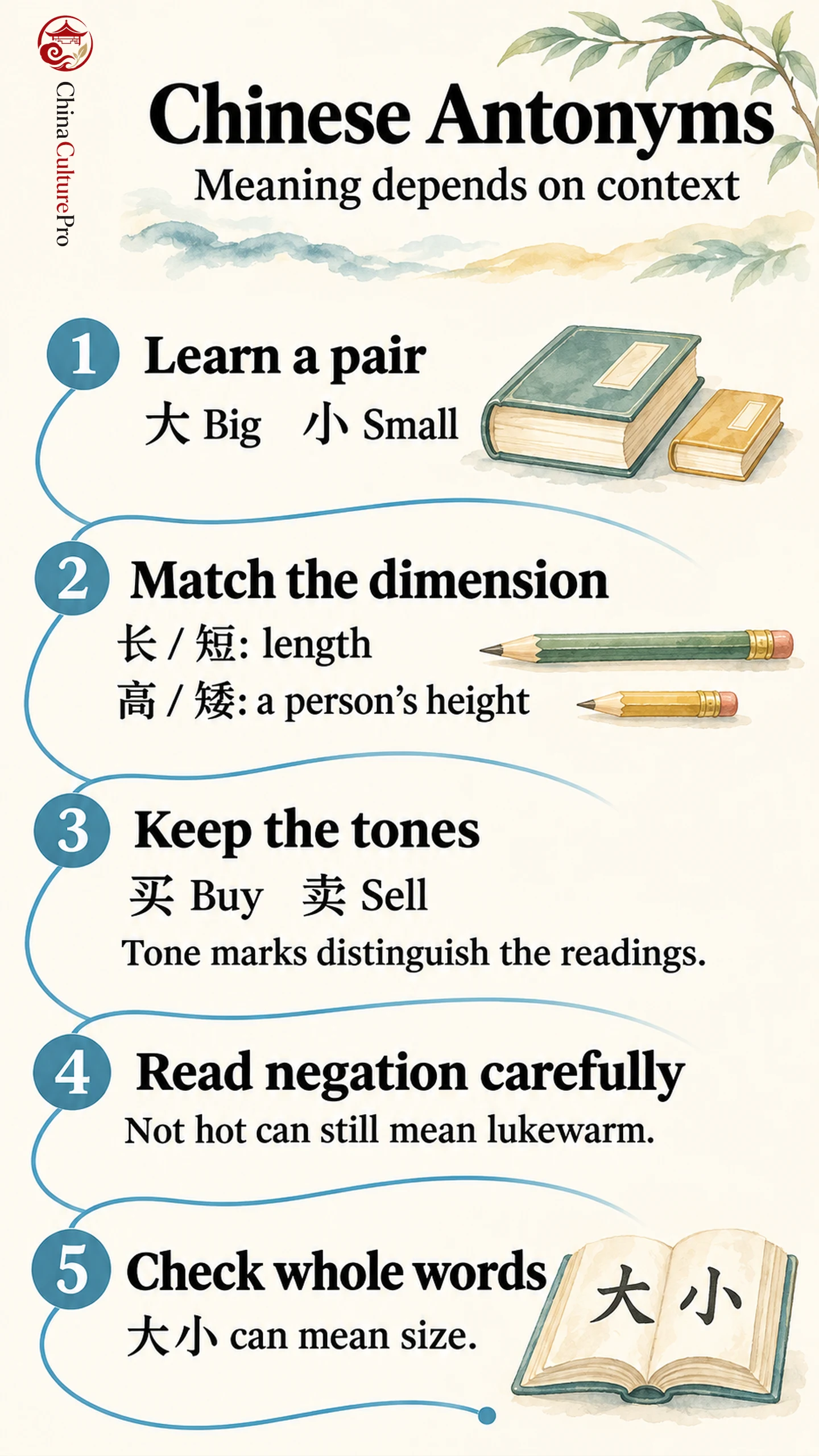
- Context: English “short” can require different Chinese words for length and a person’s height.[4][5]
- Negation: Saying that something is not hot does not necessarily say that it is cold.[2]
Learn a pair with the thing or situation it describes, and read compounds as complete words.
When reading an opposite pair, ask what is being compared: size, length, height, speed, temperature or the roles of people in an event.
Six Common Pairs and Their Reading Contexts
Use the context column to decide what each pair describes, then practise it with a suitable phrase.
| Word and meaning | Opposite and meaning | Useful context |
|---|---|---|
| 大, dà — Big | 小, xiǎo — Small | Size.[3] |
| 长, cháng — Long | 短, duǎn — Short in length | Distance or duration.[4] |
| 高, gāo — Tall | 矮, ǎi — Short in stature | A person’s height.[4][5] |
| 快, kuài — Fast | 慢, màn — Slow | Speed.[6] |
| 热, rè — Hot | 冷, lěng — Cold | Temperature.[2] |
| 买, mǎi — Buy | 卖, mài — Sell | Opposing roles in a transaction.[2] |
Pay attention to tones: 买 and 卖 differ in tone as well as meaning. A pinyin spelling without tone marks loses that distinction.
For practice, choose one relevant noun or situation for each pair. A road can be long or short; a person can be tall or short. That English repetition is a reason to learn the Chinese words through their contexts.
Why Negation Does Not Always Select the Opposite
Some pairs mark contrasting ends of a scale. A drink described as 不热 (spoken bú rè), “not hot”, could be lukewarm rather than cold. Negating one description does not automatically choose the other extreme. Research on Chinese opposites likewise distinguishes opposition from the wider range of relationships found in negative constructions.[2][8]
Buying and selling pose a different question: they identify different roles in a transaction. Someone who is not buying a particular object need not be selling it.[2] Compare the relationship expressed, rather than assuming every pair follows the same logical pattern.
Read an Opposite Pair as a Whole Word
When opposite-looking characters appear together, check whether they form one lexical item. 大小, dàxiǎo, can mean “size”: the dictionary illustrates this with the size of shoes. It also records other senses, so even the compound needs context.[7]
Reading it only as “big” followed by “small” can miss the intended meaning. Consult a Chinese dictionary for the whole expression. The same whole-expression habit is useful when studying four-character expressions.
FAQs About Chinese Antonyms
Does every word have one fixed antonym?
No. Match the sense used in the sentence. Dictionary antonym listings can distinguish opposite meanings for different senses of the same word.[1]
Does putting 不 before a word create its antonym?
It creates a negative expression, but not necessarily the lexical opposite. “Not hot” leaves room for a temperature between hot and cold.[2]
Which Chinese word means “short”?
For length, learn 短 with 长. For a person’s stature, learn 矮 with 高. Choose the intended meaning instead of translating the English word in isolation.[4][5]
Sources
[1] Ministry of Education, Taiwan. Antonym index and sense instructions
[2] Jing Ding, Hong Kong Polytechnic University. A Lexical Semantic Study of Chinese Opposites
[3] Ministry of Education, Taiwan. Concised Mandarin Chinese Dictionary: 大
[4] Ministry of Education, Taiwan. Concised Mandarin Chinese Dictionary: 長
[5] Ministry of Education, Taiwan. Concised Mandarin Chinese Dictionary: 矮
[6] Ministry of Education, Taiwan. Concised Mandarin Chinese Dictionary: 快
[7] Ministry of Education, Taiwan. Concised Mandarin Chinese Dictionary: 大小
[8] Hong Kong Polytechnic University, BEPTH. Tone sandhi: 不 before a fourth tone