


Quick Answer: What Is Almond Boneless Chicken?
Almond boneless chicken, often shortened to ABC, is a Chinese-American restaurant dish associated with Michigan: battered chicken is fried, sliced and served with savory gravy, commonly over shredded lettuce. It belongs to the regional food culture of Chinese-American restaurants.[1]
- Chicken: A boneless cutlet carries the crisp coating.
- Sauce: A stock-based gravy supplies the savory finish.
- Presentation: Lettuce, almonds and scallions provide contrasting textures.[2]
The name describes a recognizable style, while individual recipes and toppings differ.
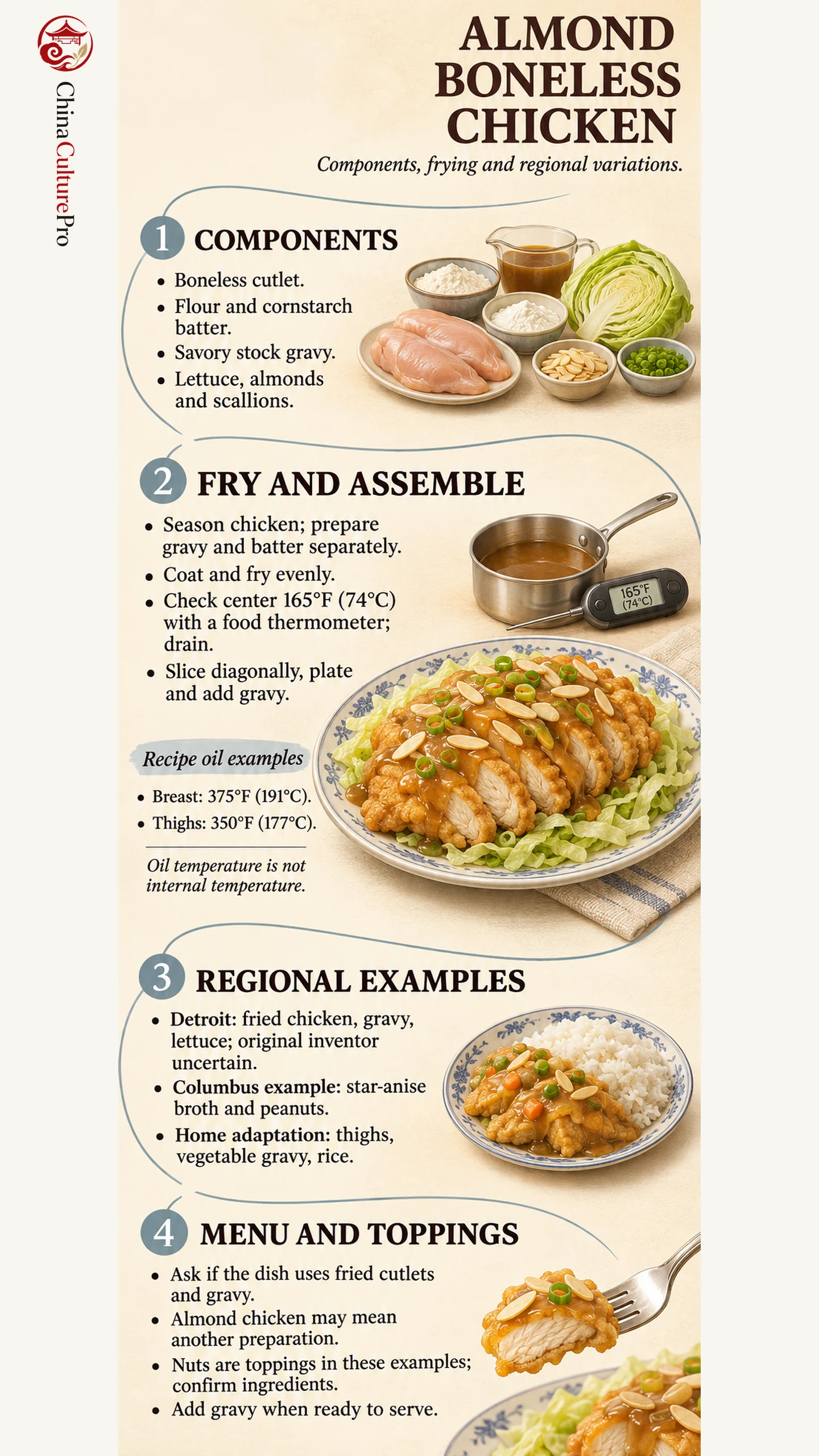
A sliced fried cutlet under gravy gives this dish a different structure from small chicken pieces tossed through a wok sauce. Understanding that structure helps you choose the recipe or menu item you actually want. For wider context, explore the differences between Chinese and Chinese-American food.
The Chicken, Batter and Savory Gravy
One four-breast version combines 3 tablespoons each of cornstarch and flour, ½ teaspoon baking powder, one egg and 1 tablespoon water for batter; toasted almonds are a topping.[2]
Its gravy combines 3 cups broth with butter, soy and oyster sauces and a cornstarch slurry; mushrooms also feature. [2]
A Michigan home adaptation uses thighs and gravy with celery, mushrooms, bamboo shoots and water chestnuts, which can remain or be strained out. The shared name allows different sauces.[3]
When choosing a recipe, decide on the cut and gravy together. A breast-cutlet formula and a thigh formula have different cooking instructions; borrowing only a frying time from one does not make it suitable for the other.
A Frying and Assembly Sequence
Treat the following as an action map for a complete recipe, rather than as quantities for a combined formula. Batter preparation, gravy cooking and final assembly are separate jobs.
- Prepare separate components: Season the boneless chicken and prepare the chosen batter and gravy separately; keep raw chicken away from the lettuce and other ready-to-eat toppings.
- Cook the gravy: Cook the stock-based gravy and thicken it with the recipe’s cornstarch slurry, stirring until smooth.
- Coat and fry the chicken: Coat the chicken evenly in batter and fry using the selected recipe’s oil temperature, turning as needed for even cooking.[2][3]
- Check and drain: Check the thickest part of the chicken with a food thermometer for 165°F (74°C), then drain on a rack.[4]
- Slice and assemble: Slice the cooked chicken diagonally, arrange it over lettuce or rice and finish with gravy and the chosen toppings.[2][3]
The two home examples use different frying temperatures: breast cutlets at 375°F (191°C), thighs at 350°F (177°C).[2][3] Check the chicken’s center separately for the safe internal temperature.[4] The distinction also matters when comparing other Chinese cooking methods.
Detroit, Ohio and Home-Kitchen Variations
In Detroit’s Chinese-American restaurant tradition, ABC became a familiar takeaway abbreviation. Restaurant-family interviews describe cooks sharing and adapting recipes, while acknowledging uncertainty about the original inventor. That supports a regional history without assigning the dish to one proven birthplace.[1]
Ohio has its own versions. A Columbus restaurant-owner interview describes star anise in the gravy’s broth and peanuts on top; other local versions have darker, more ginger-forward gravy. Peanuts therefore belong to a documented restaurant example, rather than a substitute to assume everywhere.[5]
The Michigan thigh recipe uses rice, almonds and green onion. The other home version adds snow peas, described as a Louisville addition.[2][3]
Serving the Dish and Reading a Menu
For a restaurant order, ask whether the dish uses battered fried cutlets, savory gravy and a lettuce base. Those questions are more useful than relying on “almond chicken” alone: that broader name can point to a different preparation. Interviews with Michigan diners describe encountering quite different versions elsewhere.[1]
Almonds also require a direct question. One restaurant featured in the Detroit report had stopped adding them because of allergy concerns while retaining the dish’s familiar name. Their absence from the top does not by itself establish that a meal is safe for someone with an allergy.[1]
For home serving, choose whether you want the lettuce presentation or the rice adaptation before assembling the plate. Keep the toppings appropriate to the recipe and your diners, and add the gravy when you are ready to serve.
FAQs About Almond Boneless Chicken
Are almonds mixed into the batter?
In the breast-cutlet example, the nuts are added at serving. They are not part of its batter.[2]
Is almond boneless chicken the same as an almond chicken stir-fry?
The Michigan style discussed here centers on battered fried chicken and gravy. When a menu says only “almond chicken,” confirm the preparation before ordering.[1]
Can chicken thighs be used?
Yes. A published Michigan home adaptation uses boneless, skinless thighs and serves them with gravy over rice. Follow that recipe’s cut-specific method and check poultry for 165°F (74°C).[3][4]
Sources
[1] Detroit PBS. Cinecyde/The Origin of Almond Boneless Chicken
[2] Steve and Michelle. Almond boneless chicken, exhibit ABC of Chinese-American idiosyncrasy
[3] Tilly Frueh. Almond Boneless Chicken – War Su Gai
[4] USDA Food Safety and Inspection Service. What is a safe internal temperature for cooking meat and poultry?
[5] Missy Frederick. Almond Boneless Chicken Is a Chinese-American Cult Favorite