
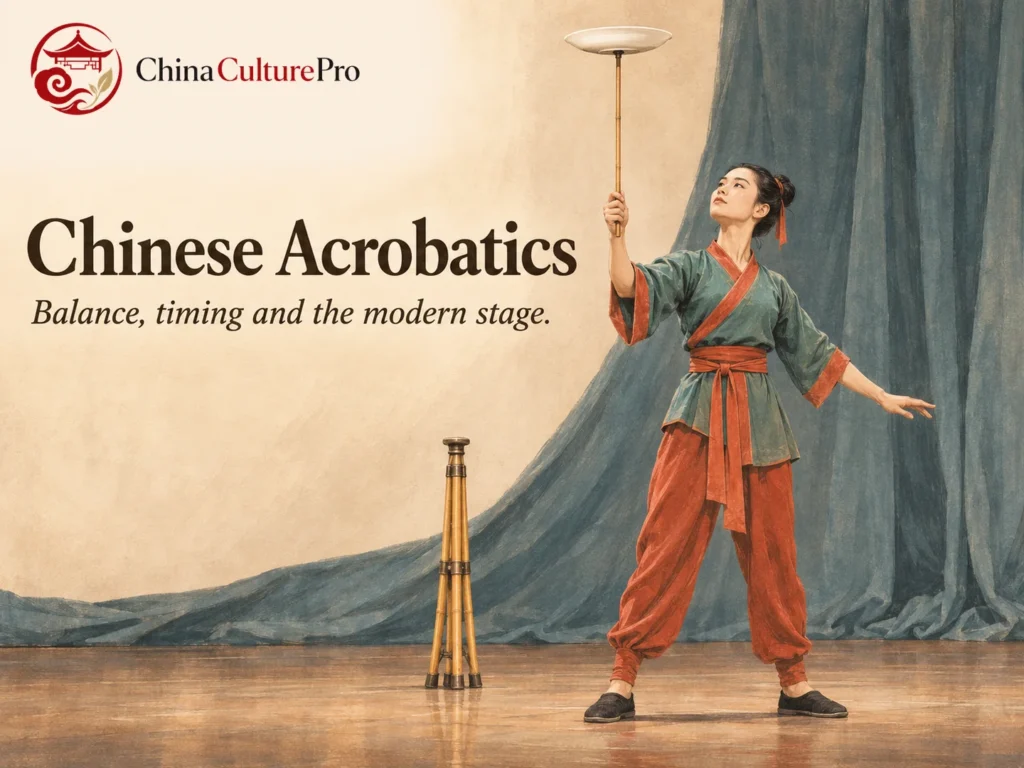

Quick Answer: What Is Chinese Acrobatics?
Chinese acrobatics, or zaji(杂技,zájì), includes stage acts built around physical control, timing and coordination. Performers can balance, tumble or keep objects in motion. An act can feature one person or depend on several people moving together.
Historical images show skilled acts alongside music and dance. Local traditions such as Wuqiao’s include ways of making props and teaching as well as repertoires. Modern companies may present individual numbers or combine several skills within a staged story.
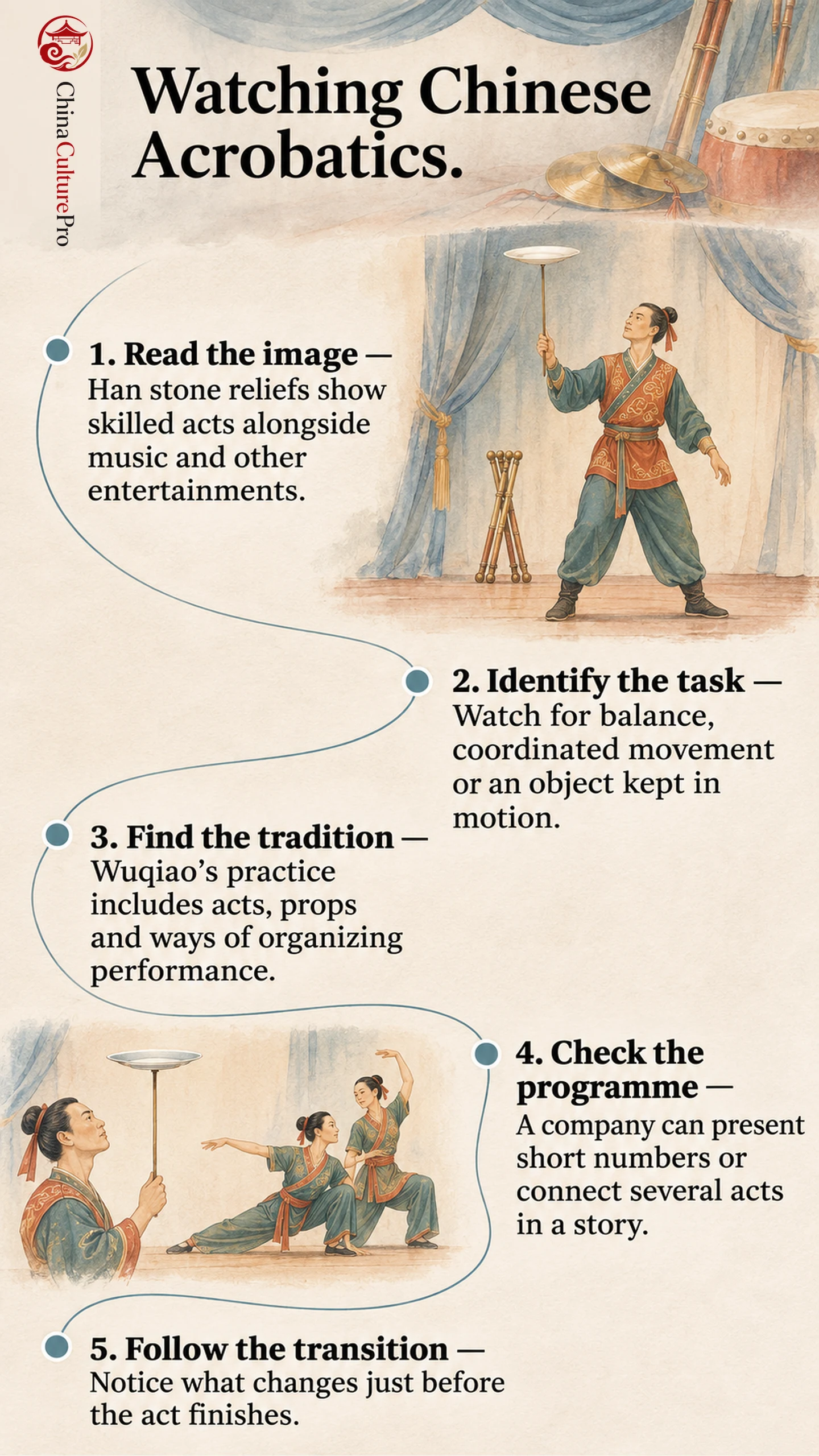
A plate can keep spinning while a performer shifts their attention to another object. The audience can follow what moves and what stays steady at the same time. That tension is a good way into many acrobatic acts.
What Historical Images Can Tell Us
The stone reliefs at the Han-period tomb site at Beizhai, Yinan, Shandong, include a scene with musicians, acrobatic figures and mounted performance. The figures show several kinds of entertainment brought together in one image. The relief shows how these acts were represented together. It preserves a view of props, poses and groupings. [1]
The term baixi(百戏,bǎixì), often rendered as a hundred entertainments, can refer to a range of displays. Its scope is broader than a single modern act. A historical image can show a posture, prop or grouping. The timing, sequence and training behind a particular performance need other evidence. [2]
Balance, Tumbling and Object Control
An acrobatic number can combine skills. Use the visible task as a starting point and notice what a performer keeps stable or changes. The same act may use balance, timing and cooperation in quick succession. [2]
| Main task | Examples | What to watch |
|---|---|---|
| Balance | A held posture or a balancing act with a prop | How the performer moves into and out of a moment of stillness. |
| Tumbling and coordinated movement | Rolls, flips or a timed group sequence | How the end of one movement sets up the next. |
| Object control | Juggling or manipulating objects with the feet | How objects change direction, remain in motion or arrive on a beat. |
In an act with several performers, notice when the group moves together and when one person acts separately. An ensemble’s change of pace can draw attention to the performer about to take the next turn.
Wuqiao and the Work of a Troupe
Wuqiao in Hebei is a documented center of acrobatic practice. Its national heritage entry describes different kinds of acts, specialized vocabulary, props and ways of organizing performances. It also records spoken and musical elements associated with local work. The performers pass on a repertoire as well as ways of presenting it to audiences. [3]
This is one regional tradition within a much wider field. A company’s programme can show the variety more clearly than a general name for the art. Wuqiao acrobatics appeared on China’s first national intangible cultural heritage list in 2006. The listing is for Wuqiao’s practice, including the ways local performers organize and transmit their repertoire. [3]
From Individual Acts to Stage Stories
Some programmes present short acts, each built around a particular task or prop. Others give the acts a story that continues across scenes. The China National Acrobatic Troupe’s *Touch: A Journey of Encounters* follows a boy through a future world, using acrobatic numbers as part of his journey. Other works from the troupe draw on Chinese dance or use techniques from theatre, Chinese opera and stage illusion. [4]
In a story show, an act can change what happens to a character or lead into a new scene. In a short number, the setup, repetition and finish can provide the structure. Both can give the audience time to recognize the skill before the movement changes.
How to Watch an Acrobatic Act
Pick a short section and look at its beginning and end. Notice when the performer sets an object in motion and what changes just before the act finishes. If several people are onstage, watch their spacing and listen for the moment the music marks a transition.
Then return to the whole performance. Ask where the act fits in the programme and what it asks you to watch. A number can make one feat stand out, while a theatre work can let that same kind of movement carry part of a story.
FAQs About Chinese Acrobatics
Is Chinese acrobatics the same as Chinese opera?
They are distinct performance traditions. Some Chinese opera roles also use martial movement or acrobatic skills as part of the drama.
What does baixi mean?
It is a historical label for a variety of entertainments. A programme described that way could include skilled physical acts alongside music or dance.
Are Chinese acrobatic acts always presented separately?
A troupe can present separate numbers or organize multiple acts as part of a stage story.
Sources
[1] Shandong Provincial Publicity Department. Han Stone Reliefs from Yinan
[2] Academy of Chinese Studies. Chinese Acrobatics
[3] China Intangible Cultural Heritage Digital Museum. Wuqiao Acrobatics
[4] China National Acrobatic Troupe. Stage Repertoire