


Quick Answer: What Is Buyi Batik?
Buyi (布依族, Bùyīzú) batik (蜡染, làrǎn) is a textile tradition documented in Guizhou. Makers draw designs in wax before dyeing the cloth. The wax helps keep parts of the fabric pale against the dyed ground.[2]
- The Anshun heritage record names Buyi work in Zhenning, Guanling and the Huangguoshu area.[1]
- Its designs include spirals, waves, diamonds, flowers and animals.[1]
- Huishui has a separate tradition of sweetgum-resist dyeing (枫香印染, fēngxiāng yìnrǎn).[3]
The pattern-making method helps identify the craft when several local fabrics share a blue-and-white palette.
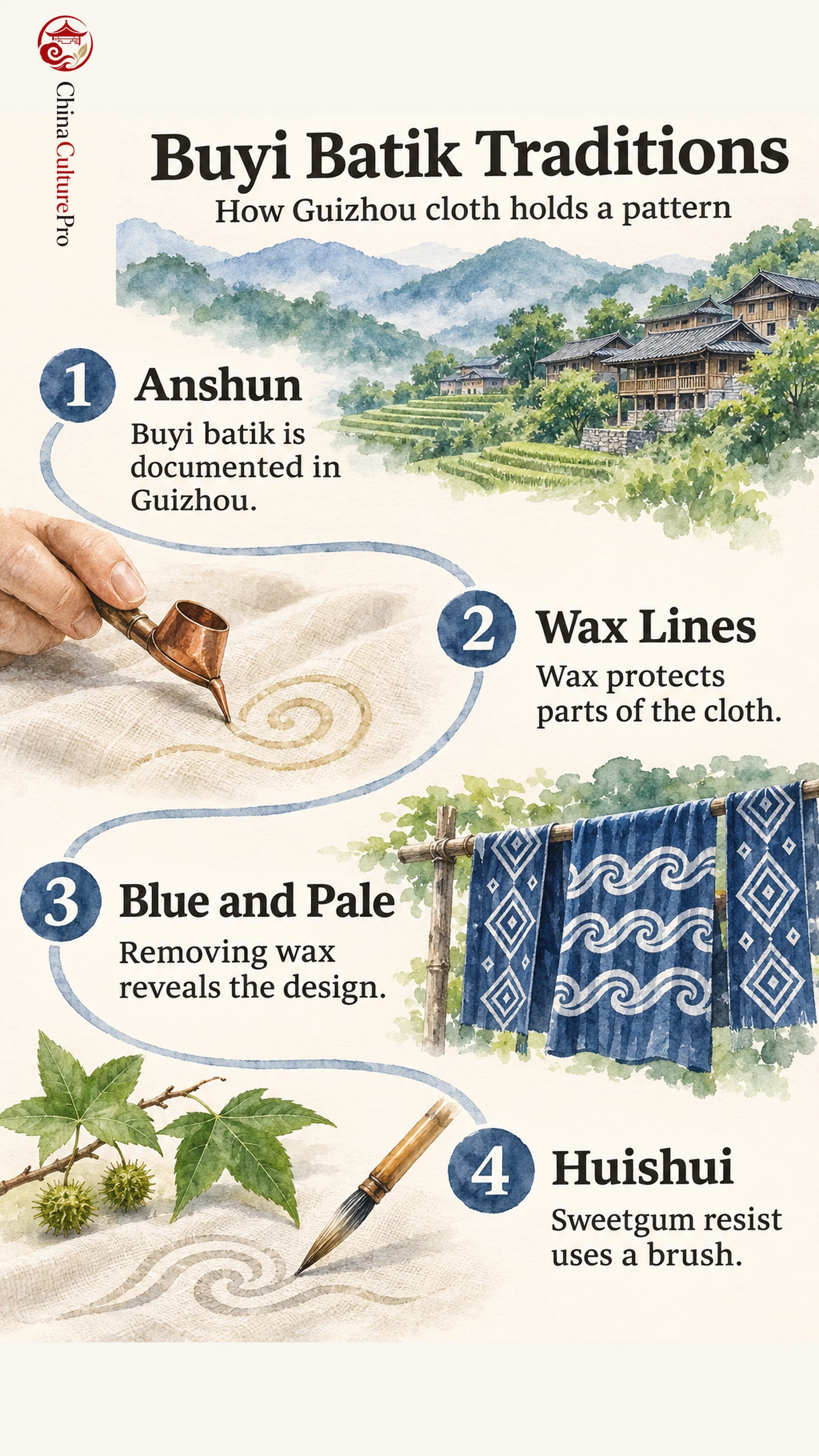
A pale spiral can begin as a wax line on undyed cloth. Other resist methods also produce pale designs. The kind of resist is one clue to how the work was made.
What the Wax Does to the Cloth
Anshun makers use a copper wax tool to draw on pale fabric. In the dye bath, exposed parts take up color. Removing the wax reveals the design. Fine crackled lines can appear where color enters cracks in the resist. That effect links the appearance of Chinese batik to the behavior of wax during indigo dyeing.[1][2]
Patterns and Uses in Anshun
The register describes both natural forms and abstract geometry. Similar tools appear in Buyi and Miao traditions in Anshun. A label naming the maker or locality gives stronger attribution than a motif alone. Wax-resist fabric is one part of Buyi garment making alongside woven, dyed and embroidered work.[1][6]
Wax, Sweetgum and Stitched Resist
In Huishui, Buyi sweetgum-resist makers apply a resin-based mixture with a brush. Yang Guangcheng (杨光成, Yáng Guāngchéng) learned that craft from his father and later taught it in local classes. In Bai Zhoucheng tie-dye in Yunnan, tight stitches hold folds closed during dyeing. A wax line, a brush-painted resist and a stitched fold are three different ways to make areas resist the dye.[3][4][5]
How the Craft Is Recognized
The Anshun batik entry was added to the national list of Chinese intangible cultural heritage as an extension in 2008. It documents Buyi and Miao work within the same local batik project. The Huishui sweetgum practice appears under its own craft entry.[1][3]
FAQs About Buyi Batik
Does every Buyi blue-and-white cloth use wax?
Buyi textile traditions also include indigo dyeing, sweetgum resist and tie-dye. A blue-and-white palette alone cannot establish the method.[2][3]
What makes the crackled lines?
Small amounts of dye can enter cracks in the wax and leave fine marks in the lighter area.[2]
Is Huishui sweetgum resist part of the Anshun batik entry?
The national register lists Huishui’s sweetgum technique under a separate craft entry.[1][3]
Sources
[1] China Intangible Cultural Heritage Digital Museum. Anshun batik techniques
[2] National Ethnic Affairs Commission. Buyi customs and crafts
[3] China Intangible Cultural Heritage Digital Museum. Sweetgum-resist dyeing in Huishui
[4] China Intangible Cultural Heritage Digital Museum. Yang Guangcheng
[5] Dali Municipal People’s Government. Dali Bai tie-dye as a national heritage craft
[6] China Intangible Cultural Heritage Digital Museum. Buyi clothing