


Quick Answer: Is Bring in the Wine Simply a Drinking Song?
Bring in the Wine (将进酒, Qiāng Jìn Jiǔ) by Li Bai (李白, Lǐ Bái) combines urgent celebration with awareness of passing time, unrecognized worth and enduring sorrow. Its invitations to drink gain their force from those pressures, rather than from pleasure alone.
- Start with the opening: A rushing river and suddenly white hair make time feel irreversible.
- Hear the changes of voice: Direct calls to companions interrupt the longer, sweeping lines.
- Return to the last phrase: The wish to dissolve ancient sorrow reveals what drives the feast.
Its extravagant quantities and commands are part of poetic expression. They should not become literal drinking instructions or a factual account of everything done at one banquet.
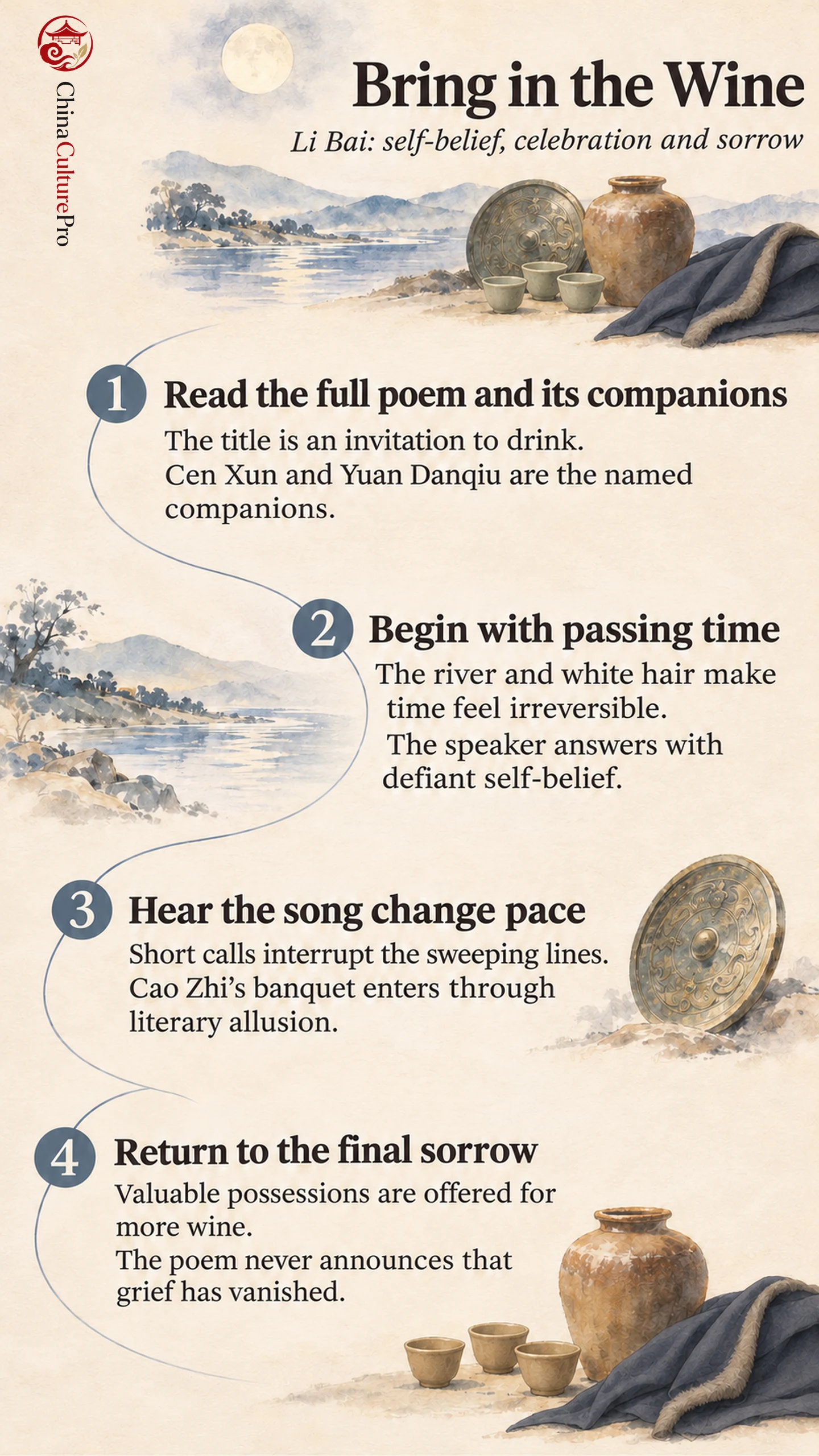
The poem’s famous claim of inborn worth can sound wholly confident when quoted alone. Read between its opening anxiety and closing sorrow, it becomes more defiant: a voice insisting on value while confronting the possibility of being overlooked.
Read the Full Poem and Meet Its Named Companions
The title reuses an old musical-poetic heading. Its first character is read Qiāng here, with the force of an invitation or request. The named companions are Cen Xun (岑勋, Cén Xūn), addressed as Master Cen, and Yuan Danqiu (元丹丘, Yuán Dān Qiū). [2]
The opening names the Yellow River (黄河, Huáng Hé). Later, Cao Zhi (曹植, Cáo Zhí) appears through his title, Prince of Chen (陈王, Chén Wáng); Pingle (平乐, Píng Lè) recalls a banquet in his poetry. [1][3]
Here is a complete, original English rendering, grouped by the poem’s changing movements.
| Chinese text | Plain English rendering |
|---|---|
| 君不见,黄河之水天上来,奔流到海不复回! | Do you not see the Yellow River pouring from the sky, racing to the sea and never turning back? [1] |
| 君不见,高堂明镜悲白发,朝如青丝暮成雪! | Do you not see, in a high hall’s bright mirror, grief over white hair: black silk at morning, snow by evening? [1] |
| 人生得意须尽欢,莫使金樽空对月。 | When life gives pleasure, enjoy it fully; let no golden cup face the moon empty. [1] |
| 天生我材必有用,千金散尽还复来。 | Heaven gave me abilities that must have use; a fortune spent away will come again. [1] |
| 烹羊宰牛且为乐,会须一饮三百杯。 | Prepare sheep and ox for our delight; let us drink three hundred cups at a sitting. [1] |
| 岑夫子,丹丘生,将进酒,杯莫停。 | Master Cen, friend Danqiu: take the wine; keep the cups moving. [1] |
| 与君歌一曲,请君为我倾耳听。 | Let me sing a song for you; turn your ears toward me and listen. [1] |
| 钟鼓馔玉不足贵,但愿长醉不复醒。 | Bells, drums and precious dishes are not worth prizing; I wish for lasting drunkenness, never waking sober again. [1] |
| 古来圣贤皆寂寞,惟有饮者留其名。 | Since ancient times, sages have gone unrecognized; only drinkers have left their names. [1] |
| 陈王昔时宴平乐,斗酒十千恣欢谑。 | The Prince of Chen once feasted at Pingle, reveling freely over wine worth ten thousand a measure. [1] |
| 主人何为言少钱?径须沽取对君酌。 | Host, why speak of too little money? Go and buy more; we shall drink together. [1] |
| 五花马,千金裘,呼儿将出换美酒,与尔同销万古愁。 | The fine horse, the costly fur robe: call the attendant to take them out for good wine, and with you dissolve the sorrows of countless ages. [1] |
The Li Bai guide and Tang poetry guide provide wider reading.
Move from the River and White Hair to Defiant Self-Belief
The river begins on an immense scale, then the mirror draws attention toward a human life. Both images compress time: water does not return upstream, and black hair seems to become white between morning and evening. The second is an exaggeration of aging’s swiftness, not a literal overnight transformation. [1]
The invitation to pleasure follows that pressure. So does the declaration of personal ability. The speaker refuses to let wealth or present recognition determine his worth, even while the surrounding poem suggests how painful a lack of recognition can be. [1][3]
The promise that a spent fortune will return belongs to this extravagant voice. Reading it as a guarantee about money would strip away the risk and defiance that make the line vivid.
Hear the Drinking Song, Its Allusion and Its Changing Pace
The brief calls to Cen and Danqiu break the sweep of the opening. A request to listen then creates a song within the poem. Its changing line lengths make the reader hear a voice addressing people, not simply reciting a uniform series of statements. [1]
The contrast between neglected sages and remembered drinkers is deliberately sweeping. Cao Zhi gives it a literary focus: the Prince of Chen’s banquet enters through an allusion to his verse. This is not a claim that Li Bai himself held that royal title. [3]
The literary allusions guide explains how a borrowed scene can let one writer position a present feeling beside an earlier voice.
Return to the Sorrow behind the Final Command
The ending pushes generosity toward extravagance by offering valuable possessions for more wine. It is a command, not a completed transaction recorded in a household account. No subsequent line proves that the horse or robe was actually sold. [1]
Most tellingly, the last object is sorrow. The voice that has insisted on enjoyment now names a burden reaching across the ages. Older commentary understands the apparent abandon as a way of consoling talent that has not found its place. [3]
The poem does not end by announcing that grief has vanished. Its energy holds celebration and distress together. Compare Ballad of the Ancient Moon, where another luminous opening also leads toward an unresolved ending.
FAQs About Bring in the Wine
How is the title’s first character pronounced here?
Qiāng. Here it carries the force of an invitation or request, rather than its common reading jiāng.
Who are Master Cen and Danqiu?
They are Cen Xun and Yuan Danqiu, companions addressed in the poem. Master Cen is Cen Xun, rather than the frontier poet sometimes named in older notes.
Does three hundred cups describe a literal drinking target?
It is poetic exaggeration, contributing to the extravagant voice of the feast. It is not a practical quantity to reproduce.
Sources
[1] Li Bai, via Wikisource. Bring in the Wine: Complete Chinese Poem
[2] Education Bureau, Hong Kong. Classical Poetry Reading Selection 24: Bring in the Wine
[3] Yang Qixian and Xiao Shiyun, via Wikisource. Classified and Supplemented Commentary on Li Bai’s Poems, Volume 3: Bring in the Wine