


Quick Answer: What Is Birds Paying Homage to the Phoenix?
Birds Paying Homage to the Phoenix (Bai Niao Chao Feng, 百鸟朝凤, Bǎiniǎo Cháofèng) is a traditional tune famous for birdlike sounds on the suona (唢呐, suǒnà), a Chinese double-reed instrument.[2][4]
- Tradition: The piece is part of southwestern Shandong wind and percussion repertory.[1]
- Player: Ren Tongxiang (任同祥, Rèn Tóngxiáng) helped bring it to a wider audience.[1]
- Versions: Concert credits document both suona with a small ensemble and two suonas with orchestra.[2][3]
Listen for the moment when the steady tune opens into short calls and replies.
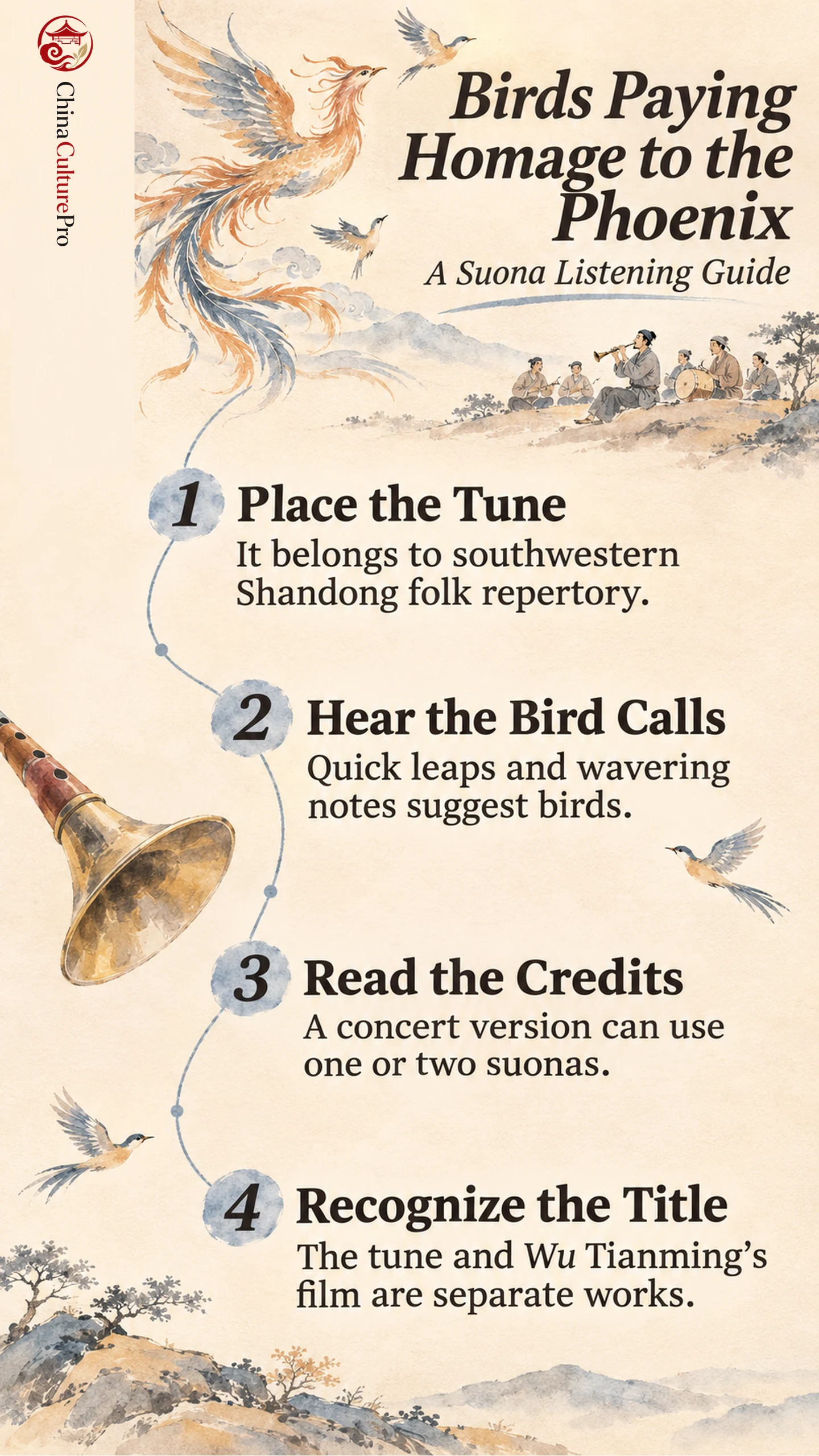
The title gives you something to listen for as soon as a phrase breaks into quick notes. A sudden jump, a wavering held pitch or a short burst repeated several times can suggest birds without a singer or any recorded bird calls.[4]
From Local Ensembles to Concert Programs
The national heritage archive lists the work in the wind and percussion tradition of southwestern Shandong. It describes that tradition playing for weddings, funerals and other community events. The archive highlights Ren Tongxiang’s performances and recordings as part of the tune’s wider circulation.[1]
Those settings describe the ensemble tradition as a whole. Individual occasions and places differ, as the guides to regional Chinese weddings and Chinese funeral traditions illustrate.
Listen for the Bird Calls
The suona gives a pointed attack. In the birdlike passages, quick changes in pitch and small fluctuations on a held sound make one phrase stand apart from the next. Listen for the difference between a brief repeated call and a sustained note with a wavering pitch.[4]
A Chinese Ministry of Culture and Tourism account of a lecture mentions circular breathing in connection with the piece. The technique can let a long sound continue. Short, separated calls create a different effect, and a listener can recognize both without identifying each bird by species.[5]
Follow the Arrangement Credits
The Hong Kong Chinese Orchestra credits a performance by Ma Wai Him on suona with ensemble, based on Ren’s performance score as compiled by Chen Jiaqi. A different program lists two suonas with orchestra for excerpts arranged by Simon Kong Su Leong.[2][3]
Compare the number of lead players and whether the title is followed by the word “excerpts.” Use those details to distinguish one lead reed from two and a full performance from a set of excerpts.
The Phoenix Image and the Film
The Chinese phoenix or fenghuang (凤凰, fènghuáng) is the figure named in the title. The gathering of birds gives a listener a way to imagine the calls. For related regional styles, see Chinese traditional music.
Wu Tianming’s film Song of the Phoenix follows a suona apprentice. The Busan International Film Festival describes it as a drama about passing on a tradition amid social change. Use the director’s name when looking for the film and the suona performer’s name when looking for the tune.[6]
FAQs About Birds Paying Homage to the Phoenix
Who wrote Birds Paying Homage to the Phoenix?
Concert credits identify it as Shandong folk music. Ren Tongxiang is associated with an influential performance version.[1][2]
Is the piece only played at funerals?
The regional wind and percussion tradition has multiple settings. The tune is also documented in concert programs.[1][2]
Does every version use one suona?
Some programs credit one suona with ensemble. An orchestral arrangement also credits two suonas.[2][3]
Sources
[1] China Intangible Cultural Heritage Digital Museum. Southwestern Shandong Wind and Percussion Music
[2] Hong Kong Chinese Orchestra. The Allure of Tradition: Wind, Pluck, Bow and Strike Masterpieces
[3] Hong Kong Chinese Orchestra. A Musical Treasure Hunt III
[4] University of North Carolina Greensboro repository. Study of Chinese Rhapsody No. 3 and Suona Idiom
[5] Ministry of Culture and Tourism of China. Folk Music Public Lecture in Jinan
[6] Busan International Film Festival. Song of the Phoenix, Festival Archive